Showing posts with label insects. Show all posts

Friday, August 10, 2018

A Place to Start a Family (David L. Harrison)


Illustrator:  Giles Laroche

Target Ages:  5-10

Genre:  Non-Fiction Poetry

Publisher Summary:
Many animals build in order to find a mate, lay eggs, give birth, and protect their babies.  The types of structures they create are often extraordinary.  From the prairie dog to the pufferfish and from the termite to the stork, discover how and why many animals build.

Poem Samples (Click for Larger View):


Evaluation: 
Earlier this year, I reviewed another Harrison-Laroche collaboration Now You See Them, Now You Don't.  Like the previous book, this one deserves to be in every library, classroom, and home.  

The poems are insightful. Harrison features many animals and attributes I was not previously familiar with, like the only snake that builds a nest and the spider that feeds its young for weeks after birth.  Young and old will be engaged and fascinated with the creatures’ preparation for and care of their babies. 

The poems are entertaining.  For instance, “Red Ovenbird” has short stanzas with repetition. Similarly, “Termite” uses repetition and predictive phrasing.  Both are perfect for choral reading.  Others connect animals to human behaviors like the animals that kiss and play king of the hill or the animals that keep their babies safe and dry. 

Laroche’s illustrations are stunning and brilliant.  I love the textures, the contrasts,  the colors.  Each sight feels like a peek into the secret lives of these creatures with all its vividness and beauty. 

Whether you come for the illustrations and stay for the poetry or come for the poetry and stay for the illustrations, you are going to love both in A Place to Start a Family.

Ideas for Extension Activities at Home or Lesson Plans for Teachers:
  • Science:  Use poems in a unit related to mammals, fish, insects, reptiles, or baby animals. 
  • Poetry vs. Prose: Each creature is featured in a short prose paragraph at the end book.  Both the prose paragraph and the poetry include many of the same facts, but one uses figurative elements and experiences the facts imaginatively.  Put the prose and the poetry side by side and compare them to teach the difference of these two writing forms.
  • Poetry:  Using a short paragraph of information from science or other subject area, write poems that imaginatively experience the facts. 
  • Categorization:  Break the animals into groups like type (mammal, fish), location (air, water, underground), type of home, caring for young, and so forth.  To extend to math, create one or more charts of information.
  • Comparison:  Pick two creatures to compare and contrast.  How are they similar?  Different?
  • Language:  Identify rhyming words and alliteration.  For younger children, use them as a spring board for reading instruction.  For instance, list the words that rhyme in the poem. (“European Paper Wasp” is a good poem for this exercise.)  Point out similarities in spelling and sound.  Write out new words that rhyme.  Allow early readers to decipher them. 


Thursday, June 14, 2018

Thunder Underground (Jane Yolen)

Title:  Thunder Underground

Author:  Jane Yolen

Illustrator:   Josee Masse

Target Ages:  5-10

Genre:  Poetry

Publisher Summary: 
What is under your feet?
Ant cities
Fox dens
Rabbit warrens

Now dig deeper.
Subways
Forgotten towns
Fossilized bones

What other secrets hide deeper still beneath your shoes?

Favorite Poem:

“Corny Conversations”
It sounds too odd
for us to hear,
corn plants can talk,
not mouth to ear.
But with a strange
and clicking sound,
their taproots speak
beneath the ground.
We don’t know what
corn rootlings say
when they communicate
this way.
But scientific studies
show
they do this as they
grow and grow
and grow.

Evaluation:
I am drawn to poetry that brings out the wonder of the world, utilizes imaginative language, and teaches a little science at the same time.  It makes me wish I was still an elementary teacher.  Poetry brings out the spectacle and awe of the world that science textbooks sorely lack.

Thunder Underground can be used along with several science units to start a lesson or to prompt writing across the curriculum:
  • Insects
  • Plants
  • Paleontology/Dinosaurs
  • Volcanoes
  • Earthquakes
  • Archeology
  • Geology
Yolen uses a variety of poetry styles from haiku to free verse.  Each one brings out a new angle about the hidden world below from the natural to the man-made (subway, basement).  Some of the information is common knowledge for adults, but not necessarily so for children.  Other fascinating facts will surprise many like plants communicating with each other and the sound of beetles walking underground. 

I love Josee Masse’s illustrations.  Each page turn offers a sweeping look at the world—both above and below the surface—with deep colors and stunning depictions. Two inquisitive children (a boy and a girl) are often pictured observing and inquiring. 

Poetry and science collide to make a wondrous experience in Thunder Underground.  It is a must have for an elementary school classroom or home collection.  These poems are sure to encourage children to think about the many unseen and unknown aspects of the world. 

For more great poems and poetry book selections, visit this week's Poetry Friday.

Thursday, April 5, 2018

Cricket in the Thicket: Poems about Bugs (Carol Murray)


Author: Carol Murray

Illustrator:  Melissa Sweet

Target Ages:  5-10

Genre:  Non-Fiction Poetry

Publisher Summary: 
Playful poems highlight surprising facts about the world of insects—from familiar ants to exotic dragonflies to cringe worthy ticks and magnificent fireflies.  

Sample Poems:

“Trees and Knees and Bumblebees”
Rumble, rumble,
Bumblebee.
Don’t you know
you’re bugging me?

Your buzzing
in the climbing tree
may make me tumble,
Bumblebee.

Stop that rumble,
Bumblebee.
Perhaps I’ll stumble
as I flee.

I’ll crash and crumble,
skin my knee,
and then I’ll grumble,
Bumblebee.

“Praying or Preying?”
Pray tell us, Mr. Mantis,
do you prey or simply pray?

Do you scout about for victims
or fold your hands all day?

You look a little scary,
but appearances deceive.

So, tell us, Mr. Mantis,
what should we believe?

“Fruit Fly Fantasy”
They seem to arise
from bananas and pears,

then capture the table
and circle the chairs. 

Oh, where do they come from
and where do they go? 

They stage an invasion
and vanish like snow.

Evaluation:
Cricket in the Thicket is an entertaining and informative collection of poems.  

Poems are written from a child-like perspective, using vocabulary and sound words they will enjoy.  The poems have a smooth rhythm and flow.  Often a whimsical approach is taken when describing the insects, such as the idea of hugging a ladybug or a cricket being an alarm. 


Sweet’s signature style collage and mixed media are amazing, as always. She brings in interesting items like a tape measure for the inchworm page and a magnifying glass for the mites.  Her bright blues, reds, and greens contrast nicely with neutral colors.  On every page, the insects are the stars.

The poems are not heavy in facts, though some of the insects’ habits and characteristics are highlighted.  However, each page has a box with insect facts.  Some of the information I knew, but it will likely be new to children.  However, there are facts that were new to me like daddy long legs spiders are more like a mite than a spider; grasshoppers spit out a brown liquid when they are afraid, and inch worms are moth larvae.  (I probably should have known the last one.) There is additional information in the author’s (cricket) notes. 


The tie ins to science and language arts as well as the engaging way the poems are formed make Cricket in the Thicket an excellent addition to a classroom or home library. 

Activities and Extension Ideas for Lesson Plans:
  • Science:  This book connects well to a study of insects.  Incorporate the poems into an insect unit or use the book as a springboard to learn more about insect.  
  • Sound devices:  Connect with a lesson on rhyme or alliteration.  “June Bugs Whoosh” and “Green Grasshopper” are perfect for alliteration  “Just Jumping Spider” and “Go, Ants, Go” are for rhyme.
  • Writing:  Study and/or observe an insect.  Then write a poem about it. 
  • Social Studies:  Discuss what quality or qualities makes each bug special.  Connect that idea to how each person has his/her own special qualities that make him/her special.
  • Comparison:  Identify ways these insects and others are similar, such as based on body type, legs, wings, color, and other characteristics. 
  • Art:  With Melissa Sweet’s illustrations as inspiration, create insect collages. 
Visit The Poem Farm for more Poetry Friday selections.


Friday, March 2, 2018

Crawly School for Bugs: Poems to Drive You Buggy (David L. Harrison)


Illustrator:  Julie Bayless

Target Ages:  4 - 10

Genre:  Poetry Collection

Publisher Summary:
Welcome hummers, diggers, leapers, and creepers to Crawly School for Bugs!  Meet your classmates and teachers, and get ready to learn all the important buggy lessons, such as

The danger of welcome mats
How to avoid birds
And the best way to bug humans

Watch out for the school nurse (she loves to draw blood), and please try not to eat any fellow classmates!

Sample Poems:
“Tick Lesson:  The Problem with People”
Teacher says it’s not a rumor,
people have no sense of humor.
She says they hate it when we bite,
hide our heads and dig in tight.
She says they’re good with evil squeezers,
quick to grab us with their tweezers.
She says if someone yells, “I gottom!”
prepare to have a painful bottom.

“Camouflage Class”
“It pays to hide,”
our teacher said.
“Change your color,
blend,
play dead.
Look like
something else instead.
Sit so still
you disappear.”

One kid went
too far,
we fear.

He’s gone
without a trace
behind him.

We’ve looked
and looked
but we can’t
find him.


Evaluation:
This playful collection envisions life through the perspective of insects attending school.  Children will connect to the natural and imaginative worlds as they read these poems. 

Some of the poems are on lessons the bugs need in relation to humans.  For instance, “Cricket Lessons: How to be Annoying in 4 Easy Steps,” provides instructions for driving people crazy at night!  The process is broken into 4 lyrical stanzas, each part with an illustration. The humorous and all too realistic steps including hiding, waiting, chirping, and doing it again!  In “Today’s Lesson in Grasshopper Class,” the grasshoppers do not understand how humans can eat them—and in so many different ways (creamed, roasted, sautéed).  The grasshoppers look with horror at a recipe book .  The final line adds a twist of irony: “It’s fine to eat/the farmer’s crop/but eating US/has got to stop!!”  

Sometimes the bugs learn lessons about themselves.  In “My Life as a Lightening Bug,” the speaker feels like the butt of others’ jokes as they call him “dim bulb,” “winky,” and similar names.  The only time he feels appreciated is when the lights go out.  An illustration shows another bug following him and trying to read a book.  In “Stink Bug Class” everyone is wondering about the “awful” and “unlawful” smell.  Even the stink bugs do not realize they are the source of it until everyone is pointing at them.  Finally, “Private Thoughts of a Praying Mantis in the Lunchroom” reveals the daily struggle to resist his natural tendency to eat other bug (i.e. his classmates).  

In addition, the insects take classes in survival, such as “Camouflage Class,” “What We Learn in Bird Class,” and “Hiding from Spiders:  Run, Don’t Count!”  Each poem teaches the students in an amusing way how to avoid predators.  The illustrations add humor.  For instance, as they learn how to avoid birds and study a flip chart with one on it, there is a bird shadow right above them.  To avoid looking at the spider, they walk by with books on top of their heads. 

Crawly School for Bugs is an entertaining and creative collection of poems full of whimsical illustrations, lively language, catchy rhythmic patterns, witty situations, and imagination aplenty.  The collection can be enjoyed for an engaging read-a-loud session or as a springboard for other lessons and extension activities. 

Activities and Extension Ideas for Lesson Plans:
  • Science:  This book connects well to a study of insects.  Incorporate the poems into an insect unit or use the book as a springboard to learn more about insect.  
  • Sound devices:  Connect with a lesson on rhyme or alliteration. “What’s Left of Termite Class” is especially well suited for a lesson about alliteration, and “Tick Lesson” is perfect for a rhyming one. 
  • Poetry:  Pick an insect.  Write a poem from its perspective. 
  • Fact vs. Fiction:  Children learn facts about the various insects through the poems.  However, through the literary elements of hyperbole and personification, there are also fictional elements as well. Together, distinguish fact from fiction in one or more poems. 
  • Writing:  Using “Cricket Lessons:  How to be Annoying in 4 Easy Steps” as the inspiration, teach students how to write a simple process paragraph.   Then, instruct students to write one on a creative or funny topic of their choice.
  • Social Studies:  Discuss what quality or qualities makes each bug special.  Connect that idea to how each person has his/her own special qualities that make him/her special.
Visit No Water River for the Poetry Friday link up.


Visit Susanna Hill for Perfect Picture Book Friday.

Saturday, February 10, 2018

Five Fabulous Female Scientist Biographies


Margarita Engle, author
Julie Paschkis, illustrator

Publisher Summary:  
In the Middle Ages, people believed that insects were evil, born from mud in a process called spontaneous generation. Maria Merian was only a child, but she disagreed.  She studied caterpillars in secret, for the neighbors would have accused her of witchcraft if they knew.

Maria watched carefully as her caterpillars spun themselves cocoons, which opened to reveal summer birds, or butterflies and moths.  She saw the whole life cycle of the summer birds and documented what she learned in vibrant paintings. 

This is the story of one young girl who took the time to observe and learn, and in so doing, disapproved a theory that went all the way back to ancient Greece. 


Why It’s Fabulous:
Most of the story is about Maria as a young girl who observes, questions, and explores. Interwoven in the narrative is some basic information about butterflies and their life cycle as well as bit of medieval history. Not only does Maria have a scientific mind, but she also she has artistic talent.  Using her keen sense of observation, she paints insects, plants, and other creatures. One of the best parts of the book is Julie Paschkis’ meticulous and vibrant illustrations. Maria’s life demonstrates to children that they do not have to wait until they are adults to engage in scientific discovery and artistic exploration.  Most importantly, they can overcome prejudice and ignorance to make a difference in the world


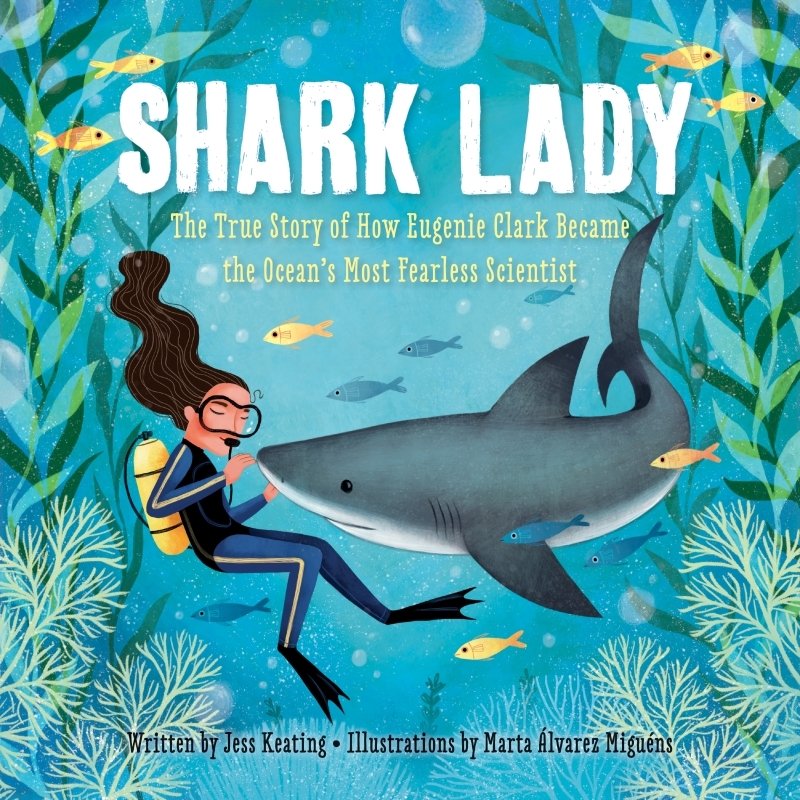
Jess Keating, author
Marta Alvarez Miguens, illustrator

Publisher Summary:
This is the story of a woman who dared to dive, defy, discover, and inspire.  This is the story of the Shark Lady.

Eugenia Clark fell in love with sharks from the first moment she saw them at the aquarium.  She couldn’t imagine anything more exciting than studying these graceful creatures.  But Eugenia quickly discovered that many people believe sharks to be ugly and scary, and they didn’t think women should be scientists.

Determined to prove them wrong, Eugenie devoted her life to learning about sharks…Through her accomplishments, she taught the world that sharks were to be admired rather than feared—and that women can do anything they set their minds to.


Why It’s Fabulous:
This biography presents a fascinating picture of a determined and fearless woman.  Eugenia boldly went where few dared to plunge—in the ocean to study sharks.  In the process, she discovered new ocean species and information about sharks.  She followed her childhood dream, and in the process, changed the way the world saw sharks.  The vivid illustrations add to the engaging story of Eugenia Clark’s accomplishments.


Emily Arnold McCully, author & illustrator

Publisher Summary:
In 1786, Caroline Herschel became the first woman to discover a comet.  She was also the first woman ever to be paid for scientific research.

But no one who knew Caroline as a child could possibly have predicted her stellar future.  Illness scarred her face and stunted her growth.  Her mother didn’t want Caroline to be educated and insisted that Caroline’s role in life was to be the family’s housekeeper.

Through words, including excerpts from Caroline Herschel’s diary, and pictures, bring Caroline’s inspirational story to life.


Why It’s Fabulous:
Despite numerous challenges and constraints, Caroline (along with her brother) laid the foundation for future astronomers.  Their detailed observations and calculations endowed astronomy with a status equal to other fields.  Refusing to settle for just being her brother’s assistant, her work and boldness earned her a salary from the King.  As a result, she is known as the first profession woman scientist.  Her story of overcoming great odds and devoting her life to her passion is sure to inspire readers.


Laurie Wallmark, author
Katy Wu, illustrator

Publisher Summary:
Meet Grace Hopper:  the woman who revolutionized computer coding.

An ace inventor, groundbreaker, and recipient of the Presidential Medal of Freedom, she coined the term “computer bug” and developed the program that taught computers to recognize words and not just endless O’s and I’s.  Laurie Wallmark tells the inspirational story of this brilliant woman who had a passion for science and math and the firm belief that new solutions to problems were not found by those who said, “We’ve always done it this way.”


Why It’s Fabulous:
In a time when woman rarely studied science and math, Grace became a leader in an emerging field—computer science.  She was determined.  Despite some initial set backs in her education and career, she did not give up until she achieved her goals. Also, she had an insatiable curiosity to solve problems.  She fought against conventional thinking.  For instance, she would doodle fantastic creatures to help her think outside the box when she had a problem to solve.  Among other things, her innovations helped programmers write code more quickly.  (Bonus:  You will learn how the term “computer bug” came about.)  Her contributions continue to positively impact both men and women in the field. Grace was an amazing and inspiring figure. 


Robert Burleigh, author
Raul Colon, illustrator

Publisher Summary:
Marie Tharp was always fascinated by the ocean. Taught to think big by her father who was a mapmaker, Marie wanted to do something no one had ever done before: map the bottom of the Atlantic Ocean. Was it even possible? Not sure if she would succeed, Marie decided to give it a try.

Throughout history, others had tried and failed to measure the depths of the oceans. Sailors lowered weighted ropes to take measurements. Even today, scientists are trying to measure the depth by using echo sounder machines to track how long it would take a sound wave sent from a ship to the sea floor to come back. But for Marie, it was like piecing together an immense jigsaw puzzle.

Despite past failures and challenges—sometimes Marie would be turned away from a ship because having a woman on board was “bad luck”—Marie was determined to succeed.


Why It’s Fabulous:
Like the other women on this list, Marie overcame discrimination in her field.  Though she had a job at a prestigious university, she often had to work “beneath” her skills and education.  However, she persevered and made friends. Eventually, she worked in collaboration with other scientists and mapped the ocean floor at a time when little was known about it.  She proved a much-disputed theory of her time—continental drift.  Her contribution to her field helped the world not just gain a map of the ocean floor, but learn more about how the Earth works. 

For more women in STEM biographies, click HERE.

A Better Way to Teach Theme: Why I Built the Jory John Now Prove It Series

If you’ve ever taught theme, you know the moment. Students finish a story, you ask “What’s the theme?” — and suddenly you’re flooded with a...