Showing posts with label community helpers. Show all posts

Friday, April 20, 2018

The Doctor with an Eye for Eyes (Julia Finley Mosca)


Illustrator: Daniel Rieley

Target Ages:  5 and up

Genre:  Picture Book Biography

Publisher Summary: 
Meet Dr. Patricia Bath—the scientist who never lost sight of her dreams!  As a girl coming of age during the Civil Rights Movement, Patricia Bath made it her mission to become a doctor.  When obstacles like racism, poverty, and sexism threated this goal, she persevered—brightening the world with a game-changing treatment for blindness. 

First Lines:
If you like to think BIG,
But some say you’re too small,
or they say you’re too young
or too slow or too tall…

Pay no mind to their doubts,
and just follow the path
of one AWESOME inventor,
PATRICIA E. BATH!

Memorable Moment:
So, if helping the world
seems too hard, you are wrong.

If some say you can’t do it,
don’t listen.  Be STRONG.

Like Patricia, stay FOCUSED.
Push FORWARD. Shine BRIGHT.

And you’ll find all your DREAMS
will be well within SIGHT.

Evaluation:
I thoroughly enjoyed this book!  There is so much about Dr. Bath’s life that is inspirational.  She had to overcome difficulties to get an education and dealt with racism and sexism early in her career. The narrative is more focused on what she did to overcome those negative people and social constraints than the actual incidents themselves, which is empowering.    

There are several pages devoted to her childhood that give an nice picture of the influences in her from her parents to her brothers to her first science kit.  Her parents instill some vital lessons that parent and teacher readers will want to highlight, explore, and expand on. 


Another admirable character trait is her never-ending quest to learn and to advance in her field.  Her post-school educational pursuits are what led to eye treatment advancements that have helped millions around the world. 

The story keeps a steady pace, focusing on the highlights of her career.  The information is the right balance of being informative without being overwhelming.  However, the author provides plenty of additional information for teachers and parents to share with students, including Fun Facts and Tidbits from the Author’s Chat with Patricia, Timeline of Dr. Bath’s life, and About Dr. Patricia Bath section.


YouTube has a short, animated video about Dr. Bath in her own words.

Here is a Reading Guide for the book.  

Check out other women in STEM biographies. 

Activities and Extension Ideas for Lesson Plans:
  • Science: Learn about the parts of the eye—pupil, cornea, lens, and so forth—what the parts do, and how to keep eyes healthy.  To spark of love of science, order a science kit for the family or plan some science experiments in class. 
  • Senses:  Read this biography while studying the 5 senses.  Some fun five senses activity ideas are HERE
  • Time Line:  The book includes a timeline of Dr. Bath’s life.  Use this organizer in a history unit or to outline the life of another famous scientist.  Another possible way to apply it is to have student create a timeline for their future.  What do they hope to accomplish and by what age?  This ties in nicely with math as well since they have to calculate the year they will be the target age for each accomplishments. 
  • Geography:  Identify the places on the map that Dr. Bath lived or traveled to for her work, such as California, New York, and Paris.
  • Community Helpers:  Connect this book with a unit on community helpers for younger children.  Older students can learn more about the process of becoming a doctor and their important contribution to the community.
  • Letter Writing:  Write a letter to Dr. Bath.  Tell her about what you enjoyed most about her story or what inspired you from her life story. 
  • Writing—Personal:  Dr. Bath accomplished many “firsts.”  Students can write about what they want to be the first to do or to discover.  Younger students can fill in a simple sentence like:  “I want to be the first to ______.” Older students can write more, depending on age and ability.
  • Writing—Argument:  Pick one of the lessons her parents taught her (“We’re equal—all genders, all shades.”  “Nothing’s off limits—no job, dream, or role.”  “Education is the key to success.”).  Use it as a prompt for students to write an argument, such as arguing why the quote is true or how it was the lesson that impacted her life most (based on the evidence in the story). 
  • Poetry:  The story is written in poetic form.  Possible connections can be anywhere from identifying rhyming words to students writing their own poetic lines.  Poems can be about Dr. Bath or about their own goals for the future.  Assign a specific poetic form or allow them to write in free verse.
Historical Connections:
Civil Rights Movement


For more great picture book recommendations, visit the Perfect Picture Book Friday Round Up.


Wednesday, May 16, 2012

Picture Book: Dreams Around the World (by Takashi Owaki)


Photographer Takashi Owaki traveled around the world, visiting multiple countries on 6 different continents.  To the children he met, he asked the question:  “What do you want to be when you grow up?” Owaki highlights 13 of the children he interviewed and photographed in Dreams Around the World. 

For each child, his/her name, age, and native country are provided.  Then, Owaki shares a little of what he learned about each one's life and dreams.   Many of the children have very different lives from the typical American child.  For instance, Udayakumar (age 6) works in his family’s restaurant while Armando (age 8) takes care of the llamas and donkeys in a traveling circus his family works in.   Others have similar experiences to many American children, like Angelica (age 6) who plays hide and seek with her friends and Sara (age 7) who goes on bike rides with her family.  American youngsters will definitely related to their occupational dreams, such as dancer, teacher, pilot, kung-fu master, police officer, ballerina, and princess.  The photographs are striking.  Each child has a full-page picture facing the information on him/her.  Underneath the text, additional pictures of the child are shown that reflect cultural and personal attributes. 

Dreams Around the World reveals that no matter where we live, children have similar interests and hobbies.  Family and friends are important.  Most importantly, children all have dreams for the future.  I recommend this book for ages 3-8.  

Teaching Opportunities:
  • Geography: identify the countries represented on a map; learn a few basic cultural and geographical elements about each one (or a couple favorites)
  • Writing:  instruct the child to write one or more sentences about what he wants to be when he grows up like “I want to be a ___________ when I grow up.”  OR “When I grow up I want to be a _____________ because I want to ______________.”
  • Art:  allow the child to draw a picture of himself working in his dream job
  • Unit Study:  use as a part of a unit on community helpers; visit (or bring in as a guest speaker) community helpers like firemen, police officers, and business owners
  • Math:  create a graph of some of the most popular dream jobs from the book; allow students to vote on their favorite and create a graph together to depict the data
  • Literature:  pick 1 or more countries of interest; then, find a couple fiction books (such as myths, legends, or popular stories) in the library that reflect the culture; read and discuss them together
  • Comparison:  talk about similarities and differences between the children in the book and those in the class or neighborhood of the readers/listeners


Disclaimer: As per FTC guidelines, I received a copy of this book from the publisher in exchange for my honest review. I received no monetary compensation. All opinions expressed here are mine and mine alone. 

Tuesday, March 13, 2012

Picture Books: Road Work Ahead & Job Site

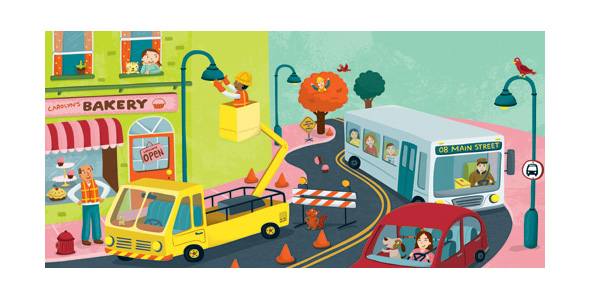
I recently came across two new titles that preschool aged children, especially little boys, are sure to love.  Each have a slightly different emphasis, but both are full of vehicles and workers.  Educators and parents may use these books to accompany a unit or study on transportation or community helpers.   
A little boy sets off with his mom and dog to visit his grandmother, who is making yummy oatmeal cookies!  As they drive along, they encounter some delays due to all the work being  done on and around the road.   The snappy, rhyming text makes it just right for reading out loud:  

Left lane closed for drilling holes.   
Watch out now, they’re putting up poles.     

Right lane closed to pour concrete.   
Workers plant trees along the street.       

Each sentence is illustrated (by Jannie Ho) with a vivid two page scene of the his ride and all the people who work to make the community run smoothly and safely—bus driver, construction workers, police men, landscapers, and more.   Machines and vehicles are plentiful—jackhammer, dump truck, bus, loader slides, cement truck, and others.  The story ends with the boy arriving at his destination where he enjoys seeing his jovial grandmother and eating her delectable cookies.     


Suen superbly depicts the importance of all the various workers in the community.  The straightforward text makes it perfect for young listeners with shorter attention spans and older youngsters who are beginning to read.  I recommend Road Work Ahead for ages 2-6. 


Job Site (by Nathan Clement)  
Bulldozers, dump trucks, cranes, and other construction vehicles are the stars of this narrative.  For each job, the boss gives a short command and the community helper/vehicle accomplishes the job.  I can envision an enthusiastic young listener quickly memorizing each command and “reading” right along.  The text followings this basic set-up:  

Boss says, “Level that pile!”  
And the bulldozer lowers its blade and levels the pile of gravel.

Boss says, “Dig a hole!”
And the excavator tips its bucket and starts to dig.

Each vehicle has an important role in creating a community project that is not revealed until the final pages.  The grey background of the illustrations allow the bright colored vehicles to pop off the page.  Job Site is a cool read for any youngster excited about trucks and what they do!   I recommend it for ages 2-6. 


This post is linked up with Read Aloud Thursday at Hope is the Word 


Saturday, May 14, 2011

Trashy Town (Andrea Zimmerman)


Summary of Trashy Town:  
Mr. Gilly drives around town doing an important job:  collecting trash.  As he goes to various places in the community—the school, the pizza parlor, the park, the doctor’s office, and the fire station—the following fun, rhythmic refrain is recited:

Dump it in,
smash it down,
drive around
the Trashy Town! 

Then, the question is posed:  “Is the trash truck full yet?”  Each time (except for the final one) the answer is “No.  Mr. Gilly drives on.”  The narrative ends with Mr. Gilly depositing the trash into the dump where “up, up, up goes the truck.   Down, down, down goes the trash.”   When he is done ridding the town of all its trash, he goes home where he cleans himself up. 

Evaluation:
Youngsters will love the catchy repetition and opportunities for interaction in Andrea Zimmerman’s Trashy Town.  Younger children can respond to the question at each stop and anticipate where Mr. Gilly will go next.  Older children can recite the chant along with adult readers.  The appealing illustrations (by Dan Yaccarino) are created with simple shapes and a coherent color scheme (blues, reds, neutrals).  For added fun, there are two little grey mice on each page.   Mr. Gilly’s amiable smile and hard-working behavior provide a positive view of this community helper.   The text and illustrations emulate a sense of pride and satisfaction in a job well done.  Trashy Town is good, clean fun that children ages 2-7 will enjoy experiencing over and over again. 

Teaching Opportunities
  • Choral Reading: Recite the repetitive stanza and question/answer together.
  •  Community Helpers—Add to a unity study of community helpers or transportation.   Even though being a trashman is far from glamorous, it is an essential job in the community.  Children can learn to appreciate their important contribution as well as where the trash ultimately goes.
  •  Environmental Science: The story provides an opportunity for action!  If all the trash is being dumped in our environment, what can we do to limit what we discard?  Discuss recycling and composting along with ways to limit individual trash output.   
  • Character Education: Mr. Gilly has a smile on his face and a cheerful attitude.  He epitomizes what it looks like to have joyful heart no matter what job you are doing.  Children can be reminded of the importance of doing their jobs or chores with a happy heart.   
  •  Creative Movement/Physical Education: Around an open area (gym, playground, field), place “trash” all around.  This can be real (paper balls, food boxes, beverage containers) or fake items (small balls, cones, athletic equipment).    Have the children in small groups first collect it into smaller containers.  Then, dump into a larger one.  The first group with a full large container wins. 
  • Music: Pick a tune familiar to the students.  Write original lyrics together teaching others about littering or recycling. 
  • Art: Use trash items (bottle caps, newspaper, shoe boxes, wire bits, old magazines) to create an original work of art. 
  •  Writing: As a class, write a thank you note to local trash men, thanking them for their essential community service.  Teach and demonstrate the parts of a friendly letter.    

Thursday, February 17, 2011

Picture Book: Astro The Steller Sea Lion by Jeanne Walker Harvey

A baby sea lion, only a few days old, is separated from his mother.  Fortunately, he is rescued by a scientist and taken to The Marine Mammal Center—a place for sick, injured, and stranded marine mammals.  The lost sea lion is named Astro.  For 10 months, he is cared for and feed by the staff.  When Astro is mature enough to join the other sea lions, he is taken down to the ocean shore.  Confused and frightened, he refuses to leave the beach area to find food.  He has bonded with humans instead of other steller sea lions, so he does not feel “at home” in the open sea.   Workers attempt on two more occasions to acclimate Astro back into his natural habitat.  Each time though, he returns to the area near the Center where he seeks to interact with humans.   The staff decides to find him an alternate home.  Fortunately, an aquarium in Connecticut offers him a place to live.  After some training in the Long Marine Lab at the University of California, Astro flies on a plane across the country.  He quickly acclimates into his new home, complete with lots of people visiting him each day!   This happy and playful seal is now a stellar attraction at the Mystic Aquarium.

Evaluation:
Astro, The Steller Seal is based on real events.  Author Jeanne Walker Harvey brings this remarkable and beloved sea lion’s story to students all over the country.  Realistic pictures accompany the fascinating narrative.  This book is especially conducive to teachable moments and the classroom instruction.  The resource pages in the back give general and life cycle information on steller sea lions.  A map is provided to plot out Astro’s travels.  Also, there is a comparison of steller sea lions to harbor seals.  Finally, Sylvan Dell, the publisher, has provided a 31-page Teaching Activity Guide full of across the curriculum handouts and ideas to accompany the book.  The website includes quizzes and other information.   Families and classroom students are sure to enjoy this story! 

Visit the Mystic Aquarium to see him in person or click on Meet the Real Astro to meet him on the web.    

Sunday, November 7, 2010

Picture Books that Celebrate Imagination (for Boys)

Today, kids are bombarded with television, video games, computers, and other technology.  In many ways, these things have deprived children of imaginative moments and exploration.  I notice a difference in my children (especially my son) when I “unplug” them, meaning no electronics.  He spends more time in his room playing with his toys (especially his stuffed animals that all have names and personalities) and exploring outside with his friends.  He also reads more. 
If you don’t see that imaginative curiosity in your children or your students, unplug.  Spend an afternoon together playing with blocks, cars, and toy animals/dolls or just take some old boxes to create a clubhouse or a vehicle.  Older kids can put on dramas/skits or use art supplies to create something original.  Pull out some books and read some imaginative tales.  There are so many great picture books and novels that kids of all ages can enjoy.  They don’t have to be in preschool or even grade school to enjoy a good picture book!  I still read picture books to my 13 year old.
Here are a few of my favorite imaginative tales for boys.  Also, check out my favorites for girls


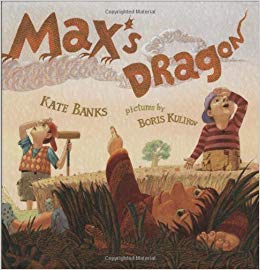
Max’s Dragon (ages 5-10) by Kate Banks
This book is a celebration of imagination!   As his brothers play croquet, Max begins his magical quest by sitting under an umbrella (though there is no rain) and brainstorming rhyming words.  His words conjure up and manipulate his imaginary dragon’s activities.  For instance, when he sees a giant dinosaur in the clouds over taking his dragon, he says, “If my dragon isn’t faster, there’ll be a disaster.”  Later, Max states “My dragon’s sneeze makes quite a breeze” when he feels the rough winds of on oncoming storm.  The boys experience how their imaginations and their words bring adventure, amusement, and accord between them. 
Because this book also uses rhyming words as a major component of the story, it is a good opportunity to teach and/or practice this early reading skill.   It would be fun to practice a rhyming game or activities.  Here are a few ideas:  Online Rhyming Games, Fun Activities for Teaching Rhyming Words, and Rhyme Lesson Plan.


Alexander’s Pretending Day (ages 4-8) by Bunny Crumpacker
Alexander draws pictures at the table as his mother reads the newspaper.  He asks his mom to pretend he is a mouse.  She plays a long and gives him a snack (cheese).  Enjoying his mom’s attention and his imaginative world, Alexander pretends he is an angry lion, a fast train, a mean monster, and a large dinosaur.  Each time he looks to his mother for affirmation and attention.  She lovingly and wisely responds to each one of his imaginative rides.  I love the last page when he asks her what she would do if she did not have a boy like him.  It is a tender mommy moment meant to be experienced!  
Captain Bob Takes Flight (ages 3-7) by Roni Schotter
Using a big box and lots of household items, Captain Bob becomes the fiercest flyer that ever flew in the cloud covered skies!  As he zooms off the cluttered bedroom runway, he scoops up unidentified low lying objects (such as socks) and spots the man on the moon (his lamp with an astronaut figure next to it).  He takes time to relax and write out a sky message that follows his plane through the clouds.  It is only a southerly wind (his mother’s voice) that brings him back to a hungry reality---for lunch.  Also, this imaginative selection uses many alliterative phrases and vivid pictures. 
Firefighter Ted (ages 3-8) by Andrea Beaty
Ted wakes up to the smell of smoke which begins his day of imagination as a firefighter.  He does his best to put out “fires” throughout the day and to rescue those in need, but unfortunately, his good intentions are not always wanted or needed.  Ted usually leaves people speechless.  For instance, he rescues 1 cat, 2 dogs, and 3 tricycles, but he does so by putting them in the tree.  Later, he attempts to “help” the school principal and the class during the science fair.  Each endeavor ends in disaster which Ted appears oblivious to.  When there is a real fire though, Ted springs into action to help save the day.  The story closes with him beginning to imagine what it would be like as an artist. 

Other Good Books in this Category:
The Puddle  (ages 3-7) by David McPhail
Using a boat and a rain puddle, a little boy has an imaginative experience with a turtle, an alligator, a frog, a pig, and an elephant on a rainy day. 

A Box Can be Many Things (ages 4-8) by Dana Meachen Rau
Two siblings use a box to create a cave for a bear,  a car for a race, a house for a visit, and a cage for a bird.  Even when the box is in pieces after all their imaginative play, they find it has one more use.

A Better Way to Teach Theme: Why I Built the Jory John Now Prove It Series

If you’ve ever taught theme, you know the moment. Students finish a story, you ask “What’s the theme?” — and suddenly you’re flooded with a...