Showing posts with label animals ocean. Show all posts

Friday, August 10, 2018

A Place to Start a Family (David L. Harrison)


Illustrator:  Giles Laroche

Target Ages:  5-10

Genre:  Non-Fiction Poetry

Publisher Summary:
Many animals build in order to find a mate, lay eggs, give birth, and protect their babies.  The types of structures they create are often extraordinary.  From the prairie dog to the pufferfish and from the termite to the stork, discover how and why many animals build.

Poem Samples (Click for Larger View):


Evaluation: 
Earlier this year, I reviewed another Harrison-Laroche collaboration Now You See Them, Now You Don't.  Like the previous book, this one deserves to be in every library, classroom, and home.  

The poems are insightful. Harrison features many animals and attributes I was not previously familiar with, like the only snake that builds a nest and the spider that feeds its young for weeks after birth.  Young and old will be engaged and fascinated with the creatures’ preparation for and care of their babies. 

The poems are entertaining.  For instance, “Red Ovenbird” has short stanzas with repetition. Similarly, “Termite” uses repetition and predictive phrasing.  Both are perfect for choral reading.  Others connect animals to human behaviors like the animals that kiss and play king of the hill or the animals that keep their babies safe and dry. 

Laroche’s illustrations are stunning and brilliant.  I love the textures, the contrasts,  the colors.  Each sight feels like a peek into the secret lives of these creatures with all its vividness and beauty. 

Whether you come for the illustrations and stay for the poetry or come for the poetry and stay for the illustrations, you are going to love both in A Place to Start a Family.

Ideas for Extension Activities at Home or Lesson Plans for Teachers:
  • Science:  Use poems in a unit related to mammals, fish, insects, reptiles, or baby animals. 
  • Poetry vs. Prose: Each creature is featured in a short prose paragraph at the end book.  Both the prose paragraph and the poetry include many of the same facts, but one uses figurative elements and experiences the facts imaginatively.  Put the prose and the poetry side by side and compare them to teach the difference of these two writing forms.
  • Poetry:  Using a short paragraph of information from science or other subject area, write poems that imaginatively experience the facts. 
  • Categorization:  Break the animals into groups like type (mammal, fish), location (air, water, underground), type of home, caring for young, and so forth.  To extend to math, create one or more charts of information.
  • Comparison:  Pick two creatures to compare and contrast.  How are they similar?  Different?
  • Language:  Identify rhyming words and alliteration.  For younger children, use them as a spring board for reading instruction.  For instance, list the words that rhyme in the poem. (“European Paper Wasp” is a good poem for this exercise.)  Point out similarities in spelling and sound.  Write out new words that rhyme.  Allow early readers to decipher them. 


Monday, April 16, 2018

5 Fabulous Biographies of Women in STEM Fields

Each one of these women have a story that will inspire young women and men. They overcame obstacles--physical and social--to find success and fulfillment in STEM fields.  They made important contributions in their fields of study. 


Claire A. Nivola, author and illustrator

Publisher Summary:
Sylvia Earle was a biologist and botanist long before she even knew what those words meant.  As a child, she spend hours observing plant and animal life on her family’s farm, but it was when she moved to Florida and Sylvia discovered the Gulf of Mexico that she lost her heart to the ocean.  These early investigations inspired her along the path to becoming a prominent and compelling advocate for the ocean. 

Sylvia dives deep and reveals the wonders of an underwater world of whales, angelfish, coral reefs, and tiny creatures that glow in the darkest depth of the sea.  Whether she’s designing submersibles for exploration, living underwater for two weeks, or taking deep-water walks, Sylvia Earle has dedicated her life to learning more about, and urgently calling on all of us to protect, what she call “the blue heart of the planet.” 


Why It’s Fabulous:
Earle’s story is a celebration of curiosity, patience, and observation.  These are skills she practiced in her earliest years in her notebooks and sample collections.  She also sought information in the library to feed her unquenchable desire to know more. After earning a degree in science, she joined an expedition in the Indian Ocean (as the only woman).  Her STEM degree took her to many exciting places from a deep-sea laboratory off the U.S. Virgin Islands to a deep-seas station fifty feet underwater. She walked on the ocean floor, traveled 13,000 feet below the surface in a Japanese submersible, and swam with the whales.  As a world-renowned oceanographer and environmentalist, she taught people to care about and to protect the ocean.


Jeanette Winter, author and illustrator

Publisher Summary:
Zaha Hadid grew up in Baghdad, Iraq, and dreamed of designing her own cities. After studying architecture in London, she opened her own studio and started designing buildings. But as a Muslim woman, Hadid faced many obstacles. Determined to succeed, she worked hard for many years, and achieved her goals—and now you can see the buildings Hadid has designed all over the world.


Why It’s Fabulous:
Hadid was inspired by her homeland of Iraq—ancient cities, rivers, dunes, and marshes.  As a young girl, she dreamed of designing her own city.  During her time in college, her imagination was the driving force behind her work and study of architecture.  After graduation, she rented a room in a old school building.  Along with some fellow visionaries, they drew and planned endlessly.  Her designs were not like anyone else’s. The buildings swooshed and zoomed and flowed and flew.  She believed the world is not a rectangle.  Despite many rejections, Hadid “made a conscious decision not to stop.”  Using nature as her inspiration, she created tall buildings like the marsh grass, a stadium that looks like a shell, and an opera house like a pebble in the sand. Eventually every room in the old school building was filled with people designing and planning her buildings.  Her belief in the impossible and her dedication allowed for her unique visions to come to life. Even after her death, her architect firm “[kept] their lights on” and “her flame blazing bright.”


Jeanette Winter

Publisher Summary: 
At five years old, Jane was already a watcher.  Little Jane Goodall loved to watch all the animals in her world—the earthworms and insects, the birds and cats.  She loved to read about Dr. Dolittle, who could talk to animals. 

When she grew up, Jane followed her dream and traveled to Africa to study chimpanzees.  She watched them, she listened to them, and, in time, she became their friend. 


Why It’s Fabulous:
Goodall worked to earn the money to go to Africa.  Then, she bravely traveled across the ocean in hopes of finding an opportunity to study animals in their natural habitat.  She finally received a post to study chimps.  Out in the middle of the jungle, she heard their calls.  However, they stayed hidden.  Even after suffering from malaria—she was determined to wait it out.  Finally, after many months, they revealed themselves.  At first she acted uninterested and watched quietly.  Eventually, they trusted her.  She spent every day with them—observing and taking notes.  She revealed many things we did not previously know about chimps specifically and animals in general. Later when men began to kill and to kidnap them, she fought to save them.  She spoke for the chimps and against deforestation.


Emily Arnold McCully, author and illustrator

Publisher Summary:
With her sketchbook labeled My Inventions and her father's toolbox, Mattie could make almost anything – toys, sleds, and a foot warmer. When she was just twelve years old, Mattie designed a metal guard to prevent shuttles from shooting off textile looms and injuring workers. As an adult, Mattie invented the machine that makes the square-bottom paper bags we still use today. However, in court, a man claimed the invention was his, stating that she "could not possibly understand the mechanical complexities." Marvelous Mattie proved him wrong, and over the course of her life earned the title of "the Lady Edison."

Why It’s Fabulous:
Mattie began inventing small things as a child by sketching, problem solving, and building.  She used her factory experience during the industrial revolution to make the lives of workers safer.  Through perseverance and hard work over a two-year period, she invented a complex machine from sketch, to prototype, to final product. She problem solved when things did not work out.  For instance, there was a problem in the initial testing of her first prototype.  Mattie worked to figure it out and to fix it.  She fought against sexist views, but she did not give up even when a man stole her idea.  Instead, she took him to court and won her case.  Rather than sell her invention, she opened up her own business.  Mattie spent her life inventing new machines and trailblazing for women in STEM fields.


Cheryl Harness, author
Carlo Molinari, illustrator

Publisher Summary:
Mary Edwards Walker was always an outspoken woman.  She was one of America’s first woman doctors, and she fought for women’s rights and gave speeches around the country.  But she could also make a statement just by walking down the street—wearing pants in a time when women always wore dresses!

When the Civil War struck, she set out to serve her country and treat wounded soldiers—not as a nurse, but as a doctor.  She faced extreme danger behind enemy lines and for her bravery she received the Medal of Honor, the highest a war veteran can receive.  She remains the first and only woman to ever hold this honor. 

A hero far ahead of her time, Dr. Walker encountered prejudice and ridicule as well as glory.  And she always insisted on living—and dressing—on her own terms. 

Why It’s Fabulous:
Dr. Walker volunteered when the Civil War began, doing anything she could from writing letters for wounded soldiers to raising money to help with medical care.  She wanted to do more.  She wanted to use her medical knowledge and skills.  Patriotic and determined, she followed the troops and helped in the makeshift battlefield hospitals.  Though her perseverance, she was finally appointed “to serve as an assistant surgeon in the U.S. Army, a first for the military and a first for women.”  While moving back and forth between enemy lines helping the wounded, she was taken as a prisoner of war for several months until being released in an officer exchange.  People laughed at her for her clothes, even after the war.  However, she stayed “true to her ideals.”  She wore her suit and her Medal of Honor with pride.  She wanted women to live and to think freely “unbound by a corset or her society’s expectations.”

Saturday, February 10, 2018

Five Fabulous Female Scientist Biographies


Margarita Engle, author
Julie Paschkis, illustrator

Publisher Summary:  
In the Middle Ages, people believed that insects were evil, born from mud in a process called spontaneous generation. Maria Merian was only a child, but she disagreed.  She studied caterpillars in secret, for the neighbors would have accused her of witchcraft if they knew.

Maria watched carefully as her caterpillars spun themselves cocoons, which opened to reveal summer birds, or butterflies and moths.  She saw the whole life cycle of the summer birds and documented what she learned in vibrant paintings. 

This is the story of one young girl who took the time to observe and learn, and in so doing, disapproved a theory that went all the way back to ancient Greece. 


Why It’s Fabulous:
Most of the story is about Maria as a young girl who observes, questions, and explores. Interwoven in the narrative is some basic information about butterflies and their life cycle as well as bit of medieval history. Not only does Maria have a scientific mind, but she also she has artistic talent.  Using her keen sense of observation, she paints insects, plants, and other creatures. One of the best parts of the book is Julie Paschkis’ meticulous and vibrant illustrations. Maria’s life demonstrates to children that they do not have to wait until they are adults to engage in scientific discovery and artistic exploration.  Most importantly, they can overcome prejudice and ignorance to make a difference in the world


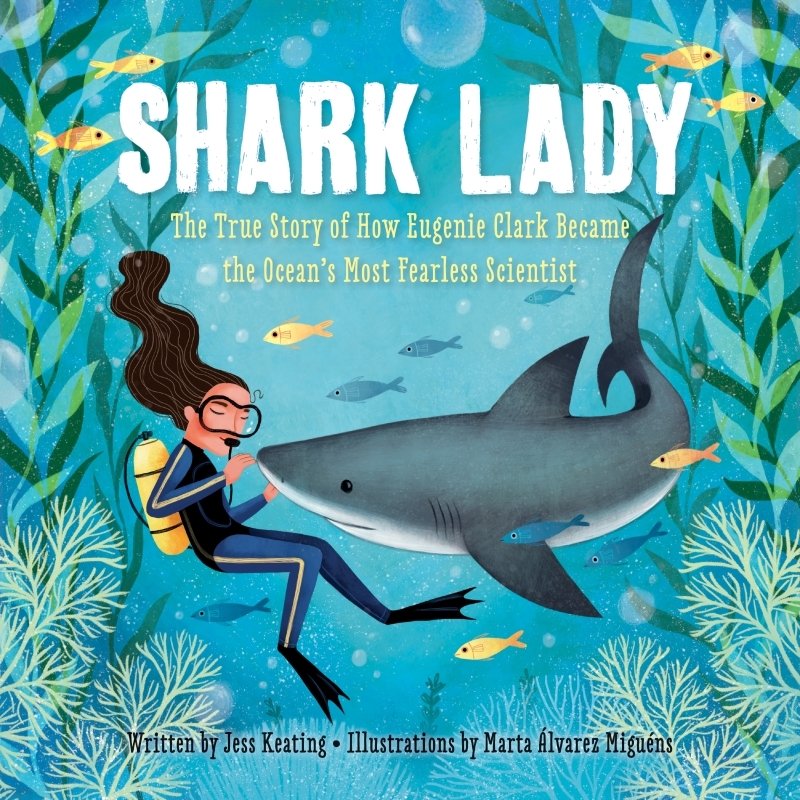
Jess Keating, author
Marta Alvarez Miguens, illustrator

Publisher Summary:
This is the story of a woman who dared to dive, defy, discover, and inspire.  This is the story of the Shark Lady.

Eugenia Clark fell in love with sharks from the first moment she saw them at the aquarium.  She couldn’t imagine anything more exciting than studying these graceful creatures.  But Eugenia quickly discovered that many people believe sharks to be ugly and scary, and they didn’t think women should be scientists.

Determined to prove them wrong, Eugenie devoted her life to learning about sharks…Through her accomplishments, she taught the world that sharks were to be admired rather than feared—and that women can do anything they set their minds to.


Why It’s Fabulous:
This biography presents a fascinating picture of a determined and fearless woman.  Eugenia boldly went where few dared to plunge—in the ocean to study sharks.  In the process, she discovered new ocean species and information about sharks.  She followed her childhood dream, and in the process, changed the way the world saw sharks.  The vivid illustrations add to the engaging story of Eugenia Clark’s accomplishments.


Emily Arnold McCully, author & illustrator

Publisher Summary:
In 1786, Caroline Herschel became the first woman to discover a comet.  She was also the first woman ever to be paid for scientific research.

But no one who knew Caroline as a child could possibly have predicted her stellar future.  Illness scarred her face and stunted her growth.  Her mother didn’t want Caroline to be educated and insisted that Caroline’s role in life was to be the family’s housekeeper.

Through words, including excerpts from Caroline Herschel’s diary, and pictures, bring Caroline’s inspirational story to life.


Why It’s Fabulous:
Despite numerous challenges and constraints, Caroline (along with her brother) laid the foundation for future astronomers.  Their detailed observations and calculations endowed astronomy with a status equal to other fields.  Refusing to settle for just being her brother’s assistant, her work and boldness earned her a salary from the King.  As a result, she is known as the first profession woman scientist.  Her story of overcoming great odds and devoting her life to her passion is sure to inspire readers.


Laurie Wallmark, author
Katy Wu, illustrator

Publisher Summary:
Meet Grace Hopper:  the woman who revolutionized computer coding.

An ace inventor, groundbreaker, and recipient of the Presidential Medal of Freedom, she coined the term “computer bug” and developed the program that taught computers to recognize words and not just endless O’s and I’s.  Laurie Wallmark tells the inspirational story of this brilliant woman who had a passion for science and math and the firm belief that new solutions to problems were not found by those who said, “We’ve always done it this way.”


Why It’s Fabulous:
In a time when woman rarely studied science and math, Grace became a leader in an emerging field—computer science.  She was determined.  Despite some initial set backs in her education and career, she did not give up until she achieved her goals. Also, she had an insatiable curiosity to solve problems.  She fought against conventional thinking.  For instance, she would doodle fantastic creatures to help her think outside the box when she had a problem to solve.  Among other things, her innovations helped programmers write code more quickly.  (Bonus:  You will learn how the term “computer bug” came about.)  Her contributions continue to positively impact both men and women in the field. Grace was an amazing and inspiring figure. 


Robert Burleigh, author
Raul Colon, illustrator

Publisher Summary:
Marie Tharp was always fascinated by the ocean. Taught to think big by her father who was a mapmaker, Marie wanted to do something no one had ever done before: map the bottom of the Atlantic Ocean. Was it even possible? Not sure if she would succeed, Marie decided to give it a try.

Throughout history, others had tried and failed to measure the depths of the oceans. Sailors lowered weighted ropes to take measurements. Even today, scientists are trying to measure the depth by using echo sounder machines to track how long it would take a sound wave sent from a ship to the sea floor to come back. But for Marie, it was like piecing together an immense jigsaw puzzle.

Despite past failures and challenges—sometimes Marie would be turned away from a ship because having a woman on board was “bad luck”—Marie was determined to succeed.


Why It’s Fabulous:
Like the other women on this list, Marie overcame discrimination in her field.  Though she had a job at a prestigious university, she often had to work “beneath” her skills and education.  However, she persevered and made friends. Eventually, she worked in collaboration with other scientists and mapped the ocean floor at a time when little was known about it.  She proved a much-disputed theory of her time—continental drift.  Her contribution to her field helped the world not just gain a map of the ocean floor, but learn more about how the Earth works. 

For more women in STEM biographies, click HERE.

Tuesday, March 29, 2016

X Why Z Animals (by Mark Shulman & James Buckley Jr.)


Summary of X WhyZ Animals (by Mark Shulman & James Buckley Jr.)
X Why Z Animals is written for inquiring young minds.  This non-fiction book is broken into 8 sections, each a different class of animals—mammals, reptiles, amphibians, insects, arachnids, sea animals, birds, and dinosaurs.  The sections begin with a brief description of each class, including a description of characteristics unique to them.  Then, there are questions that kids commonly ask like:

Why do chameleons change color?
Why do snakes stick out their tongues?
Why do baby deer have spots?
Why do roosters crow in the morning?
Why do dolphins make clicking sounds?
Why do fish swim in schools?

The questions have a short explanation in child-friendly language.  There are also “X Why Z Facts” interspersed throughout, which are fun tidbits about animals.  Colorful photographs compliment each page of this “Time for Kids” book. 

Evaluation
The book is oversized with big print and vivid photographs.  The information is laid out well and the questions are engaging.  It is ideal for sitting with young children and reading out loud.

X Why Z Animals could be used in a classroom to accompany units on different classes of animals.  The only downside is that each animal class is not dealt with equally.  For instance, there are 20 pages devoted to mammals, but only 2 for amphibians. Granted it, children may be more interested in mammals because of their interaction with them at home, on farms, and in the woods.  However, I feel the coverage could be a bit more equal. 


Overall, I enjoyed this book.  I recommend it for kids ages 3-8.  They will enjoy the pictures and dialogue about some of their favorite animals. 

The X Why Z series includes books on space, the human body, and general questions.

A Better Way to Teach Theme: Why I Built the Jory John Now Prove It Series

If you’ve ever taught theme, you know the moment. Students finish a story, you ask “What’s the theme?” — and suddenly you’re flooded with a...