Showing posts with label problem solving. Show all posts

Thursday, December 27, 2018

Something Smells! (Blake Liliane Hellman)


Author:  Blake Liliane Hellman

Illustrator:  Steven Henry

Target Ages:  3-7

Genre:   Humorous Realistic Fiction Picture Book

Publisher Summary:  There is a smell.  A most terrible smell!  Is it the dog?  Is it the baby?  Is it the trash?  Or could it be Grandma’s Gefartzenschnaffel?  Something smells.  And Elliot is determined to find out what that something is!

First Lines:  
Early one morning,
Elliot woke up
to a most terrible smell. 
He looked around his room
and frowned. 
Something smells, he thought.

Memorable Moment:
“Elliot was disappointed he had not solved the mystery of the terrible smell.”  Readers will solve it—with the picture clues!

Evaluation:
The title is intriguing!  I picked up this book because I wanted to know—What smells?!   Children are sure to be interested too!   Who doesn’t love a mystery?

The story is engaging!  As the curious protagonist goes through the house, he encounters all sorts of possible “terrible” smells.  Each smell is an opportunity to guess if he has found the “right” one.  


There is some subtle humor.  For instance, Elliot thinks it is “perfectly clean” under his bed, and he says his leftover snack from days earlier doesn’t smell—at least not much.   Children will laugh at grandma’s famous dish—Gefartzenschnaffer.  Whether they try to say it themselves or guess what might be in it, there are sure to be some giggles.  The funniest part:  Elliot is unable to figure out the source of the smell—even though it is right under his nose! 


The clever watercolor and gouache illustrations are wonderful.  The soft, muted colors and uncluttered layouts, vividly illustrate the text and add to it by providing clues to the mystery. 

Something Smells is one thing you need to add to your class or home library this year.  This amusing and mysterious read is sure to charm your little ones.

Activities and Extension Ideas for Lesson Plans:
  • Predicting Skills:  Ask the children to predict:  What do you think the terrible smell is?   How do you think Elliot will try to figure out the smell?
  • Math:  Narrow to the top 5 predictions of the terrible smell.  Children can pick their best guess with a show of hands.  Make a bar graph to show how the class voted.
  • Problem Solving:  Discuss how Elliot worked to solve the terrible smell mystery.  Connect this book with problem solving activities related to Math, Games, or Other Activities. 
  • Context Clues:  After reading, go back to discover the context clues.  For instance, the smell is something that follows him wherever he goes, his mom tells him he can’t wear his costume one more day, and he doesn’t want to take it off—ever (implying he has worn it a long time).
  • Five Senses:  Gather items with different smells—pleasant and unpleasant.  Blindfold one or more children.  Allow them to guess the smells.  Also discuss which smells are the best and which are the worst. 
  • Writing:  Pick one smell from the Five Senses activity.  Children can describe the smell using a simple sentence like:  “__________ smells like __________ and ___________.”    
  • Similes:  Teach about similes.  Point out examples in the book, such as “Digsy smelled like bacon” and “Lucy smelled like maple syrup.” Then, allow the children to write their own similes about the smell.  “Elliot’s costume is as stinky as a _______.“ 


Sunday, June 26, 2016

10 Picture Books That Will Make You Smile (and Laugh)

This list is for everyone who loves an twisty, turny, funny, ironic, laugh out loud picture book. Each one is sure to warm your heart as you snuggle with your little ones during story time, share in your classroom, or read independently because you are a picture book junkie like me. Be sure to check out these 10 picture books on your next trip to the library or bookstore. They will make your day a whole lot brighter as well as elicit smiles and giggles from the kids in your life.  


I Am Bear by Ben Bailey Smith and Sav Akyuz
Publisher Summary:
“This is Bear.  He was bare.  Now he’s wearing…purple hair.  His favorite thing is playing tricks. He makes trouble just for kicks. “

What’s to Love: 
This book had me laughing out loud.  The rhyming text is quick and snappy. The humor is primarily in the discrepancy between the words and the pictures (situational irony).  For instance, Bear says he does magic which prompts a pile of fish to appear.  However, it is clear that the wand has a fishing line on it.  He reveals his favorite game is cops and robbers, but it is quite different than what the reader expects. Kids may not fully understand irony, but they will recognize the humor.  (Do not hesitate to identify the ironies to young listeners.  They will likely catch on to this concept quicker than you think.)


Publisher Summary: 
“Everyone likes hugs, especially when Bear gives them!  Everyone, that is, except for Skunk.  Bear really gets on Skunk’s nerves.  He’s too happy…and he’s always giving way too many hugs!  Skunk has the perfect plan to keep Bear from giving any more hugs.  Will it work?”

What’s to Love: 
Skunk tries three different tricks on Bear, each with a hilarious and unfortunate end—for Skunk.  Kids are sure to giggle as Skunk gets skunked. Bear continuously offers Skunk a hug, but he adamantly declines it.  Bear always replies, “It’s okay.  I’ll save you one for later.”  When Skunk finally changes his mind, Bear really wants to save it for later—and for good reason. 


Publisher Summary: 
“Clemmie the Cat knows everything about how to catch a mouse—and she would prove it, too, except that she’s never actually seen a mouse! Perhaps, she thinks, they’re all afraid of her.  But wait…is that a pink tail? And a whiskery nose?” 

What’s to Love: 
Clemmie sees a long pink tail.  She creeps up, thinking it is a mouse.  Instead, it is a ribbon on a hat.  The same sequence happens with two round ears (a stuffed bear) and whiskery, pointy nose (a spider).  She is convinced she has scared away all mice.  However, there is a mouse lurking around craftily.  This story has potential for interaction as children look for and guess along with Clemmie as well as point out the sneaky mouse.  The ending is a fun surprise. 


Publisher Summary: 
“Sandwich?  What sandwich? Oh, that sandwich. Right. Um. Well. It all stated with the bear…”

What’s to Love: 
The bear’s journey from the forest into the “jungle” of a city is worth the read.  The illustrations add so much energy and humor as the bear scratches his back on a tree (light post), squishes in the mud (wet cement), and finds interesting smells (trash cans).  His experience finding, eating, and retreating is a rollicking fun time.  What got me, though, was the end.  I laughed out loud (but I won’t ruin the surprise).


How to Share with a Bear by Eric Pinder and Stephanie Graegin
Publisher Summary: 
“The perfect thing to do on a chilly day is to make a cave.  But, of course, a comfy cave never stays empty for long.  What’s a boy to do when a bear takes over his cave?  Try to distract him with a trail of blueberries?  Some honey? A nice long back scratch?”

What’s to Love: 
The protagonist comes up with several solutions to his “bear” problem, showing resourcefulness and creativity.  The illustrator does an excellent job with blocking, so the reader does not see what is really going on until the end.  This imaginative text is so sweet you will not be able to help but smile real big. 


Publisher Summary:
“Meet Max.  Max the Brave, Max the fearless,  Max the Mouse-catcher.  But, in order to be a Mouse-catcher, Max needs to know what a mouse is.”

What’s to Love:
Following a similar format as “Are You My Mother?” Max asks each animal if he is a mouse.  The hilarity begins when he actually meets Mouse.  After a couple quick twists and turns, there is a satisfying and clever ending. 


Publisher Summary: 
“Two bears. Three yaks. Four seals. Six cats. All of them have one thing in common: They hate to share. But here comes a pack of twenty pigs—count on them to prove that sharing makes everything twice as fun.”

What’s to Love: 
This concept book teaches counting and number words while illustrating the importance of sharing in a comical way.  It is the most energetic concept book I have seen.  Word play includes onomatopoeia, alliteration, and rhyme.  The illustrations are fantastic.  Sharing and underwear are taken to a whole new level. 


Publisher Summary:  
“I am my own dog.  I fetch my own slippers, curl up at my own feet, and give myself a good scratch.  But there’s one spot in the middle of my back, that I just can’t reach.” 

What’s to Love:  
This story is told through the dog’s perspective, mimicking many of the phrases associated with them, but in unexpected ways.  The “little guy” who follows him home is the man pursuing the dog.  The ones “yapping” are the people as the dogs looked annoyed.  Of course, he has to clean up all the man’s messes.  Dog lovers will smile and chuckle at this inversed story full of irony and humor. 


Publisher Summary
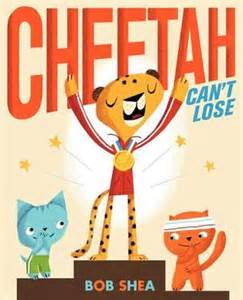
"It's race day, and once and for all, it's time to determine the better feline:  little cats or big cheetah.  Cheetah might be bigger, taller, stronger, faster...but the little cats have some tricks up their sleeves, so don't count them out." 

What’s to Love: 
Cheetah is, let's say, an over-achiever.  He has to win and to be the best at everything!  The sly little cats let him win several challenges but have an ulterior motive.  While Cheetah has no clue, the reader can infer what is really going on.  Full of humor and action, this story will be a winner with readers or all ages.   


How to Cheer up Dad by Fred Koehler
Publisher Summary
"Little Jumbo's dad is having a bad day. Little Jumbo has no idea why.  Luckily, he does know just how to cheer up Dad with some of his--ahem, his dad's--favorite things!"

What’s to Love: 
This endearing story about a boy and his loving dad is sweet.  The adorable pictures capture the mischief and energy typical in preschool-aged children.  I laughed in a couple places and smiled all the way through. The pictures and the words convey different ideas, making this one ideal for teaching inference and irony.  

Saturday, June 25, 2016

Author Spotlight: Chris Gall


I discovered Chris Gall’s work only recently when I came across one of his Dinotrux’s books. Struck by his amazing style, I checked out several of his other books.

Chris Gall has been working as an illustrator for more than 20 years.  With close to a dozen picture books published so far, he has already made an indelible mark on the industry. Working as both author and illustrator on most of his books, he has shown innovative vision and extraordinary talent. His style has similarities to other beloved illustrators like David Wiesner, Steven Kellogg, and Chris Van Allsburg.

Like Wiesner, he has an amazing imagination. Gall brings the ordinary and the fantastic, mashes them together, and creates a captivating experience. For example, in Dear Fish he takes the ideas of pen pals and company visiting to hyperbolic and astonishing levels. Substitute Creature begins with every day occurrences in the classroom and moves them to outrageous flights of fancy.

Like Kellogg, he utilizes every space, including end, copyright, and title pages. Gall uses his illustrations as much as the text to move the storytelling forward and make little detours of humor. For instance, in The Revenge of the Dinotrux the bots escape after being “civilized” by school and books. Left in the tracks is the book Escape from Alcatraz. Also, there are often bits of irony and pun included. In Dear Fish, puns are abundant, such as when a school of fish invades a classroom and swordfish help a carpenter with his work. 

Like Van Allsburg, he is a profound storyteller.  Gall’s stories are not about animals or Dinotruxs.  Instead, his characters are often metaphors or symbols. The unruly Dinotruxs symbolize undesirable behaviors often found in children like impatience, thoughtlessness, and selfishness. Dog vs. Cat represents a blended family though it could be more universally connected to learning to get along with others. 

Gall’s illustrations are bold. They often have a three-dimensional appearance.  Sometimes, he employs techniques commonly found in graphic novels like blocking and multiple scenes on a page. A variety of mediums work together to create each illustration.  He frequently uses more traditional means like clay-engraved art or colored pencils with digital effects. Other books have revolutionary tools. Dinotrux was created using bearskins and stone-knives while Substitute Creature utilized bat wings, toad juice, and the bundled whiskers of a black cat. :)

Finally, his books often have a twist at the end. In Awesome Dawson the final scene depicts Dawson using one of his inventions to help in an alien invasion while Dinotrux simply has the eyes of one of the bots flash on. These types of endings prompt a discussion of inference and provide opportunities for creative writing. 

Like a great literary fiction, there are layers and layers to unpack in his books.   Look closely at the illustrations as well as their interconnectedness with the text. Chris Gall's books will surprise you with new insights and small treasures with each reading.

Peter Alan writes a letter to the fish, places it in a bottle, and throws it out to sea. The next morning he wakes up to find the fish have taken him up on his offer to visit. They are everywhere—in the bathtub, at the baseball game, in the yard, and at the rodeo.  After numerous disruptions, he writes the fish another letter to encourage them to go back home.  Eventually, life returns back to normal.  Until, Peter Alan finds a note on the beach. This one is from the fish! 

Teaching Connections:  Puns (primarily in the illustrations), Onomatopoeia, Strong Verbs, Letter Writing, Inference 

Dawson spends all his time repurposing toys and household items into new imaginative and useful creations.  Hating to do chores, he comes up with a solution—that ends up causing so much trouble, he wishes he was at home doing chores!  Dawson stops the “monster” machine, but he does not stop coming up with ways to make chore time go more quickly and efficiently.  

Teaching Connections: Simple Machines, Robotic, STEM, Recycling, Problem Solving, Inference

When a riotous class gets an unexpected substitute teacher, they think it is an opportunity for mischief and mayhem. Their substitute is not what they expected—nor what the audience thinks either. As he presents hard cases from past classes of daydreamers, doodlers, and paste-eaters, the audience is treated to highly imaginative and disastrous consequences that ensue.  Students are not fully convinced though until the substitute creature reveals his own past delinquency. 

Teaching Connections:  Inference, Irony, Creative Writing, Poetry, Rhyme, Hyperbole

Cat and Dog are far from being two peas in a pod. Dog is a playful mess.  Cat is seriously organized. Their idea of fun could not be more different. When trying to co-exist peacefully doesn’t work, it becomes an all out war.  An unexpected event prompts a truce though.  Will the peace last?   

Teaching Connections: Sibling/Step-Sibling/Friendship Relationships, Problem Solving, Puns, Hyperbole

Dinotrux, part-truck, part dino demolition dynamos, ruled the world millions of years ago. Rude Rollodon, greedy Garbageadon, and edgy Dozeratops were just a few of the disruptive Dinotrux.  Ironically, they are so uncivilized that even the cave people are fussing at them! A terrible storm causes most of Dinotrux to rust and sink down, down, down into the mud.  The smart ones migrate south where they slowly lose their misbehaving ways and ancient features. Now they are always on the job and never quit working hard.  A prehistoric discovery may change everything though!

Teaching Connections:  Manners, Dinosaurs, Onomatopoeia, Irony

After spending decades in a museum being poked, prodded, and mistreated, Tyrannosaurus Trux leads the other Dinotrux out into the modern world. Reminiscent of a Godzilla take-over (with lots of humor and irony), they wreak havoc on the town. The mayor sends them to school to learn “how modern trucks behave.”  School seems to be helping to tame their wild ways…at least until they are on the loose again. When the Dinotrux are tracked down deep in the woods, everyone is afraid to see what is causing all the commotion.  

Teaching Connections:  Manners, Dinosaurs, Onomatopoeia, Irony, Problem Solving

Gall has two new books premiering later this year. Nanobots will be released in August 2016. The Ninjabread Man with author C.J. Leigh is due out September 2016.

Friday, May 27, 2016

The Day the Crayons Quit (Drew Daywalt)


TitleThe Day the Crayons Quit      

Author:  Drew Daywalt

Illustrator:  Oliver Jeffers

Target Ages: 2-6

First Lines:  “One day in class, Duncan went to take out his crayons and found a stack of letters with his name on them.”

Publisher Summary:  “Poor Duncan just wants to color.  But when he opens his box of crayons, he finds only letters, all saying the same thing:  We quit!  Beige is tired of playing second fiddle to Brown.  Blue needs a break from coloring all the water, while Pink just wants to be used.  Green has no complaints, but Orange and Yellow are no longer speaking to each other.  What is Duncan to do?” 

Evaluation:  Readers will never look at a box of crayons the same way!  Each crayon has a personality and a problem, making for a humorous and imaginative read.  The letters are written in crayon using a child-like handwriting.  The pictures sprinkle a little digital art in, but they mostly look like something a child drew and color. This approach to storytelling is engaging and inventive.  I highly recommend The Day the Crayons Quit and its sequel The Day the Crayons Came Home.

The Day the Crayons Came Home Publisher Summary:  “Boy, Duncan’s crayons sure are a colorful bunch of characters.  Having soothed the hurt feelings to one group who threated to quit, Duncan now faces a whole new group of crayons asking to be rescued.  From Maroon Crayon, who was lost beneath the sofa cushions and then broken in two after Dad sat on him; to Turquoise, whose head is now stuck to one of Duncan’s stinky socks after they ended up in the dryer together—each crayon has a woeful tale to tell and a plea to be brought home to the crayon box.” 

Activities and Extension Ideas for Lesson Plans:

Younger Students
  • Identify the colors.
  • Discuss the colors of objects both on the page and in real life.
  • Point out the parts of a letter (greeting, body, salutation, signature).
  • Write a letter to someone/something together—either imaginatively or realistically.
  • Practice the proper way to care for and to store crayons and other supplies.
Older Students
  • Practice the letter-writing format by writing to a friend or family member.
  • Write an imaginative letter from the perspective of a crayon color, other household object, or character.
  • Teach about the literary technique of personification and use these books to apply the concept to.
  • Read through each letter carefully.  Pick one character quality or emotion that each color depicts like sassy, optimistic, frustrated, or sad.
  • Identify the tone of each letter and how the author creates it.
  • Evaluate the problem that each crayon has and how it is solved (see Duncan’s new picture).
  • Take a class survey on one or more aspects such as the color each student uses most and/or which letter is their favorite.  Make a class graph that depicts the responses.
Visit Susanna Hill for Perfect Picture Book Friday where you will find suggestions from around the web for story time in your classroom or home.


A Better Way to Teach Theme: Why I Built the Jory John Now Prove It Series

If you’ve ever taught theme, you know the moment. Students finish a story, you ask “What’s the theme?” — and suddenly you’re flooded with a...