Showing posts with label cats. Show all posts

Friday, March 29, 2019

There Are No Bears in This Bakery (Julia Sarcone-Roach)


Illustrator:  Julia Sarcone-Roach

Target Ages:  3-9

Genre:  Picture Book

Publisher Summary: 
There was a low rumbling noise in the night.
Muffin is the whiskers of this neighborhood, so she steps out to investigate.
She tracks down the usual suspects—the mice, the raccoons, the bats.
But no, this sound is new.
And the window to the bakery is open.
It’s called the Little Bear Bakery.
But there are no bears there.
Not real bears.
Not ever.
Not usually.
But maybe…?

First Lines:
Each night, the moon rises,
the bread rises, and I rise.
The air cools, and the sounds get interesting.

That’s when the night shift begins.

Memorable Moment:
Suddenly it was
LIGHTS-OUT!
Everything went dark, and I couldn’t move.
I was smooshed, like a muffin between the couch cushions.

Evaluation:
The rich language and endearing illustrations are a delicious combination.  The characters are sweet.  The setting and plot combine a sprinkle of mystery, a dash of suspense, and a pinch of humor. This light-hearted and entertaining book is delight! 

Add There Are No Bears in This Bakery to your must read list!


Activities and Extension Ideas for Lesson Plans:
  • Similes:  Tie this book in with an simile activity or use it as a spring board to discuss them.
  • Onomatopoeia:  Students can identify the sound words.  Discuss other night sounds.  As an independent practice activity, fold a sheet of paper in half.  On the front, the student can write a night sound.  Inside, draw a picture of what is making the sound.  Students can share their sounds.  Others can guess who or what is making it!
  • Science:  Read about other nocturnal animals or pick one to learn about further. 
  • Cooking:  At home, bake an item commonly found in a bakery.  For the classroom, bring in an baked good item to share.  For instance, bring in cupcakes.  Give the student sprinkles and small candies to decorate theirs.
  • Art:  Complete an art project where the students create a bear.  Here is an adorable and easy one.  Provide paper plates in big and small to make one or both bears from the story.
  • Dramatic Play:  Create or provide puppets of a cat and two bears.  Students can act out the story or new adventures with the characters.
  • Irony:  Discuss examples of irony, and explain how they make the story humorous.


Saturday, December 29, 2018

Can't Catch Me (Timothy Knapman)


Author:  Timothy Knapman

Illustrator:   Simona Ciraolo

Target Ages:  3-7

Genre:  Picture Book

Awards:

Publisher Summary: 
“I’m the fastest mouse in the world!”
Jake claims.  “I’m like the wind!
I’m faster than lightening!”

But will speed alone keep boastful
Jake from being caught by a cat,
a fox, a wolf, or a bear?

First Lines:
Here’s Jake,
the fastest mouse in the world.

OH, NO – he’s gone!
Quick!  After him!

Memorable Moment:
No spoilers on this one!  The ending is clever and memorable. 

Evaluation:
This mischievous cumulative tale is reminiscent of The Gingerbread Man. Despite the similarities in the narratives, Can’t Catch Me has its own personality and twist. 

In this version, Jake the mouse takes on the role of the gingerbread man.   Jake boastfully taunts his predators.  He proves to be faster than the Old Tom Cat, the fox, the wolf, and the bear.  However, he is not as sly as the cat.  His arrogance blinds him to danger, which is a valuable lesson for all ages.

The pencil and watercolor illustrations capture the animation and energy of the mouse as well as the toil and frustration of the predatory animals.  The muted colors minimal backgrounds keep the focus on the action and characterization.

All in all, Can’t Catch Me is a cheeky, entertaining read!  It is one of those books kids will want to hear again and again.

Activities and Extension Ideas for Lesson Plans:
  • Predicting Skills:  Before you read, ask the children to guess what the book is about.  As you read, allow them to guess what will happen in each encounter and how they think the book will end.
  • Comparative Literature:  Read both Can’t Catch Me and a version of The Gingerbread Man.  Compare and contrast the two stories using a Venn diagram or other graphic organizer.
  • Characterization:  Discuss the characters of Jake and Old Tom Cat.  For instance, Old Tom Cat is dramatic.  He acts like he is starving.  As he sits watching the mouse, he is getting “thinner and thinner.”  He later uses this hyperbolic language to trick Jake. 
  • Science:  Discuss how animals have different defense mechanisms.  For example, the mouse is fast so he can outrun larger animals while cats are cunning and patient so they can sneak up on fast prey. 
  • Choral Reading:  Children can be prompted to read along on repetitive parts like when each predator “runs and runs,” and Jake chants multiple times  "can’t catch me” and “I’m the fastest mouse in the world.”    
For more great suggestions, head over for the Perfect Picture Book Link Up.


Friday, January 26, 2018

They All Saw a Cat (by Brendan Wenzel)


Author:  Brendan Wenzel

Illustrator:  Brendan Wenzel

Target Ages:  3 and up

Genre:  Picture Book

Awards:  Caldecott Honor Book

Publisher Summary:  When you see a cat, what do you see?  In this glorious celebration of observation, curiosity, and imagination, Brendan Wenzel shows us the many lives of one cat, and how perspective shapes what we see.

First Lines: 
The cat walked through the world,
with its whiskers, ears, and paws…
and the child saw A CAT,
and the dog saw A CAT,
and the fox saw A CAT.
Yes, they all saw the cat.


Evaluation: 
The striking multi-media pictures in They All Saw A Cat will thrill young readers while expanding their understanding of others. Each fascinating perspective can prompt a discussion. Children can evaluate why the artist made the cat look skinny in one picture and fat with an emphasis on his bell in another.  Also, the use of color varies greatly, making each illustration a feast for the senses and ripe for conversation.


On a concrete level, it is fascinating to get the vantage point of animals and insects. There are emotional differences (like how the mouse sees the cat as  monstrous) and physical ones (like the bee seeing in dots).  Also, the vantage point impacts the view: To the bird, the cat is a small speck, and to the flea, the cat is an enormous mountain. This book allows readers to imaginatively see life through another's perspective.  


On a more abstract level, the book prompts a deeper discussion on how perspective impacts perception.  This perspective can come from cultural, familial, community, and individual experiences.  It explains how two people can witness the same event, yet view it in a completely different way.  Because of the larger message, this book could be used to springboard a discussion with older children. 


For younger children, this abstract idea will be harder to grasp. However, they can begin to understand that an object, for instance, is not inherently good or bad, valuable or worthless.  It is about how we view it. 

They All Saw A Cat is simple, yet profound children's book. Overall, the illustrations and thought-provoking story make it worthy of your bookshelf.

Ideas for Extension Activities at Home or Lesson Plans for Teachers:
  • Lesson Opener:  Show one or more pictures or objects that will likely get varied responses from the children.  Prompt the children for replies. Depending on the age of the children, they may raise hands to different prompts (like, dislike, or neutral), words, or pictures (smiley, sad, or neutral faces).   Tally the responses.  Spring board into the book by discussing how we all have different perspectives.
  • Math:  Use the responses in the lesson opener to create a graph.
  • Science Research: Learn how various creatures see objects.   
  • Science Exploration: Using keen observation skills, discuss or draw nature finds. 
  • Social Studies: Discuss how different perspectives impact how a person sees a situation or other person.  
  • Writing: Write a simple sentence from the cat’s or other creature’s perspective. The cat saw the ____, the ______ and the ______.  Then, illustrate it the way you think the cat (or other animal) sees each one.
  • Choral Reading: The repetitive text is ideal for choral reading or audience participation. 
  • Reading: Limited, simple vocabulary for early reader practice.
  • Art:  Complete a fun cat craft like the ideas here and here.

 For Perfect Picture Book Friday, visit Susanna Leonard Hill's blog. 


Sunday, June 26, 2016

10 Picture Books That Will Make You Smile (and Laugh)

This list is for everyone who loves an twisty, turny, funny, ironic, laugh out loud picture book. Each one is sure to warm your heart as you snuggle with your little ones during story time, share in your classroom, or read independently because you are a picture book junkie like me. Be sure to check out these 10 picture books on your next trip to the library or bookstore. They will make your day a whole lot brighter as well as elicit smiles and giggles from the kids in your life.  


I Am Bear by Ben Bailey Smith and Sav Akyuz
Publisher Summary:
“This is Bear.  He was bare.  Now he’s wearing…purple hair.  His favorite thing is playing tricks. He makes trouble just for kicks. “

What’s to Love: 
This book had me laughing out loud.  The rhyming text is quick and snappy. The humor is primarily in the discrepancy between the words and the pictures (situational irony).  For instance, Bear says he does magic which prompts a pile of fish to appear.  However, it is clear that the wand has a fishing line on it.  He reveals his favorite game is cops and robbers, but it is quite different than what the reader expects. Kids may not fully understand irony, but they will recognize the humor.  (Do not hesitate to identify the ironies to young listeners.  They will likely catch on to this concept quicker than you think.)


Publisher Summary: 
“Everyone likes hugs, especially when Bear gives them!  Everyone, that is, except for Skunk.  Bear really gets on Skunk’s nerves.  He’s too happy…and he’s always giving way too many hugs!  Skunk has the perfect plan to keep Bear from giving any more hugs.  Will it work?”

What’s to Love: 
Skunk tries three different tricks on Bear, each with a hilarious and unfortunate end—for Skunk.  Kids are sure to giggle as Skunk gets skunked. Bear continuously offers Skunk a hug, but he adamantly declines it.  Bear always replies, “It’s okay.  I’ll save you one for later.”  When Skunk finally changes his mind, Bear really wants to save it for later—and for good reason. 


Publisher Summary: 
“Clemmie the Cat knows everything about how to catch a mouse—and she would prove it, too, except that she’s never actually seen a mouse! Perhaps, she thinks, they’re all afraid of her.  But wait…is that a pink tail? And a whiskery nose?” 

What’s to Love: 
Clemmie sees a long pink tail.  She creeps up, thinking it is a mouse.  Instead, it is a ribbon on a hat.  The same sequence happens with two round ears (a stuffed bear) and whiskery, pointy nose (a spider).  She is convinced she has scared away all mice.  However, there is a mouse lurking around craftily.  This story has potential for interaction as children look for and guess along with Clemmie as well as point out the sneaky mouse.  The ending is a fun surprise. 


Publisher Summary: 
“Sandwich?  What sandwich? Oh, that sandwich. Right. Um. Well. It all stated with the bear…”

What’s to Love: 
The bear’s journey from the forest into the “jungle” of a city is worth the read.  The illustrations add so much energy and humor as the bear scratches his back on a tree (light post), squishes in the mud (wet cement), and finds interesting smells (trash cans).  His experience finding, eating, and retreating is a rollicking fun time.  What got me, though, was the end.  I laughed out loud (but I won’t ruin the surprise).


How to Share with a Bear by Eric Pinder and Stephanie Graegin
Publisher Summary: 
“The perfect thing to do on a chilly day is to make a cave.  But, of course, a comfy cave never stays empty for long.  What’s a boy to do when a bear takes over his cave?  Try to distract him with a trail of blueberries?  Some honey? A nice long back scratch?”

What’s to Love: 
The protagonist comes up with several solutions to his “bear” problem, showing resourcefulness and creativity.  The illustrator does an excellent job with blocking, so the reader does not see what is really going on until the end.  This imaginative text is so sweet you will not be able to help but smile real big. 


Publisher Summary:
“Meet Max.  Max the Brave, Max the fearless,  Max the Mouse-catcher.  But, in order to be a Mouse-catcher, Max needs to know what a mouse is.”

What’s to Love:
Following a similar format as “Are You My Mother?” Max asks each animal if he is a mouse.  The hilarity begins when he actually meets Mouse.  After a couple quick twists and turns, there is a satisfying and clever ending. 


Publisher Summary: 
“Two bears. Three yaks. Four seals. Six cats. All of them have one thing in common: They hate to share. But here comes a pack of twenty pigs—count on them to prove that sharing makes everything twice as fun.”

What’s to Love: 
This concept book teaches counting and number words while illustrating the importance of sharing in a comical way.  It is the most energetic concept book I have seen.  Word play includes onomatopoeia, alliteration, and rhyme.  The illustrations are fantastic.  Sharing and underwear are taken to a whole new level. 


Publisher Summary:  
“I am my own dog.  I fetch my own slippers, curl up at my own feet, and give myself a good scratch.  But there’s one spot in the middle of my back, that I just can’t reach.” 

What’s to Love:  
This story is told through the dog’s perspective, mimicking many of the phrases associated with them, but in unexpected ways.  The “little guy” who follows him home is the man pursuing the dog.  The ones “yapping” are the people as the dogs looked annoyed.  Of course, he has to clean up all the man’s messes.  Dog lovers will smile and chuckle at this inversed story full of irony and humor. 


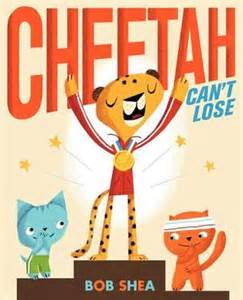
Publisher Summary
"It's race day, and once and for all, it's time to determine the better feline:  little cats or big cheetah.  Cheetah might be bigger, taller, stronger, faster...but the little cats have some tricks up their sleeves, so don't count them out." 

What’s to Love: 
Cheetah is, let's say, an over-achiever.  He has to win and to be the best at everything!  The sly little cats let him win several challenges but have an ulterior motive.  While Cheetah has no clue, the reader can infer what is really going on.  Full of humor and action, this story will be a winner with readers or all ages.   


How to Cheer up Dad by Fred Koehler
Publisher Summary
"Little Jumbo's dad is having a bad day. Little Jumbo has no idea why.  Luckily, he does know just how to cheer up Dad with some of his--ahem, his dad's--favorite things!"

What’s to Love: 
This endearing story about a boy and his loving dad is sweet.  The adorable pictures capture the mischief and energy typical in preschool-aged children.  I laughed in a couple places and smiled all the way through. The pictures and the words convey different ideas, making this one ideal for teaching inference and irony.  

A Better Way to Teach Theme: Why I Built the Jory John Now Prove It Series

If you’ve ever taught theme, you know the moment. Students finish a story, you ask “What’s the theme?” — and suddenly you’re flooded with a...