Showing posts with label multicultural. Show all posts

Thursday, April 2, 2020

Poetry Friday: The Blacker the Berry


Title:  The Blacker the Berry 

Author:  Joyce Carol Thomas 

Illustrator: Floyd Cooper 

Target Ages:  3 and up 

Awards: Coretta Scott King Award for Illustrators, Coretta Scott King Award for Authors (nominated), ALA Notable Children’s Book 

Genre:  Poetry Picture Book 

Publisher Summary: 
Black is dazzling and distinctive, like toasted wheat berry bread; snowberries in the fall; rich, red cranberries; and the bronzed last leaves of summer. In this lyrical and luminous collection, Coretta Scott King honorees Joyce Carol Thomas and Floyd Cooper celebrate these many shades of black beautifully. 

Poem Samples: 
“What Shade Is Human?"
 At breakfast

I pour milk all over my bowl of berries

And Grandpa says,

“It's the milk of kindness

that makes us human.”

“Yes, Papa," I answer,

and he continues:

"White milk

Chocolate milk

Sweet milk

Mother’s milk.”

I nod between bites of berries

because

My mother long ago

When she nursed me my first milk

Said, “You are beautiful,”

And I heard her.


“The Blacker the Berry"
 “The blacker the berry

the sweeter the juice.”

I am midnight and berries

I call the silver stars at dusk

By moonrise they appear

And we turn berries into nectar

Because I am dark the moon and stars

shine brighter

Because berries are dark the juice is sweeter

Day couldn’t dawn without the night

Colors, without black, couldn’t sparkle

quite as bright

“The blacker the berry

the sweeter the juice”

I am midnight and berries 

Evaluation:  
The poems have a couple significant connections.  

First, the berry metaphor is used throughout in creative and poignant ways.   For instance, one speaker is her “great-grandma’s raspberry color,” her “grandma’s blackberry cheeks,” and her “mama’s mulberry mouth.”  Another child refers to himself as “raspberry black” because he is part Native Indian and part African American.  Each use of color—shades of dark—reflects the child’s heritage and instills confidence.

Second, the poems reflect the diversity within the African-American community.  Colors range from deep black like coffee berries to “light as snowberries in fall.”  Many of the children are mixed race.  Each child recognizes his or her uniqueness and beauty.   

Finally,  the poems instill pride in children (and adults) of color.  In “Snowberries,” the child  speaker wants to be “black as midnight” so she isn’t made fun of for her “snowy skin.”  She comes to realized that if she bleeds “the one drop of blood” she is just as “Black” as a dark skinned person.  Another child declares she “feels absolutely fabulous to be this brown.”  In the final poem, it says: “Each color is rich in its own right/We come in all shades.”

Floyd Cooper’s illustrations enrich the diversity, beauty, and pride that exude from each poem.  Each two-page spread shows the sparkle, radiance, and musing of the children as they contemplate their heritage and individuality.  

The Blacker the Berry is a stunning collection of poems and art.  

This post is part of the Poetry Friday link up hosted by My Juicy Little Universe.


Saturday, February 1, 2020

Across the Bay (Carlos Aponte)


Title:  Across the Bay

Author:  Carlos Aponte 

Target Ages:  4-10

Genre:  Realistic Fiction Picture Book

Award: Pura Belpre’ Illustrator Honor

Publisher Summary:  Carlitos lives in a happy home with his mother, his abuela, and Coco the cat.  Life in his hometown is cozy as can be, but the call of the capital city pulls Carlitos across the bay in search of his father.


Memorable Moment:
When Carlitos loses his only picture of his father, a park ranger helps him cope with his loss. 

Evaluation:
Carlitos has a loving home with his mother, abuela, and cat.  Nevertheless, he is spurred to search for what is missing—his father.  

After an unsuccessful quest to locate his father, Carlitos finds contentment in his circumstances.  He learns, “No matter the storm, the sun always returns.”  As he journeys back home, he has a renewed appreciation for the loving people in his life and they home they have created for him.  

Through Carlitos’ quest, author Carlos Aponte aptly conveys the heartache and loss a child feels when a parent is no longer in the home—especially when that parent is completely absent.  The story subtly but powerfully shows the longing and loss through the juxtaposition of Carlitos’ circumstances with those of other young boys who are sharing every day experiences with their father—in the neighborhood, the barbershop, and the city.  

The illustrations show the beauty and diversity of Puerto Rico as Carlitos traverses the ancient city of Old San Juan and his more modern hometown of Catano.  From the colorful foliage to the vast array of people and activities, young readers get a glimpse of island life. 

Across the Bay reminds us of the quiet desperation many children around the world feel for a missing parent. This poignant narrative is both heartbreaking and uplifting, a blast to the heart and a spark of delight. 

Interview with Carlos Aponte 

Sunday, April 21, 2019

Finding Langston (Lesa Cline-Ransome)


Target Ages:  9-13

Genre:  Historical Fiction

Awards:  Coretta Scott King Honor Book, 2019 Scott O'Dell Award for Historical Fiction,  Junior Library Guild selection

Publisher Summary: 
When eleven-year-old Langston’s mother died in 1946, he and his father move from Alabama to Chicago’s Bronzeville.  Langston must leave behind everything he cherishes:  family, friends, Grandma’s Sunday suppers, even the magnolia trees Mama loved so much.  The northern city is noisy and hectic, and their kitchenette apartment is just a lonely room with old newspapers covering up holes.  At school Langston is tormented for being too country.  But his new home has something his old one did not:  unlike the whites-only library back home, the George Cleveland Hall Library welcomes everyone.  There, hiding out after school, Langston discovers another Langston, a poet whose words are powerful.  In one of his poems lies a secret that will bring Langston closer to his mother’s spirit. 

First Lines:
“Never really thought much about Alabama’s red dirt roads, but now, all I can think about is kicking up their dust.  I miss the hot sun on the back of my neck and how now the racket of cicadas, seems like not sound at all.” 

Memorable Moment:
“I get to thinking how much I didn’t know about my Daddy when we lived in Alabama.  With Mama there, he barely spoke to me, and I didn’t know what to say to him.  But now, with just us two in Chicago, I know Daddy better than I ever hoped to” (103).

Evaluation:
Finding Langston would fit well into a middle grade classroom.  The post-World War II setting focuses on black Americans who are a part of the Great Migration.  People at different places in the process from second generation to newly arrived illustrate the successes and struggles. 

The influence of Harlem Renaissance, especially its poetry, is shown as the renewed pride in black culture and literature impacts the protagonist, Langston.  As he discovers the connection of his name to the beloved poet Langston Hughes and his mother’s secret passion, the protagonist begins to understand himself, his mother, and his heritage on a deeper level.

The story and characters connect well with middle grade readers.  Short chapters, well-paced plot, and relatable experiences will keep them turning the pages. 

Langston deals with many common middle grade trials.  He experiences loss—both of his mother (and another dear relative) as well as his home when he moves away.  These situations make him feel lonely and isolated.  As the new kid, he tries to fit in, but instead he is mercilessly bullied.  Langston struggles in his relationship with his father, who is a good man dealing with his own loss and trying to make a better life for his son.

Langston learns to see people in a more multi-faceted way.  He is willing to re-examine his initial impressions, allowing him to come to appreciate others.  In addition, he finds positive ways to cope with his loss and loneliness, which helps him make friends with others and become more connected to his new community.

I highly recommend Finding Langston for middle grade teachers and readers.

Historical Connections:
Great Migration
Harlem Renaissance
Langston Hughes Poetry

For other great middle grade book suggestions, visit Always in the Middle for the Marvelous Middle Grade Monday Round Up.

Tuesday, July 24, 2018

Carlos and Carmen Early Reader Series


I just received set 1 of the Carlos and Carmen early reader series.  I was immediately impressed with the quality of the illustrations and the books’ durable construction.  Then, I read them.  I am officially a fan of this superb series! 

The Carlos and Carmen books are available in Spanish and English.  I read the English version.  However, Spanish words are sprinkled throughout which provides two learning opportunities. First, children are exposed to a second language.  With as many as 50 million people speaking Spanish in the United States, it is valuable for English-speaking children to be exposed early to common Spanish words. In addition, the foreign words allow children to practice using context clues.  They can figure out what the unknown word is by identifying clues in the text and by looking at the illustrations.  There is also a Spanish to English key at the back of each book. 

Each book is divided into five short chapters.  The text is written at a second to third grade reading level.  McDonald does not make the stories feel like a Basal or easy reader though.  She incorporates suspense, humor, and personality into each chapter. 

The series is family oriented.  The parents are active and present. When the twins are running around the backyard, the parents are looking on.  When their yard floods, the parents play in the water and mud with their children. When Carlos and Carmen are concerned about a noise in the night, their dad takes it seriously and investigates. The family sits down together at mealtimes.  Extended family members come over to help out or to spend time with the twins.  The Garcias are a warm and close family.

Author Kirsten McDonald has created multi-faceted young Latino protagonists who have qualities parents want their children to emulate.  They are kind, fun, inquisitive, respectful, and helpful.  They demonstrate a wide range of experiences from fear and boredom to enthusiasm and playfulness. 

Erika Meza’s illustrations are vivid and gorgeous.  The actions are lively, and the facial expressions are wide-ranging.  The best part is how the parents are represented.  They are shown working and parenting side by side.  Their expressions toward each other convey love, playfulness, and admiration.  The illustrations work in perfect harmony with the text.

I highly recommend the Carlos and Carmen series—in Spanish and in English—for public and elementary school libraries.   Parents and teachers should also consider adding these books to their classroom or home collection. 

There are currently 16 books in series.  I read the following four.  I have included the publisher’s summaries.


Carlos and Carmen get some unexpected news. They're moving to a new house. The new house is big, red, and has one tire. What! A house with one tire?! The twins worry and worry but soon discover a house with one tire can be fun.


Carlos and Carmen have a hard time falling asleep in separate rooms. Once they solve that problem, they're kept awake by a spooky noise. The twins get their mom and dad to help them solve the mystery of the noise, which turns out to be something not very scary at all.


It's been raining and raining and raining. When the sun finally peeks out from behind the clouds, Carlos and Carmen find their entire backyard is one big puddle. But the twins don't mind once they discover it's not just a puddle of water--it's a puddle of fun!


The Green Surprise
Tío Alex is joining the Garcia family for a cookout, and he's bringing a surprise. A big green surprise. At first, Carlos and Carmen are disappointed in the lumpy green surprise. But with their mom's help and a few poles and stakes, the lump becomes a green surprise filled with fun. 


Friday, July 20, 2018

5 Fabulous African Fiction Picture Books


Niki Daly, author and illustrator
Malusi is a herd boy in a mountainous region of South Africa. He wakes up early each morning to watch and care for his family’s herd. Visited by his friend, Lungisa, they play and share dreams. Malusi wants to be president, but Lungisa thinks that it is funny to aspire to such a lofty goal. When a baboon threatens the flock, Malusi fights to save the endangered lamb. Later, he is visited by an old man who encourages him: “A boy who looks after his herd will make a very fine leader.” In his humble job, Malusi learns self-discipline, bravery, and compassion—all the qualities of a great leader.


Tololwa M. Mollel, author
Catherine Stock, illustrator
Yoanes helps his grandmother by collecting the eggs laid around the farm—in the cluttered loft, in the barn, and, even, in the corner of the outhouse. One clever chicken though hides her eggs.  It is up to Yoanes to discover her secret place, but he will have to overcome his own fears in doing so! 


Tololwa M. Mollel, author
E. B. Lewis, illustrator
Every week Saruni helps his mother sell their produce at the market, earning him a 10 cent coin. There are so many options to use his money for, but instead he carefully saves it week after week in order to earn enough money to buy a bike to help his family.  This beautiful story about self-discipline, perseverance, and selflessness transcends culture and continent.


Isaac Olaleye, author
Claudia Shepard, illustrator
Ade and Tayo are given instructions to do their chores and stay in the village. The mischievous boys though decide to cross the field and stream in search of fun and sweet berries.  Pulled by curiosity toward the mysterious waters of the river, the boys become cornered by a snake. They cleverly outsmart it and run back to safety of the village...while dreading the trouble they are in for disobeying.


Jeanette Winter, author & illustrator
During the dry season, Elsina dreams of clouds and the rain they will bring.  In the tradition of her people,  her parents allow her to paint the walls of their house in hopes of her ancestors hearing her prayers. Every day she wakes up, waiting for an answer. She waits and waits…until finally, she sees black clouds and hears the roll of thunder.  With the rain comes new crops and healthy livestock that help her family survive. 

Tuesday, July 10, 2018

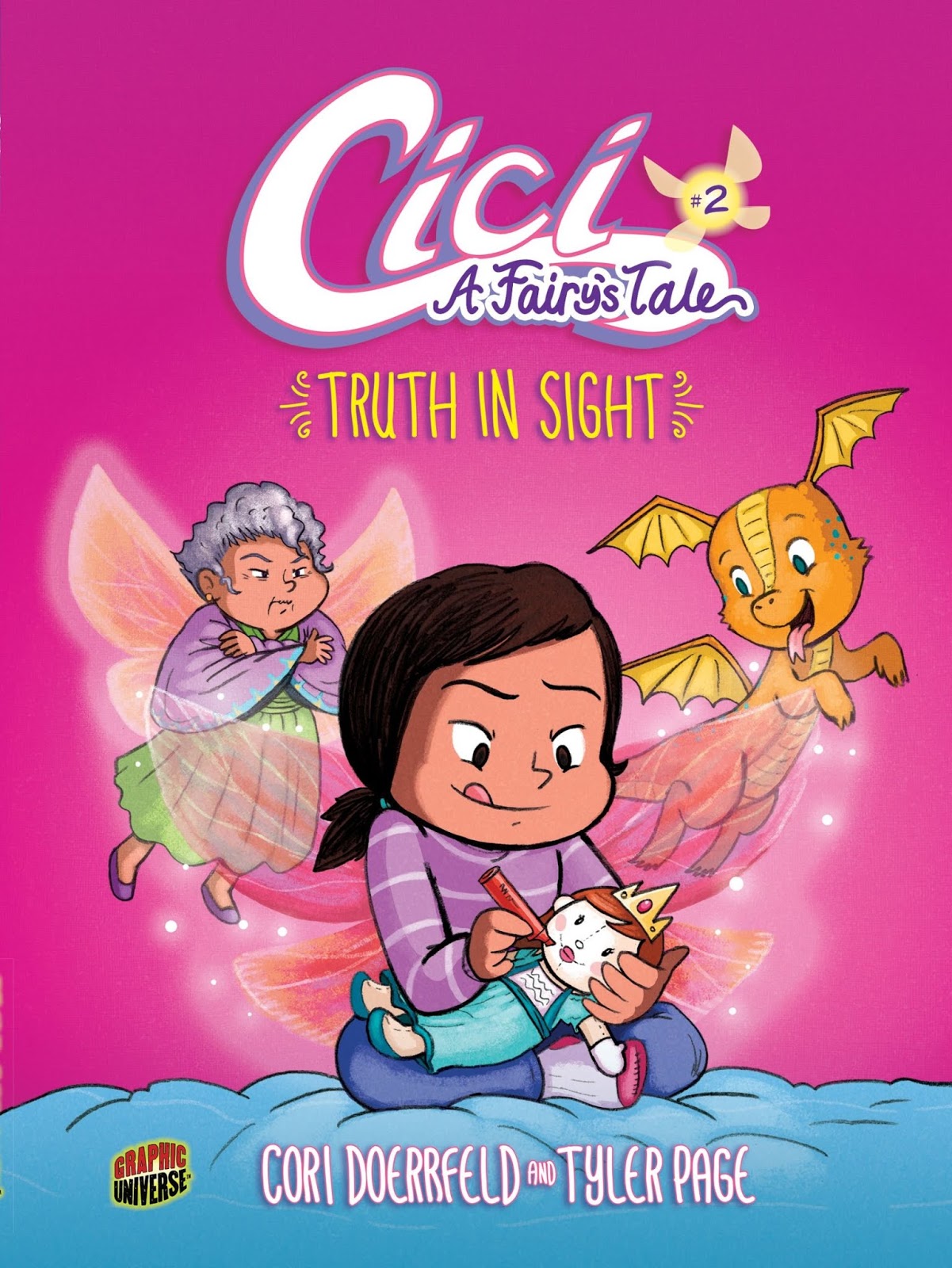
Cici: A Fairy’s Tale Series (Cori Doerrfeld & Tyler Page)

Cici: A Fairy’s Tale is an entertaining graphic novel series for early readers written by Cori Doerrfeld and Tyler Page.  The series is realistic fiction with a dash of magic and imagination. 

The series features a multi-faceted Latino protagonist and family. The young protagonist deals with many typical experiences like friendship struggles, family issues, and fitting in. The plots and characters are relatable for elementary children.  The graphic novel style and vocabulary are accessible, even for reluctant readers.

There are currently three books in the series. 


Cici’s father moves out of their home and her abuela moves in as her tenth birthday approaches.  Her plans are turned upside-down when a popular classmate schedules a party on the same night as her birthday celebration.  If all that wasn’t challenge enough, Cici wakes up on the day of the party with fairy wings and the ability to see people in a new way! Fortunately, her abuela is there to help her figure out this magical change.  With her new abilities, Cici finds that navigating friendships and family is harder than she expected.


Cici is learning to deal with her family’s new living situation—the weekdays with mom and weekends with dad.  Her younger sister is fussy, and her parents are frazzled.  Her classmate Kendra seems to have it all together—pretty, popular, and rich!  Cici acts out toward her “perfect” classmate, thinking it is all a joke. However, her actions have larger consequences than she anticipated.


#3 A Perfect View
Cici invites her new friend, Kendra, to go on her family’s annual camping trip.  Cici has everything planned for the “perfect” trip.  Cici struggles with a bad attitude when plans change—from bad weather and a campsite mix-up.  Her new magic powers have some unexpected results while in the woods as well.

Friday, July 6, 2018

African American Tall Tales

Julius Lester, author
Jerry Pinkney, illustrator
Birds, bears, panthers, and even a unicorn come out of the woods when John Henry is born.  Within moments of his arrival, John jumps out of his mother’s arms and grows taller than the roof!  The next morning he gets up and chops an acre of trees down.  As John ventures out west, he single-handedly crushes gigantic boulders and digs through a mountain!  There are many versions of this tale, but Lester’s stands out for its humorous personification, colorful hyperbole, and engaging storytelling.


Mary E. Lyons, author
Terry Widener, illustrator
Roy Tyle has a way with automobiles.  People say he “can grease an axle faster than you can say 'carburetor,' and he can clean spark plugs just by looking at them hard." Roy believes there is a fatal flaw in the factory cars—they can get into accidents.  So, he takes his talents to the next level—building his own car. After spending an hour in his garage, he comes out with one that is “accident proof.” In test after test, his car avoids cars and trucks by sliding over or under them.  He doesn’t stop there though…he builds a another car that goes so far as to impress God, himself!


Jerdine Nolen, author
Kadir Nelson, illustrator
From the moment Big Jabe shows up as a small boy floating in a basket down the river, he uses his extraordinary abilities to help the slaves on the Plenty Plantation.  When the fish aren’t biting, he commands them to jump from the river and into the wagon.  When works needs to be done, he is able to single-handedly complete it—allowing the others some much-deserved rest.  Even the plants and animals change in remarkable ways when he is present.  When slaves begin to disappear without a trace, some wonder if Jabe is the one rescuing them.


Jerdine Nolen, author
Kadir Nelson, illustrator
On a summer night during a fierce thunderstorm, a lively baby is born.  Rather than cry out while taking her first breath of life, she sits up and takes hold of the lightning and thunder.  Then, she tells her parents she is partial to the name Rose, so they call her Thunder Rose.  Full of spunk, determination, and confidence, Thunder Rose accomplishes everything she sets out to do.  She amazes her parents by drinking her milk while holding up a cow, creating objects with scrap metal, staking a fence without assistance, and building a sky scraper—all before the age of ten! These thrilling feats are just the beginning of her story!


Andrea Davis Pinkney, author
Brian Pinkney, illustrator
Feisty as a kettle of just-caught fish, Peggony-Po is able to climb a look out mast and catch whales on the high seas—all before the age of 4!  There is just one whale that eludes even that most skilled sailor’s grasp—Cetus!  Peggony-Po is determined to catch that whale—known for wrecking havoc for sailors and, even, land folk.  The young boy ventures off in search of Cetus without even bothering to take a boat!  This high seas adventures, full of astonishing acts and vivid similes, celebrates the many brave African American sailors who worked side by side as equals with white sailors on whaling ships in a time of great inequality.

Friday, April 20, 2018

The Doctor with an Eye for Eyes (Julia Finley Mosca)


Illustrator: Daniel Rieley

Target Ages:  5 and up

Genre:  Picture Book Biography

Publisher Summary: 
Meet Dr. Patricia Bath—the scientist who never lost sight of her dreams!  As a girl coming of age during the Civil Rights Movement, Patricia Bath made it her mission to become a doctor.  When obstacles like racism, poverty, and sexism threated this goal, she persevered—brightening the world with a game-changing treatment for blindness. 

First Lines:
If you like to think BIG,
But some say you’re too small,
or they say you’re too young
or too slow or too tall…

Pay no mind to their doubts,
and just follow the path
of one AWESOME inventor,
PATRICIA E. BATH!

Memorable Moment:
So, if helping the world
seems too hard, you are wrong.

If some say you can’t do it,
don’t listen.  Be STRONG.

Like Patricia, stay FOCUSED.
Push FORWARD. Shine BRIGHT.

And you’ll find all your DREAMS
will be well within SIGHT.

Evaluation:
I thoroughly enjoyed this book!  There is so much about Dr. Bath’s life that is inspirational.  She had to overcome difficulties to get an education and dealt with racism and sexism early in her career. The narrative is more focused on what she did to overcome those negative people and social constraints than the actual incidents themselves, which is empowering.    

There are several pages devoted to her childhood that give an nice picture of the influences in her from her parents to her brothers to her first science kit.  Her parents instill some vital lessons that parent and teacher readers will want to highlight, explore, and expand on. 


Another admirable character trait is her never-ending quest to learn and to advance in her field.  Her post-school educational pursuits are what led to eye treatment advancements that have helped millions around the world. 

The story keeps a steady pace, focusing on the highlights of her career.  The information is the right balance of being informative without being overwhelming.  However, the author provides plenty of additional information for teachers and parents to share with students, including Fun Facts and Tidbits from the Author’s Chat with Patricia, Timeline of Dr. Bath’s life, and About Dr. Patricia Bath section.


YouTube has a short, animated video about Dr. Bath in her own words.

Here is a Reading Guide for the book.  

Check out other women in STEM biographies. 

Activities and Extension Ideas for Lesson Plans:
  • Science: Learn about the parts of the eye—pupil, cornea, lens, and so forth—what the parts do, and how to keep eyes healthy.  To spark of love of science, order a science kit for the family or plan some science experiments in class. 
  • Senses:  Read this biography while studying the 5 senses.  Some fun five senses activity ideas are HERE
  • Time Line:  The book includes a timeline of Dr. Bath’s life.  Use this organizer in a history unit or to outline the life of another famous scientist.  Another possible way to apply it is to have student create a timeline for their future.  What do they hope to accomplish and by what age?  This ties in nicely with math as well since they have to calculate the year they will be the target age for each accomplishments. 
  • Geography:  Identify the places on the map that Dr. Bath lived or traveled to for her work, such as California, New York, and Paris.
  • Community Helpers:  Connect this book with a unit on community helpers for younger children.  Older students can learn more about the process of becoming a doctor and their important contribution to the community.
  • Letter Writing:  Write a letter to Dr. Bath.  Tell her about what you enjoyed most about her story or what inspired you from her life story. 
  • Writing—Personal:  Dr. Bath accomplished many “firsts.”  Students can write about what they want to be the first to do or to discover.  Younger students can fill in a simple sentence like:  “I want to be the first to ______.” Older students can write more, depending on age and ability.
  • Writing—Argument:  Pick one of the lessons her parents taught her (“We’re equal—all genders, all shades.”  “Nothing’s off limits—no job, dream, or role.”  “Education is the key to success.”).  Use it as a prompt for students to write an argument, such as arguing why the quote is true or how it was the lesson that impacted her life most (based on the evidence in the story). 
  • Poetry:  The story is written in poetic form.  Possible connections can be anywhere from identifying rhyming words to students writing their own poetic lines.  Poems can be about Dr. Bath or about their own goals for the future.  Assign a specific poetic form or allow them to write in free verse.
Historical Connections:
Civil Rights Movement


For more great picture book recommendations, visit the Perfect Picture Book Friday Round Up.


A Better Way to Teach Theme: Why I Built the Jory John Now Prove It Series

If you’ve ever taught theme, you know the moment. Students finish a story, you ask “What’s the theme?” — and suddenly you’re flooded with a...