Showing posts with label Asian culture. Show all posts

Monday, April 2, 2018

No Kimchi for Me! (Aram Kim)


Title:   No Kimchi for Me!

Author:  Aram Kim

Illustrator:   Aram Kim

Target Ages:  3-8

Genre:  Realistic Fiction

Publisher Summary: 
Yoomi hates stinky, spicy kimchi.  So her brothers call her a baby and refuse to play with her.  But Yoomi is NOT a baby!  Maybe if she tires it on a chocolate chip cookie…

This coming-of-age story celebrates family, food, and Korean culture.

First Lines:
It’s time for lunch!

Yoomi loves Grandma’s dried seaweed, tiny anchovies, soft egg omelets…even her seasoned bean sprouts!

But Yoomi does not like stinky spicy kimchi!


Evaluation:
No Kimchi for Me introduces children to diverse cuisine.  The foods described (seaweed, anchovies, bean sprouts, and, in particular, kimchi) are an opportunity for many to learn about another culture as well as a chance for Korean children to see their familiar foods celebrated.   

Yoomi’s aversion to a food her family enjoys is one that kids in any culture can identify with.  I was not a persnickety eater, but there were a couple family staples I abhorred as a child (creamed corn and baked beans being the two most memorable).  While the kimchi is a cultural specific food, the illustrations (anthropomorphic cats) and theme (fussy eating) are universal.  Discussing this issue is one way to illustrate to children we are more alike than different. 

Yoomi is teased by her brothers.  They call her a “baby” and leave her out of their activities.  The teasing, while not desirable, is realistic.  In most families, there is playful and some times competitive banter between siblings. While teasing is generally not a desirable response, it does prompt Yoomi to get over her picky preferences. Parents and teachers can discuss alternative ways the brothers could have responded. 


Ultimately, Yoomi is perseverant.  Even though her initial impression of kimchi is negative, she does not refuse to try it again.  Instead, she attempts to enjoy it on some of her favorite foods.  (I learned to like creamed corn after mixing it with mashed potatoes.)  None of her combinations are tasty though. 

Her clever and patient grandmother saves the day by making a special kimchi pancake recipe.  Yoomi is celebrated as a “big girl” as her family gathers around the table, sharing the big kimchi pancake!  The feeling of community and personal accomplishment is conveyed. 


Once she conquers this food feat, she joins in games with her older brothers.   Yoomi now feels both more grown up as well as part of her cultural heritage. 

I recommend No Kimchi for Me for your class or home library. 

Activities and Extension Ideas for Lesson Plans:
Activity Kit

For more Perfect Picture Books, visit Susanna Hill's Blog.  


Sunday, February 4, 2018

Seesaw Girl (Linda Sue Park)


Title:  Seasaw Girl

Author:  Linda Sue Park

Illustrator:  Jean and Mou-sein Tseng

Target Ages:   8-12

Genre:  Realistic Historical Fiction

Publisher Summary:
Jade Blossom never ventures beyond the walls of her family’s Inner Court.  In seventeenth-century Korea, a girl of good family does not leave home.  Until she marries, she is expected to spend her time learning to sew, to embroider, to do laundry, to manage a kitchen—so that when she makes her wedding journey to her husband’s Inner Court, she will be a good wife.

Jade accepts her destiny, and yet she is endlessly curious.  She eagerly questions her older brother about the adventures that only boys can have: trips to the market and to the ancestral grave sites in the mountains, reading and painting, conversations with their father about business and politics.  Sometimes the things Tiger Heart describes are more vivid in her mind than her everyday surroundings.  If only she could see them for herself.

Jade Blossom’s daring attempt to enlarge her world succeeds in surprising ways, revealing the truth of her father’s words:  “The path of wisdom lies not in certainty, but in trying to understand.”

Memorable Lines: 
“I have learned to make it enough” (51).

“Right behavior, good form, wisdom, faith, and love.  They are small words, but they hold all that is good about men” (61).

Evaluation: 
Seesaw Girl is a middle grade novella.  Short chapters and occasional black and white pictures make it ideal for youngsters getting comfortable reading longer books. 

Jade, the protagonist, lives in a world foreign to most children in the West, so the story is an opportunity to expand young readers’ understanding of other cultures and eras.  There are many possibilities to discuss how her life, culture, and future are different than the typical middle grader. 

During a conversation Jade has with her father, he says (in relation to the Dutch sailors who are shipwrecked there), “And though we have many differences, there are things about their laws that are in harmony with ours.”  This quote is a perfect springboard for discussing similarities, though maybe not as obvious, and building connections between cultures.     

Young readers will connect with Jade because she is passionate, curious, and even a bit mischievous.  She has to do chores and to follow her family’s rules.  Similar to many her age, she must deal with a close friend moving away as well as the uncertainty of change and growing up. 

Jade matures as the novella progresses.  For instance, her actions inadvertently cause a servant to lose his job.  Jade goes before her father to take responsibility for her actions and respectfully appeals on the servant’s behalf.  From her mother, she learns the importance of being content in her circumstances and taking pride in her role.  These timeless lessons resonate with readers of all ages. 

Historical Connections:
Korea’s policy of isolation
The Sperwer (Sparrow) shipwreck
Choson period in Korea

Visit Always in the Middle for more Marvelous Middle Grade recommendations.  


Wednesday, January 31, 2018

Author Spotlight: Grace Lin


Grace Lin is the author of more than 20 children’s books, ranging from picture to middle grade fiction.  She covers a wide array of subjects from animal stories to Chinese-American realistic fiction to myths and fairy tales.


The first book I read was the middle grade fantasy fairy tale Where the Mountain Meets the Moon.  I could not put this book down!  It is a beautiful mingling of myth and fiction, sacrifice and friendship.  The two follow ups, Starry River of the Sky and When the Sean Turned to Silver, are on my reading list!


She has also written the Pacy Lin series of contemporary realistic fiction for middle graders, featuring a Chinese-American family.


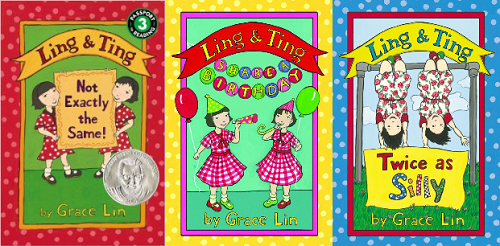
Next, I spent time with her delightful series—Ling and Ting. The text and illustrations exude positive motifs like cooperation, creativity, and kindness. You will want to add this adorable duo to your Early Reader library. 

Some of her picture books feature animal characters learning valuable lessons.


In Olvina Flies, a chicken learns to overcome her fear of flying. 


In the follow up, Olvina Swims, the protagonist deals with her fear of the water and swimming the ocean. 


Finally, Okie-Dokie, Artichokie stars a Marklee the monkey.  He initially misjudges a neighbor, but he realizes his mistake before it is too late. 


My favorite of her picture books is The Red Thread: An Adoption Tale.  A king and queen have a beautiful and peaceful land, but they have a relentless pain in their chests.  A peddler’s magical spectacles reveal the red thread pulling at their hearts, leading them to the baby they are destined to adopt.  This adoption fairy tale illustrates the parental love that begins long before a child comes to live with his adoptive parents and the important bond that connects them.

Grace Lin has written several picture books celebrating Chinese-American culture.  Her stunning illustrations use rich colors, expressive faces, and energetic children.  The text is minimal, but Lin always includes additional information for teachers and parents to read or to expand on in lesson plans.


Bringing in the New Year.  This lovely picture book illustrates the New Year traditions of many Chinese and Chinese-Americans, such as getting a fresh hair cut, making dumplings, carrying lanterns, and welcoming the dragon.  Simple text and energetic pictures provide an ideal introduction to the holiday. 


Kite Flying. Flying kites is a beloved past time in many Asian countries, including China, Japan, Thailand, and India.  In this picture book, a family works cooperatively to make a kite. Then, they take it to a nearby park to fly. 


Dim Sum for Everyone.  A family visits a dim sum restaurant in Chinatown.  Dumplings, cakes, buns, and tarts are presented to them on rolling carts.  They each have to pick what to eat from the many delicious traditional dishes. (Sharing is encouraged.)


Thanking the Moon: Celebrating the Mid-Autumn Moon Festival.  With lanterns and the full moon glowing, they eat sweet mooncakes and drink warm tea.  Join Mei-Mei and her family for this festival celebrating gratitude, prosperity, and community. 


Fortune Cookie Fortunes.  While visiting a Chinese restaurant, each family member receives a fortune cookie. The sisters disagree whether the fortunes will come true or not.  One sister learns to see the world (and the fortunes) in a different way.  This fun tale ends with fascinating background information on the origin of the fortune cookie.  

Sunday, January 7, 2018

Where the Mountain Meets the Moon (Grace Lin)


Author: Grace Lin

Target Ages:  8-12

Genre:  Fantasy, Folklore

Awards:  Newbery Honor

Publisher Summary:  In the valley of Fruitless Mountain, a young girl named Minli spends her days working hard in the fields and her nights listening to her father spin fantastic tales of the Jade Dragon and the Old Man on the Moon. Minli’s mother tired of their poor life, chides him for filling her head with nonsense.  But Minli believes these enchanting stores and embarks on an extraordinary journey to find the Old Man of the Moon and ask him how her family can change their fortune.  She encounters an assorted cast of characters and magical creatures along the way, including a dragon who accompanies her on her quest for the ultimate answer.

First Lines: Far away from here, following the Jade River, there was once a black mountain that cut into the sky like a jagged piece of rough metal.  The villagers called it Fruitless Mountain because nothing grew on it and the birds and animals did not rest there.

Notable Quote:  I should have known we could not fight the Green Tiger with more anger.  We just add to his power that way.  His anger is his strength, but it can also be his weakness.  His anger can blind him, and that is when he is vulnerable.  

Evaluation: 
The hardest part of this review is not sharing all my favorite parts!  To do so would ruin the story for potential readers!  Here is just a bit...

Where the Mountain Meets the Moon has short chapters and clearly marked sections. Each chapter begins with a small muted picture. Also, vibrant full-page traditional Chinese illustrations are interspersed. Both add to the charm and atmosphere.  

The narrative has many intertwined layers. First, it is a young heroine’s physical quest and personal journey.  On this quest the girl, Minli, meets a wide array of benevolent characters—a dragon, an orphan, a king, and twins—as well as malevolent ones—monkeys and a green tiger.  Through both charitable and wicked events, she learns the meaning of friendship and the secret of happiness (one of my favorite parts!).

A second layer is the power of stories. Nearly every character has a story to add to the fabric of the narrative. The stories inspire, guide, explain, and heal.  Like the red thread of fate, they are all interrelated to produce a thrilling adventure and to illustrate the power of the theme.   

While Minli’s quest is the main event, occasionally there is a switch to her parents.  An unexpected layer is the character development of her mother, which is not only satisfying but expertly woven into the overall theme.

Minli is a strong heroine. Her courage, sacrifice, and love for others are sure to inspire middle grade readers. I highly recommend Where the Mountain Meets the Moon for it's beautiful interwoven narrative, memorable characterization, and inspiring theme. 

Activities and Extension Ideas:
  • Geography: Identify China on a map.  Read a book about the country to learn some foundational information about the terrain and people.
  • Comparison: Discuss story parallels.  For instance, the beginning reminded me of "Jack and the Beanstalk" when she “foolishly” bought a goldfish with the only money in the home.  Then, she went on an otherworldly adventure to improve the fortune of her family.  Others have compared the story to The Wizard of Oz.  For older children, parallel Minli’s adventure to the quest motif in literature.
  • Figurative Language: There are examples of personification and imagery.  The most common type of figurative language is similes. Nearly every chapter has multiple comparisons. Have a simile scavenger hunt!  See how many the students can find in the chapter. Then, practice writing similes.  Using the surrounding details in the story, rewrite some of them using fresh and unique images.  
  • Symbolism:  To introduce the idea of symbolism, discuss the significance of some of the key images like animals—goldfish, dragons, tigers, monkeys, lions, and rabbits—and other literary archetypes like the red thread and moon, from Chinese culture and literature.
  • Story Map:  Map out how the various stories within the narrative connect to the main story line.
  • Literature: Check out a book of Chinese folklore at the library.  Read some additional stories. 
  • Writing:  As a group, with a partner, or individually, write an origin story.  Challenge students to incorporate similes and to be creative.
  • Art:  Plan one or more Chinese inspired art projects. Try Activity Village or Pinterest.
Internet Unit Plans:
For other Marvelous Middle Grade Monday recommendations, check out Always in the Middle.

Sunday, June 5, 2016

Listen, Slowly (Thanhha Lai)


Author: Thanhha Lai

Target Age: 8 and up

Awards: New York Times Book Review Notable Book and a Publishers Weekly Best Book of the Year

Publisher Summary:  A California girl born and raised, Mai can’t wait to spend her vacation at the beach. Instead, she has to travel to Vietnam with her grandmother, who is going back to find out what really happened to her husband during the Vietnam War. Mai’s parents think this trip will be a great opportunity for their out-of-touch daughter to learn more about her culture. But to Mai, those are their roots, not her own. Vietnam is hot, smelly, and the last place she wants to be. Besides barely speaking the language, she doesn’t know the geography, the local customs, or even her distant relatives. To survive her trip, Mai must find a balance between her two completely different worlds.”

Evaluation: Listen, Slowly is a profound story celebrating family, cultural diversity, and friendship. I listened to it via audio book on Hoopla, a free service through my public library.

Listening to multi-cultural audio books adds an extra layer to the storytelling.  For instance, most of the story takes place in Viet Nam. There are many words and sentences in Vietnamese. If I were reading the text, I would have glossed over them. Hearing the language being spoken though made it much more immersive. The storyteller does an excellent job changing her voice for the various characters, adding to an already engaging story.

Lai has created a memorable cast of characters.  Unlike many middle grade stories, adults—both family and friends—have a vital role. The Viet Nam setting provides an excellent contrast to the Western world.  I enjoyed learning about life there. 

There are several motifs to consider and to discuss.
  • Family:  The heart of the novel is family—immediate, extended, and cultural.  They are so much part of Mai’s life that at times she is longing for her own personal space. 
  • Teen Crushes:  Mai has a huge crush on “him,” a boy she has barely spoken to.  At first, she is so consumed with spending the summer at the beach—hopefully, getting to know “him”—that she has a negative attitude about going to Viet Nam for 6 weeks.
  • Love:  Ba, Mai’s grandmother, is the reason for the trip.  Her husband went missing in action during the war.  She goes back to her homeland in search of answers. Ba shares stories of their courtship and love.
  • War: Growing up, Mai always heard the stories of her parents fleeing during the war, but they did not have any real meaning to her life. Spending time in Viet Nam with Ba and the people in her home village allows her to begin to understand the significance and impact of the war on her family. Some details about the war are relayed, but it is all age-appropriate.
  • Life/Death:  Ba comes to terms with her husband’s death and learns to let go.  She teaches Mai to cherish life and all the moments people tend to take for granted.
  • Identity:  Mai has always identified with her American culture.  During her stay, she gains a connection with her Vietnamese heritage, even learning the language and appreciating the customs. 
  • Friendship:  There is a sharp contrast between her best friend, Montana, in America and the friendships she begins to develop in Viet Nam. 
  • Cross-Cultural: Riding mopeds through Saigon, washing each others hair monthly to protect from lice, gathering as a community of women to learn how to stitch, taking long naps in the afternoon, learning a new language, and eating big feasts with the entire village are just a few events Mai experiences.  
Through all of these areas, Mai goes through transformations of varying degrees.  Ultimately, she learns to appreciate her bi-cultural heritage and her family. 

Activities and Extension Ideas for Lesson Plans:
  • Compare and contrast suburban America with modern-day Viet Nam.
  • Have a Vietnamese feast.
  • Create a PowerPoint of pictures from modern-day Viet Nam.
  • Bring in a speaker who lived in Viet Nam to share his/her experiences.
  • Research the Viet Nam War.
  • Practice some greetings or basic words in Vietnamese.
  • Visit LibrisNotes for an excellent discussion of the novel.
Visit Ramblings of a Wanna Be Scribe for more Marvelous Middle Grade Monday novels. 


A Better Way to Teach Theme: Why I Built the Jory John Now Prove It Series

If you’ve ever taught theme, you know the moment. Students finish a story, you ask “What’s the theme?” — and suddenly you’re flooded with a...