Showing posts with label birds. Show all posts

Monday, May 16, 2016

Daylight Starlight Wild Life (by Wendell Minor)


Author:  Wendell Minor

Illustrator:  Wendell Minor

Target Ages: 3-7

First Lines:  “The sun shines on Earth, bringing the light and warmth of day.  Do you know these daylight visitors?  Then Earth spins away from the sun, bringing darkness and cool of night.  Do you know these starlight visitors?”

Publisher Summary:  “In amazing lifelike, luminous paintings, Wendell Minor, one of America’s finest wildlife and landscape painters, reveals the variety of wildlife that surrounds us when we are sleeping and when we are awake.  He invites readers to experience the movements, sounds, colors, and texture of diurnal and nocturnal creatures.”

Evaluation and Learning Activities:
The first 2-page spread previews all the animals that will be covered in this day/night comparison.  Children get a visual of the two types of animals—diurnal and nocturnal—grouped together.  Parents and educators can begin by teaching or reviewing the animals.  Then, see how many the children can identify as you read together.

The scope of the pictures varies. Two-page spreads with a single animal like the red tailed hawk and wide-eyed owl give readers a feeling of the wide expanse as well as the majesty of the creatures and nature.  Then, there are also landscape split screens with different animals, such as woodchucks in the day (top) and skunks at night (bottom), which prompt a sense of movement and connectedness.  Many of the others give a side-by-side comparison of similar animals, such as white-tailed deer—red fox, chipmunk—deer mouse, and tiger swallowtail butterfly—Luna moth.  The illustrations in all their forms are fantastic!  Worth the trip to the bookstore or library to see!


The text is straightforward, just one descriptive line per animal.  Adult readers can point out the key ideas in the words and pictures.  For instance, the cottontail rabbit and opossum are on facing pages.  Both have a trio of young.  Discuss the difference in how the two species travel and interact with their environments.  The opossum “plods” through the field and forages with her babies on her back.  However, the rabbit is more cautious as her babies follow her lead.  Similarly, the grey squirrel and flying squirrel are contrasted.  Discuss similarities and difference in how they look and act.

For older children, introduce animal classification—mammals, reptiles, birds, amphibians, and insects.  The author includes some additional “Fun Facts” on each animal.  Copy the pages.  Cut the pictures out. May also want to paste on to small notecards or halved index cards for durability. Work together to classify between nocturnal and diurnal categories or based on the aforementioned animal classifications.

After reading, parents can accompany children on a walk during the day and at dusk/night in a place where animals are likely to be spotted. See how many of the creatures from the book you can find together as well as others not mentioned.  Classroom teachers are not likely to be able to take kids on an evening walk, but they can encourage children to do one with their families. Students can share their experiences during circle or other group time.  Make a chart with the name and/or picture of each animal.  As a child shares an experience seeing one, add a check mark.  Af the close of the unit, complete math problems with the data.  

Daylight Starlight Wild Life is an outstanding introduction to animal habits and classification.  Readers of all age will love the amazing illustrations and enjoy the insightful journey the book takes you on. 

Other Book Connections:


I also recommend Divya Srinivasan’s Little Owl’s Day. A noisy squirrel wakes up Little Owl.  Fascinated by the sun and the creatures moving around during the day, he explores the woods in a new light.  Traveling around he meets butterflies flittering, dragonflies skimming, wolf pups playing, and many other daytime animals.  As the day comes to a close, he observes the diurnal animals settling down and the nocturnal ones waking up.  The adorable cartoon animals and dynamic illustrations are ideal for the 2-5 age group. 


Tuesday, March 29, 2016

X Why Z Animals (by Mark Shulman & James Buckley Jr.)


Summary of X WhyZ Animals (by Mark Shulman & James Buckley Jr.)
X Why Z Animals is written for inquiring young minds.  This non-fiction book is broken into 8 sections, each a different class of animals—mammals, reptiles, amphibians, insects, arachnids, sea animals, birds, and dinosaurs.  The sections begin with a brief description of each class, including a description of characteristics unique to them.  Then, there are questions that kids commonly ask like:

Why do chameleons change color?
Why do snakes stick out their tongues?
Why do baby deer have spots?
Why do roosters crow in the morning?
Why do dolphins make clicking sounds?
Why do fish swim in schools?

The questions have a short explanation in child-friendly language.  There are also “X Why Z Facts” interspersed throughout, which are fun tidbits about animals.  Colorful photographs compliment each page of this “Time for Kids” book. 

Evaluation
The book is oversized with big print and vivid photographs.  The information is laid out well and the questions are engaging.  It is ideal for sitting with young children and reading out loud.

X Why Z Animals could be used in a classroom to accompany units on different classes of animals.  The only downside is that each animal class is not dealt with equally.  For instance, there are 20 pages devoted to mammals, but only 2 for amphibians. Granted it, children may be more interested in mammals because of their interaction with them at home, on farms, and in the woods.  However, I feel the coverage could be a bit more equal. 


Overall, I enjoyed this book.  I recommend it for kids ages 3-8.  They will enjoy the pictures and dialogue about some of their favorite animals. 

The X Why Z series includes books on space, the human body, and general questions.

Saturday, March 31, 2012

Picture Books: Birds and Independence

Spring is definitely here.  It really has been here since January!  We’ve barely had a cold day.  I am not complaining though!   With spring come books on animals and seasonal changes.  I have a couple books on birds today.  They are not directly about spring, but they could certainly fit since the activity of birth and leaving the nest often takes place during the season.

Blue the Bird on Flying (by Becky Due)   
Blue hatches from an egg and grows up.   He does not want to fly on his own though.  Instead, he rides on the backs of other birds.  Needless to say, his friendship circle dwindles because others get tired of carrying him around.  They move on to fly with other birds that are experiencing life to its fullest.  Blue decides to make friends with a bird flying by.  After jumping unannounced on the young bird’s back, they quickly begin to fall.  Before they can crash, Blue spreads his wings to carry the young bird to safety.   Blue realizes not only can he fly, but it is fun and exciting.   He travels to places he never dreamed existed. 

Blue the Bird on Flying is a metaphor to teach children the importance of growing up and becoming independent.  Sometimes the possibility of going off to kindergarten or spending the night at a friend’s house is scary.  If they never venture out, they will miss out on all the possibilities.   I also saw this book as a political and social parable.  When adults stop expecting others/the government to carry them around, they will gain independence, self-respect, and fulfilled dreams that are not possible with dependence.  This book has the possibility to translate to a wide array of ages and situations. 

If I Never Forever Endeavor (by Holly Meade)  
Following a similar situation as the aforementioned book, this selection is written in poetic form.  It begins with a young bird in his comfortable nest contemplating:

If in all of forever,
I never endeavor
to fly, I won’t know if I can. 
I won’t know if I can’t.

He looks down at the frightening distance to the ground.  Then, he imagines two possibilities:  failure or freedom.   Next, he pictures himself seeing the world or getting lost.  Safely in his nest, he decides to “forget the endeavor.”  But then, he sees other birds soaring and swooping through the sky.  Realizing how much he will miss out on, he leaves the nest.  He has some minor setbacks as he spreads his wings, but he soon learns to dip, glide, and fly gracefully through the sky.   The young bird finds another advantage to his new found freedom.  

The illustrations use the neutral and green colors of the forest to contrast nicely with the colorful birds.  The collage and watercolors work together well to create a nice texture and dimension.  I enjoyed the poetic text.  The theme is like Blue the Bird on Flying.   To get most out of life, you need to embrace all that you have been created to do and be.  Part of that journey is taking risks and learning independence. 


Disclaimer: As per FTC guidelines, I received a copy of Blue the Bird on Flying from the publishers in exchange for my honest review. I received no monetary compensation. All opinions expressed here are mine and mine alone. 

Wednesday, February 29, 2012

Picture Book (Science): Animalogy, Animal Analogies (by Marianne Berkes)

Animalogy is not your traditional book about animals.  Instead, author Marianne Berkes compares and contrasts various creatures from insects to mammals using analogies.   Behaviors, sounds, body parts, and classifications are just some of the comparisons made between creatures that on the surface appear to have no connection.  Here is a sample:  

Robin is to wing, as goldfish is to fin.
Beaver is to build, as spider is to spin.

Youngsters have the opportunity to discover the connections within the analogies and to practice creating their own using similar patterns.  In addition, each pair (as exemplified above) of analogies ends in rhyme.  Children can identify the rhyming words and brainstorm other related ones. 

CathyMorrison, illustrator, depicts her subjects in minute detail—whether it is the fins on a goldfish or the hairs on a spider’s legs.  Every living thing is beautifully portrayed in its natural habitat.  Readers catch a glimpse of the African savannah, rocky mountain terrain, dense forests, and much more!   Each page and comparison is a starting point for lively discussion and interaction between adult readers and child listeners. 

I recommend Animalogy for ages 4-9.  It is a excellent resource for teachers and parents.  For additional resources to extend student learning, visit the Sylvan Dell website for a FREE full-color 48-page color teaching guide full of exciting and educational ideas.


This post is linked up with Enchanted Thursday blog hop at Enchanted Homeschooling.  


Saturday, February 25, 2012

Picture Book: Nothing like a Puffin (by Sue Soltis)

Summary of Nothing like a Puffin (by Sue Soltis):  
“Look, a puffin!  What a marvelous creature, one of a kind and amazing.  Indeed, there is nothing like a puffin.”  Not a ladder.  Not a house.  Not a newspaper.  Wait.  A newspaper does have something in common with a puffin—they are both black and white.  The narrator realizes that a lot of things have something in common with a puffin—a pair of jeans, a goldfish, a shovel, a snake, and a helicopter.  When they meet a penguin, the striking similarities can’t be overlooked. They appear to be almost identical, but there is one major difference though.  It is clear--"There is nothing like a puffin!"  

Evaluation:  
Author Sue Soltis leads readers on an amusing ride of compare and contrast, prompting children to look at things in their world in a refreshing manner.  Even though she takes seemingly random objects, a clear link is made between them.  Children will be challenged to look at how other objects are similar.  On another level, identical twins can be encouraged to look for and to cherish their unique qualities.  All children have the opportunity to ponder how they are special.   Bob Kolar, the illustrator, has created artwork that is bright, witty, and lively.   Youngsters will want to revise this stunning book over and over.  I recommend Nothing like a Puffin for ages 4-9.    

Teaching Opportunities:  
  • Science:  Learn about puffins, penguins, and other arctic animals
  • Comparison Chart:  Make a chart showing how puffins and penguins are similar; then, create another chart on two animals or things to show their similarities or differences
  • Predicting Skills:  Before reading, list all the objects that are connected in the book; ask, “Do you see how each one might be like a puffin?”
  • Critical Thinking:  Write the names of objects on note cards; allow children in small groups or independently to connect them and explain why (you will need to think through this ahead of time to make sure there is one or more connections)
  • Writing:  Using the objects provided or creating their own object links, write a story that parallels Nothing like a Puffin
  • Similes:  Teach or reinforce the concept of similes (because they are also focused on similarities); children can practice identifying them or creating their own
  • Other Resources on the Internet
This post is linked with the Sunday Showcase at Mom to 2 Posh Lil Divas.  Check out  this LINK with dozens of great ideas you can do at home with your kids.  


Wednesday, February 22, 2012

Picture Book (Science): Prairie Storms (by Darcy Pattison)


Summary of Prairie Storms (by Darcy Pattison):  
The prairie grasslands are explored in this ecosystem adventure.   Month by month the various seasonal storms and other weather conditions are depicted and accompanied by expressive lines.  Here is an excerpt: 

"Rain and rain and rain and--it's a flashflood!  Walls of water crash through the prairie dog town.  Deep in the muddy burrows, prairie dog families hunker, safe in pockets of air--until the waters go down."

Readers get a glimpse of the lives of a number of prairie animals, such as prairie chickens, ground hogs, prairie dogs, red foxes, cougars, bald eagles, bison, burrowing owls, and lesser earless lizards.  This celebration of the American grassland habitat is sure to leave an impression. 

Evaluation:

As with all of Sylvan Dell’s amazing titles, Prairie Storms incorporates a mixture of science and language enrichment opportunities.  The striking illustrations (by Kathleen Rietz) are spring boards for discussing the attributes of both the seasons and the diverse weather portrayals.  Each two-page spread is labeled with the month for opportunities to discuss the spelling, which season it belongs to, and typical weather during that time.  There is a nice mix of more commonly known animals with lesser known ones, allowing vocabulary and visual recognition skills to be expanded.  The lyrical lines are well-written and appealing.  I recommend this book for ages 4-8.  


Teaching Opportunities:
Sylvan Dell has developed a FREE 52-page across the curriculum teaching guide to help you with some of teaching ideas above and many more in areas like geography, science, language-arts, and math.  The book page also includes various quizzes and other resources. 

Sunday, March 20, 2011

Picture Books: The Rainforest

Children’s imaginations are sure to soar as they discover and explore the rainforest. We’re Roaming in the Rainforest: An Amazon Adventure and The Rainforest Grew All Around are two remarkable picture books to use in your study of this extraordinary habitat.  


As the sun rises, three children trek through the colorful and lively rainforest, discovering amazing creatures of all kinds.  Written in playful poetic verse, rainforest animal habitats and behaviors are revealed.  For example:

“Fly,” squawk the parrots,
from branches and twigs.
“We’ll swoop down to breakfast
on ripe, juicy figs.” 

The illustrations (by Anne Wilson) are vivid and energetic.  Butterflies are fluttering in search of nectar.   Leaf-cutter ants are on parade.  Monkeys swing in the branches.  Other pictures depict a quieter side of the rainforest.  Sloths are yawning and dozing on trees.  A jaguar stalks its prey.  Otters cuddle together as they fall asleep.  As the day comes to a close, the children leave the lulling sounds of the night.  We’re Roaming in the Rainforest offers a sweeping look at a day in this mysterious and irreplaceable habitat.  Children will become familiar with many of the creatures that dwell there which include birds, insects, mammals, reptiles, and amphibians.  The concluding pages include a wealth of information about the Amazon Rainforest, the native people, conservation, and creatures. 


The Rainforest Grew All Around (ages 4-9) by Susan K. Mitchell 
Using a clever adaption of the song “The Green Grass Grows All Around,” children learn about the rainforest from the floor to the canopy.  It begins with a seed of a Kapok tree which grows to become an essential habitat for many creatures—jaguar, emerald tree snake, leaf-cutter ants, sloth, poison dart frogs, toucans, bats, and many insects.  The poetic song is cumulative with a repeating stanza for choral reading: 

And by the snake
there crawled an ant…
the busiest ant
that you ever did see.

the ant by the snake,
and the snake by the vine,
and the vine near the cat,
and the cat in the tree,
and the tree from the seed,
and the seed in the ground,

and the rainforest grew
all around, all around;
the rainforest grew all around.

The wondrous world of the rainforest is depicted in the brilliant illustrations (by Connie McLennan).  Each page spread also has a side bar with fascinating facts about the plants, animals, and insects highlighted in the book.  The end pages provide activities, including a cookie recipe with many ingredients that come from the rainforest.  As always, Sylvan Dell provides an extensive across-the-curriculum teaching guide and other resources at their website to accompany your study and assist you in your lesson planning. 


Friday, February 11, 2011

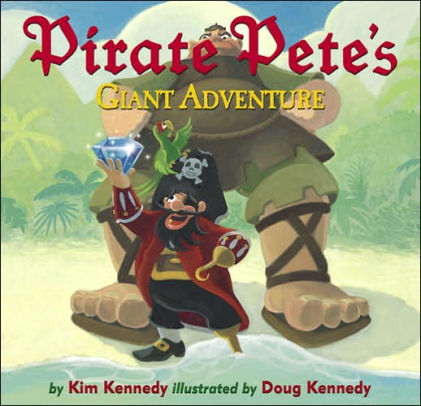
Picture Books: Pirate Pete by Kim Kennedy

Kim Kennedy, along with her artistic brother Doug, has created an amusing series of books based on a character named Pirate Pete.   The playful cartoonish illustrations and lively protagonist make this series worth checking out for ages 5-10.  There are currently 3 books in the series.


Pirate Pete loves gold.   He has plundered every ship and shore in the Seven Seas.  Discovering that the Queen has a treasure map, he comes up with a plan to steal it while his trusty parrot sings her to sleep.   Together, they make off with the map and begin their voyage to Mermaid Island in search of the treasure.  Pirate Pete is too easily lured in to other islands along the way.   He is convinced they have gold hidden on them.  For instance, he stops at Sleepy Island, reasoning that where there is sleep, there is the sandman.  Where there is the sandman, there is magic gold dust!  At Clover Island, he hopes to find the leprechaun’s pot of gold.  Each time he is disappointed to find no gold…until he reaches Dragon Island.  He plunders a gigantic golden egg!   Shortly after shoving off, the egg hatches into a fire-breathing dragon that ends up burning down his ship!  He eventually makes it to Mermaid Island, but things do not happen the way he planned.   He ends up marooned on the island with a row boat and his matey, the parrot. 


Pirate Pete’s Giant Adventure picks up where Pirate Pete left off.   The protagonist is sailing the sea in a small row boat.  His only companion is his plucky parrot.    A sea-fairy appears before him to request that he retrieve the Sea-Fairy Sapphire that was stolen.   He has two clues to help him on his quest—follow the sound of thunder and beware for thunder that does not come from clouds.   If he retrieves the special stone, he will receive a wondrous ship.  Throughout his journey, he sings a little song:

When I finds the Sea-Fairy Sapphire,
I’ll get me a ship of wonder.
All I gots to do
Is follow the sound of thunder.

Following the sound of thunder, Pirate Pete easily finds the stone.  Instead of immediately returning it to the sea though, he makes wishes for a map to the world’s greatest treasure and for the world’s mightiest sword.   Wisely, the parrot keeps insisting he return the Sapphire.   During the commotion, the “boom, boom, boom” creeps up on the duo.   It is a giant brute!   Using one of the oldest tricks (a la Briar Rabbit), Pirate Pete convinces the giant that the one thing most dreadful to him is to be thrown into the sea.  The giant finally tosses him out to sea.   Soon realizing he has been tricked, the giant continues to pursue Pirate Pete.  Eventually, the power of the Sapphire helps the pirate win his freedom and his wondrous ship. 


Now that Pirate Pete has a ship, he needs a crew!   He travels to Rascal Island to find the “dirtiest, most mischievous, and sneakiest-looking scallywags and scurvy dogs.”   As a group of bucchoneers tries out to be a member of the crew, they, first, prove themselves by shooting cannon effectively.   Second, they must convince Pirate Pete that they have all the desirable pirate characteristics---dirty, stanky, stubborn, and cranky!   Most of all, they must demonstrate they can talk like a pirate!  Each one fails on the final test.  For instance, one of the recruits responds about his beard:  “It is quite itchy…especially during the summer, when the weather tends to be sultry.”   Pete hollers that if he were really a pirate he would have said:

When the sun’s a-blazin’,
Me beard gets the itches,
Worse than a bucket of sand down me britches!

Each time Pirate Pete corrects the land-loving talk and makes the recruit walk the plank.   Not one is fit to “go a-swashbucklin’ and plunderin’” as far as he is concerned.  When Pirate Pete notices his bird talks just like a pirate, he realizes the plucky parrot is all the crew he needs.  Pirate Pete’s Talk Like a Pirate is a humorous use of language, poetry, and action.  It is the best book in the series. 

A Better Way to Teach Theme: Why I Built the Jory John Now Prove It Series

If you’ve ever taught theme, you know the moment. Students finish a story, you ask “What’s the theme?” — and suddenly you’re flooded with a...