Showing posts with label siblings. Show all posts

Tuesday, July 24, 2018

Carlos and Carmen Early Reader Series


I just received set 1 of the Carlos and Carmen early reader series.  I was immediately impressed with the quality of the illustrations and the books’ durable construction.  Then, I read them.  I am officially a fan of this superb series! 

The Carlos and Carmen books are available in Spanish and English.  I read the English version.  However, Spanish words are sprinkled throughout which provides two learning opportunities. First, children are exposed to a second language.  With as many as 50 million people speaking Spanish in the United States, it is valuable for English-speaking children to be exposed early to common Spanish words. In addition, the foreign words allow children to practice using context clues.  They can figure out what the unknown word is by identifying clues in the text and by looking at the illustrations.  There is also a Spanish to English key at the back of each book. 

Each book is divided into five short chapters.  The text is written at a second to third grade reading level.  McDonald does not make the stories feel like a Basal or easy reader though.  She incorporates suspense, humor, and personality into each chapter. 

The series is family oriented.  The parents are active and present. When the twins are running around the backyard, the parents are looking on.  When their yard floods, the parents play in the water and mud with their children. When Carlos and Carmen are concerned about a noise in the night, their dad takes it seriously and investigates. The family sits down together at mealtimes.  Extended family members come over to help out or to spend time with the twins.  The Garcias are a warm and close family.

Author Kirsten McDonald has created multi-faceted young Latino protagonists who have qualities parents want their children to emulate.  They are kind, fun, inquisitive, respectful, and helpful.  They demonstrate a wide range of experiences from fear and boredom to enthusiasm and playfulness. 

Erika Meza’s illustrations are vivid and gorgeous.  The actions are lively, and the facial expressions are wide-ranging.  The best part is how the parents are represented.  They are shown working and parenting side by side.  Their expressions toward each other convey love, playfulness, and admiration.  The illustrations work in perfect harmony with the text.

I highly recommend the Carlos and Carmen series—in Spanish and in English—for public and elementary school libraries.   Parents and teachers should also consider adding these books to their classroom or home collection. 

There are currently 16 books in series.  I read the following four.  I have included the publisher’s summaries.


Carlos and Carmen get some unexpected news. They're moving to a new house. The new house is big, red, and has one tire. What! A house with one tire?! The twins worry and worry but soon discover a house with one tire can be fun.


Carlos and Carmen have a hard time falling asleep in separate rooms. Once they solve that problem, they're kept awake by a spooky noise. The twins get their mom and dad to help them solve the mystery of the noise, which turns out to be something not very scary at all.


It's been raining and raining and raining. When the sun finally peeks out from behind the clouds, Carlos and Carmen find their entire backyard is one big puddle. But the twins don't mind once they discover it's not just a puddle of water--it's a puddle of fun!


The Green Surprise
Tío Alex is joining the Garcia family for a cookout, and he's bringing a surprise. A big green surprise. At first, Carlos and Carmen are disappointed in the lumpy green surprise. But with their mom's help and a few poles and stakes, the lump becomes a green surprise filled with fun. 


Tuesday, June 19, 2018

Sleep Well, Siba and Saba (Nansubuga Nagadya Isdahl)


Author:  Nansubuga Nagadya Isdahl

Illustrator:  Sandra van Doorn

Target Ages:  3-7

Genre:  Picture Book

Awards:  Kirkus Best Picture Books of 2017, A Might Girl’s 2017 Books of the Year

Publisher Summary:
Forgetful sisters Siba and Saba are always losing something. Sandals, slippers, sweaters – you name it, they lose it. When the two sisters fall asleep each night, they dream about the things they have lost that day. Until, one night, their dreams begin to reveal something entirely unexpected…

First Lines:
Siba and Saba lost things. Not a day slipped by when the sisters hadn’t lost something…somewhere.

Memorable Moment:
And from that day on, Siba and Saba never again dreamed of the things they had lost.  They only dreamed about the special things they would someday see.


Evaluation: 
Sleep Well, Siba and Saba can be enjoyed on many levels. Young children will love this story of close-knit sisters who have a knack for losing track of their possessions while they are caught up in the moment.  The glimpses of Ugandan culture and the scenic views are enchanting.  The soothing alliterative language floats like dream, making it an ideal bedtime story. 

However, the narrative works on another level.  The sisters are holding on to the past, even in their dreams.  By doing so, they are kept in place—in their childhood. When their dreams begin to look to the future, though, the possibilities are endless. 

Finally, it illustrates the girls’ maturity.  Siba is entrusted with money…for her future.  Saba receives a school uniform…in preparation for a new chapter in her life.  Even as they move forward, it is clear that their family’s love is constant. 

The illustrations add to the dreamy experience.  Eye-catching yellows, greens, and reds fill the pages with lively shapes and fanciful flora.  Realist scenes such as market day and sleepovers are countered with surreal ones with animals wearing shoes and sweaters flying through the air.  

Sleep Well, Siba and Saba is a poignant and whimsical look at childhood—full of beautiful moments in the present as well as hopeful ones for the future.

Monday, April 2, 2018

No Kimchi for Me! (Aram Kim)


Title:   No Kimchi for Me!

Author:  Aram Kim

Illustrator:   Aram Kim

Target Ages:  3-8

Genre:  Realistic Fiction

Publisher Summary: 
Yoomi hates stinky, spicy kimchi.  So her brothers call her a baby and refuse to play with her.  But Yoomi is NOT a baby!  Maybe if she tires it on a chocolate chip cookie…

This coming-of-age story celebrates family, food, and Korean culture.

First Lines:
It’s time for lunch!

Yoomi loves Grandma’s dried seaweed, tiny anchovies, soft egg omelets…even her seasoned bean sprouts!

But Yoomi does not like stinky spicy kimchi!


Evaluation:
No Kimchi for Me introduces children to diverse cuisine.  The foods described (seaweed, anchovies, bean sprouts, and, in particular, kimchi) are an opportunity for many to learn about another culture as well as a chance for Korean children to see their familiar foods celebrated.   

Yoomi’s aversion to a food her family enjoys is one that kids in any culture can identify with.  I was not a persnickety eater, but there were a couple family staples I abhorred as a child (creamed corn and baked beans being the two most memorable).  While the kimchi is a cultural specific food, the illustrations (anthropomorphic cats) and theme (fussy eating) are universal.  Discussing this issue is one way to illustrate to children we are more alike than different. 

Yoomi is teased by her brothers.  They call her a “baby” and leave her out of their activities.  The teasing, while not desirable, is realistic.  In most families, there is playful and some times competitive banter between siblings. While teasing is generally not a desirable response, it does prompt Yoomi to get over her picky preferences. Parents and teachers can discuss alternative ways the brothers could have responded. 


Ultimately, Yoomi is perseverant.  Even though her initial impression of kimchi is negative, she does not refuse to try it again.  Instead, she attempts to enjoy it on some of her favorite foods.  (I learned to like creamed corn after mixing it with mashed potatoes.)  None of her combinations are tasty though. 

Her clever and patient grandmother saves the day by making a special kimchi pancake recipe.  Yoomi is celebrated as a “big girl” as her family gathers around the table, sharing the big kimchi pancake!  The feeling of community and personal accomplishment is conveyed. 


Once she conquers this food feat, she joins in games with her older brothers.   Yoomi now feels both more grown up as well as part of her cultural heritage. 

I recommend No Kimchi for Me for your class or home library. 

Activities and Extension Ideas for Lesson Plans:
Activity Kit

For more Perfect Picture Books, visit Susanna Hill's Blog.  


Sunday, February 11, 2018

All’s Faire in Middle School (Victoria Jamieson)


Illustrator:  Victoria Jamieson

Target Ages:  9-13

Genre:  Realistic Fiction Graphic Novel

Publisher Summary:  
Growing up with a family who works at the Renaissance Faire, Imogene has always been sure of who she is:  A brave and noble knight.  But now, after being homeschooled, her whole life, she is about to embark on the epic adventure of…middle school!

Evaluation: 
The storytelling is superb.  Three narrative layers run through simultaneously. 

First, each chapter begins with a short paragraph foreshadowing the Imogene’s experiences.  It is written like she is in an epic story.  The ideas carry through in the real world.  For instance, she depicts difficult situations as dragons.  Also, she uses the code of chivalry as her motto.  The roles of medieval and renaissance people—knight, hermit, princess, and squire—are played out in a modern way.

Next, much of Imogene’s life and experience happens at the Renaissance Faire.  The workers are her extended family.  They encourage and support her both as she takes on a new role in the Faire as well as during her school difficulties.  In this place, Imogene begins to find her strengths and learns to make amends.

The final layer is life outside of the Faire. This part consists of her experience at middle school and in her family. The depictions of middle school angst are realistic and relevant.  Imogene tries to figure out all the rules and expectations set by her peers.  Throughout, she deals with confusion, bullying, and isolation.  The author successfully conveys the tumultuous feelings often experienced during these years.  Fortunately, Imogene has a strong family.  With all the emotional havoc of school, she sometimes acts out against her parents and younger sibling.  In response, they provide guidance and boundaries while being loving and supportive.

Imogene is a realistic character. While she is mostly kind and responsible person, she makes some poor choices. However, she repents and makes amends. Unfortunately, there are long lasting consequences. She has to work to regain trust and to rebuild relationships. Important lessons are learned during these experiences, such as selflessness, kindness, forgiveness, and perseverance.

There are two especially memorable lessons. Imogene learns that she can choose happiness and that life is not about her. Then, she puts these ideas into practice. Overtime, she regains her confidence and makes some true friends. In reality, there is too much emphasis on being a victim of your feelings and circumstances. I love that Imogene is empowered to overcome her bad attitude and difficult circumstances with her choices.  I hope others will be inspired as well.

There is much to love from storytelling to characterization to motifs. The situations are sure to resonate with young readers.  I highly recommend All’s Faire in Middle School. 

Memorable Lines:
You are not a bad person.  We all have a little dragon inside of us. It’s just a matter of keeping it tamed.

The princess volunteers to get eaten by a dragon!  She walks bravely into the very mouth of danger with nary a thought for herself.  She’s not looking for fame, or to be a hero—she’s just a nice person trying to save her village.  Kindness is the truest form or bravery.

I choose to be happy.

That’s why I wear this symbol, to mind myself of the revolutionary concept of the heliocentric model...meaning [I] am not the center of the **** universe.  

Historical and Literary Connections:
  • Renaissance
  • Galileo Galilei
  • Nicolaus Copernicus
  • Saint George and the Dragon

Visit Always in the Middle for more middle grade recommendations. 


Wednesday, January 31, 2018

Author Spotlight: Grace Lin


Grace Lin is the author of more than 20 children’s books, ranging from picture to middle grade fiction.  She covers a wide array of subjects from animal stories to Chinese-American realistic fiction to myths and fairy tales.


The first book I read was the middle grade fantasy fairy tale Where the Mountain Meets the Moon.  I could not put this book down!  It is a beautiful mingling of myth and fiction, sacrifice and friendship.  The two follow ups, Starry River of the Sky and When the Sean Turned to Silver, are on my reading list!


She has also written the Pacy Lin series of contemporary realistic fiction for middle graders, featuring a Chinese-American family.


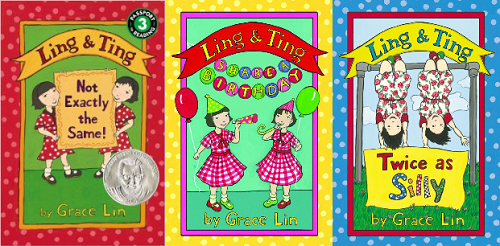
Next, I spent time with her delightful series—Ling and Ting. The text and illustrations exude positive motifs like cooperation, creativity, and kindness. You will want to add this adorable duo to your Early Reader library. 

Some of her picture books feature animal characters learning valuable lessons.


In Olvina Flies, a chicken learns to overcome her fear of flying. 


In the follow up, Olvina Swims, the protagonist deals with her fear of the water and swimming the ocean. 


Finally, Okie-Dokie, Artichokie stars a Marklee the monkey.  He initially misjudges a neighbor, but he realizes his mistake before it is too late. 


My favorite of her picture books is The Red Thread: An Adoption Tale.  A king and queen have a beautiful and peaceful land, but they have a relentless pain in their chests.  A peddler’s magical spectacles reveal the red thread pulling at their hearts, leading them to the baby they are destined to adopt.  This adoption fairy tale illustrates the parental love that begins long before a child comes to live with his adoptive parents and the important bond that connects them.

Grace Lin has written several picture books celebrating Chinese-American culture.  Her stunning illustrations use rich colors, expressive faces, and energetic children.  The text is minimal, but Lin always includes additional information for teachers and parents to read or to expand on in lesson plans.


Bringing in the New Year.  This lovely picture book illustrates the New Year traditions of many Chinese and Chinese-Americans, such as getting a fresh hair cut, making dumplings, carrying lanterns, and welcoming the dragon.  Simple text and energetic pictures provide an ideal introduction to the holiday. 


Kite Flying. Flying kites is a beloved past time in many Asian countries, including China, Japan, Thailand, and India.  In this picture book, a family works cooperatively to make a kite. Then, they take it to a nearby park to fly. 


Dim Sum for Everyone.  A family visits a dim sum restaurant in Chinatown.  Dumplings, cakes, buns, and tarts are presented to them on rolling carts.  They each have to pick what to eat from the many delicious traditional dishes. (Sharing is encouraged.)


Thanking the Moon: Celebrating the Mid-Autumn Moon Festival.  With lanterns and the full moon glowing, they eat sweet mooncakes and drink warm tea.  Join Mei-Mei and her family for this festival celebrating gratitude, prosperity, and community. 


Fortune Cookie Fortunes.  While visiting a Chinese restaurant, each family member receives a fortune cookie. The sisters disagree whether the fortunes will come true or not.  One sister learns to see the world (and the fortunes) in a different way.  This fun tale ends with fascinating background information on the origin of the fortune cookie.  

A Better Way to Teach Theme: Why I Built the Jory John Now Prove It Series

If you’ve ever taught theme, you know the moment. Students finish a story, you ask “What’s the theme?” — and suddenly you’re flooded with a...