Showing posts with label divorce. Show all posts

Saturday, February 1, 2020

Across the Bay (Carlos Aponte)


Title:  Across the Bay

Author:  Carlos Aponte 

Target Ages:  4-10

Genre:  Realistic Fiction Picture Book

Award: Pura Belpre’ Illustrator Honor

Publisher Summary:  Carlitos lives in a happy home with his mother, his abuela, and Coco the cat.  Life in his hometown is cozy as can be, but the call of the capital city pulls Carlitos across the bay in search of his father.


Memorable Moment:
When Carlitos loses his only picture of his father, a park ranger helps him cope with his loss. 

Evaluation:
Carlitos has a loving home with his mother, abuela, and cat.  Nevertheless, he is spurred to search for what is missing—his father.  

After an unsuccessful quest to locate his father, Carlitos finds contentment in his circumstances.  He learns, “No matter the storm, the sun always returns.”  As he journeys back home, he has a renewed appreciation for the loving people in his life and they home they have created for him.  

Through Carlitos’ quest, author Carlos Aponte aptly conveys the heartache and loss a child feels when a parent is no longer in the home—especially when that parent is completely absent.  The story subtly but powerfully shows the longing and loss through the juxtaposition of Carlitos’ circumstances with those of other young boys who are sharing every day experiences with their father—in the neighborhood, the barbershop, and the city.  

The illustrations show the beauty and diversity of Puerto Rico as Carlitos traverses the ancient city of Old San Juan and his more modern hometown of Catano.  From the colorful foliage to the vast array of people and activities, young readers get a glimpse of island life. 

Across the Bay reminds us of the quiet desperation many children around the world feel for a missing parent. This poignant narrative is both heartbreaking and uplifting, a blast to the heart and a spark of delight. 

Interview with Carlos Aponte 

Tuesday, July 10, 2018

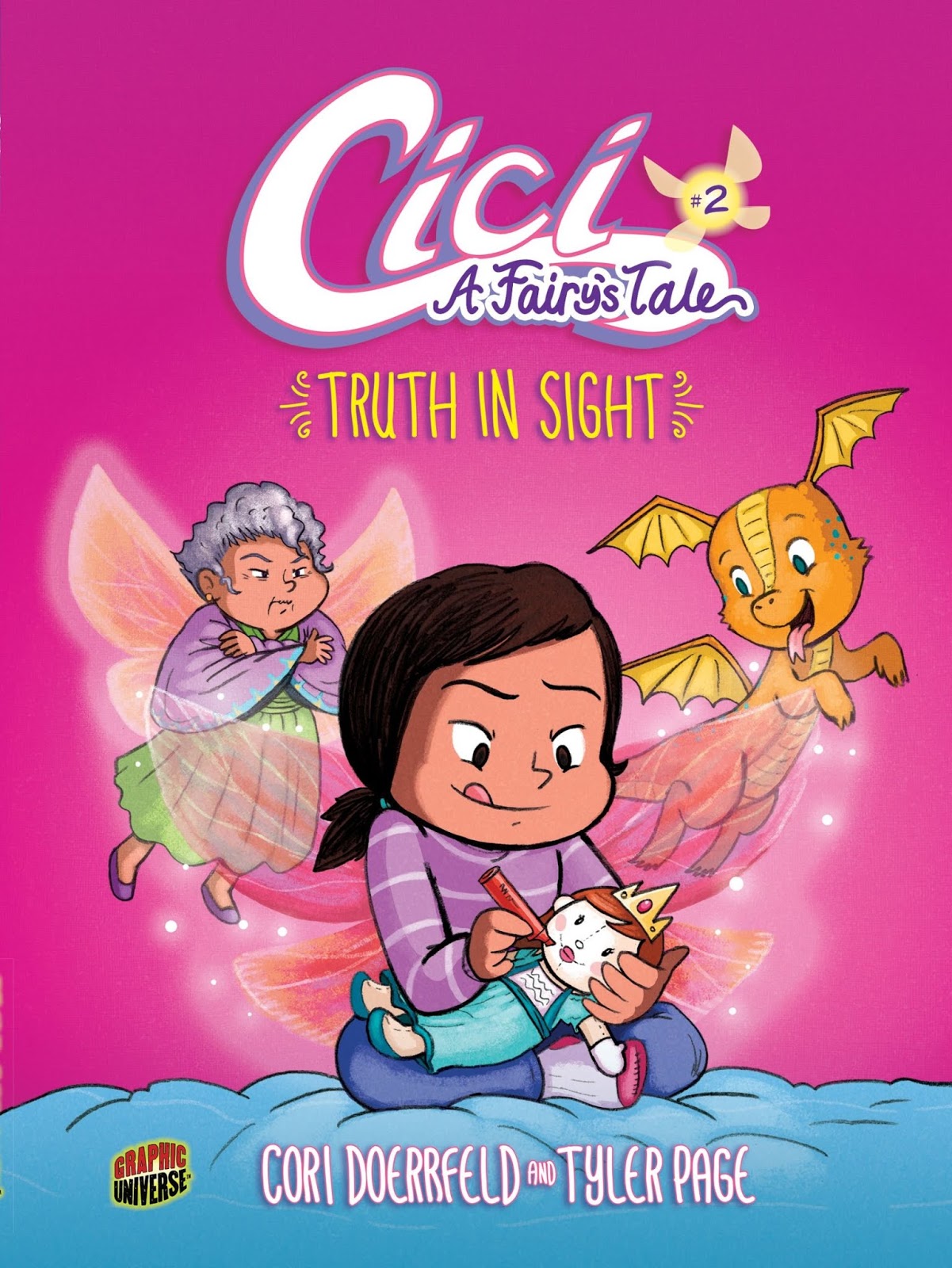
Cici: A Fairy’s Tale Series (Cori Doerrfeld & Tyler Page)

Cici: A Fairy’s Tale is an entertaining graphic novel series for early readers written by Cori Doerrfeld and Tyler Page.  The series is realistic fiction with a dash of magic and imagination. 

The series features a multi-faceted Latino protagonist and family. The young protagonist deals with many typical experiences like friendship struggles, family issues, and fitting in. The plots and characters are relatable for elementary children.  The graphic novel style and vocabulary are accessible, even for reluctant readers.

There are currently three books in the series. 


Cici’s father moves out of their home and her abuela moves in as her tenth birthday approaches.  Her plans are turned upside-down when a popular classmate schedules a party on the same night as her birthday celebration.  If all that wasn’t challenge enough, Cici wakes up on the day of the party with fairy wings and the ability to see people in a new way! Fortunately, her abuela is there to help her figure out this magical change.  With her new abilities, Cici finds that navigating friendships and family is harder than she expected.


Cici is learning to deal with her family’s new living situation—the weekdays with mom and weekends with dad.  Her younger sister is fussy, and her parents are frazzled.  Her classmate Kendra seems to have it all together—pretty, popular, and rich!  Cici acts out toward her “perfect” classmate, thinking it is all a joke. However, her actions have larger consequences than she anticipated.


#3 A Perfect View
Cici invites her new friend, Kendra, to go on her family’s annual camping trip.  Cici has everything planned for the “perfect” trip.  Cici struggles with a bad attitude when plans change—from bad weather and a campsite mix-up.  Her new magic powers have some unexpected results while in the woods as well.

Sunday, July 3, 2016

Sisters (Raina Telgemeier)


TitleSisters

Author/Illustrator:  Raina Telgemeier

Target Ages:  8 and up

Genre:  Graphic Novel Autobiography

Awards: Eisner Award (for graphic novels)

Publisher Summary:
“Raina can't wait to be a big sister. But once Amara is born, things aren't quite how she expected them to be. Amara is cute, but she's also a cranky, grouchy baby, and mostly prefers to play by herself. Their relationship doesn't improve much over the years. But when a baby brother enters the picture, and later, when something doesn't seem right between their parents, they realize they must figure out how to get along. They are sisters, after all.”

Evaluation:
Recently, I saw Sisters on a list of top 10 books for middle grade readers, so I put it on hold at the library. I did not realize it was a graphic novel nor do I have much experience with the genre.  After reading this book though, I am more likely to give a graphic novel a second look.

The story is genuine and realistic. The family is far from perfect. For instance, Raina and Amara have a typical sibling relationship. They irritate each other.  They torment each other.  They argue with each other.  Most importantly, they love each other despite everything—though it is often difficult to see.  Their family experiences job loss, new sibling arrivals, and separation (hinting at possible divorce). 

Characterization is multi-faceted. Raina’s hopes, fears, and insecurities are depicted, making her relatable to the target audience. She wants her own space and independence while also longing for acceptance from her peers and family. For instance, at the family reunion she tries to figure out where she belongs. The younger kids are rambunctious. The adults are all arguing.  However, her slightly older peers make her feel small and insignificant. Raina puts on make-up (which is not in her normal characterization) and tries to connect with them, but they pretty much ignore her. 


The complex plot is non-linear. The main structure revolves around a road trip to a family reunion taking place 4 states away. However, there are numerous flashbacks beginning with when Raina is in preschool longing for a baby sister.  Other flashbacks help round out her characterization and relationship with her family, particularly with Amara. 

Young readers will gain experience deciphering visual literacy clues.  While the text is significant, the pictures are vital to understanding the plot and characterization. Readers have the added practice of determining when the flashback sequences are starting and ending.  For instance, they tend to be in more muted, dream-like tones and the characters are younger (most of the time). In addition, there is always a full-page signal that the story is moving back to the present. 

Other key elements of plot are appealing. Foreshadowing piques readers’ interest. Early in the story, readers learn about an unspecified (but apparently dreadful) “incident.” The author craftily sets it up by depicting past related experiences as well as returns to it later to reveal and to wrap up that plot point. Suspense is also incorporated. When the family van breaks down in the middle of the desert, Amara and Raina are left alone for 4 hours in the vehicle while their mother and younger brother go get help. (I was pretty stressed out!  Glad it is a children’s book.)  Finally, a healthy dose of humor is sprinkled throughout.  From waking up in front of everyone at the family reunion cuddling with a teddy bear to listening to her mother sing “Kum-ba-yah” around the campfire to the “blackberry” incident, middle grade readers will laugh—though probably with a bit of embarrassment hoping no one catches them in one of those moments.

The story is autobiographical.  It includes some photos of the real Raina and Amara as children.  Currently, two additional books are in the series Smile and Drama, which I am anxiously awaiting my turn in the library queue to read.

Overall, the story is engaging, heart-warming, and funny.  It is ideal for middle grade and reluctant readers. 

For other Marvelous Middle Grade Monday recommendations, visit Shannon Messenger's weekly round up.  


Sunday, June 12, 2016

Booked (Kwame Alexander)


Title: Booked     


Target Ages: 10 and up

Genre:  Realistic Fiction/Novel in Poetic Verse

Sample Poems:

Thought
It does not take
a genius
to understand that
when you subtract
a mother
from the equation
what remains
is negative.

Only
ONLY. Three. Weeks.
but Dallas is in one.

ONLY your stomach is shattered
and your dream’s undone.

ONLY not playing soccer
makes the pain seem severe.

ONLY your eyes can’t conceal
tear after tear.

ONLY your ship is sinking
and you’ll miss all the fun.

ONLY. Three. Weeks.
but Dallas is in one.

What happens to a dream destroyed?
Does it sink
like a wrecked ship in the sea?

Or wade in the water
like a boy overboard?

Maybe it just floats
around and around…

or does it drown?

Publisher Summary: 
Like Lighting
You strike
Fast and free
Legs zoom
Down field
Eyes fixed
On the checkered ball
On the goal
Ten yards to go
Can’t nobody stop you
Can’t nobody cop you…

Nobody can stop Nick Hall—he’s a star on the soccer team, cruising in school and getting ready to ask out a girl of his dreams. But then a bombshell announcement shatters his world. 

Evaluation:
Booked has a strong authentic middle grade voice.  Nick, the protagonist, has the passion, sass, and vulnerability typically found in this transitional period.  

Despite being in poetic form, the language and imagery are accessible for the target age. The poems are written primarily in free verse, but there are also some structured ones, such as acrostic and haiku. Rhythm, rhyme, alliteration, and other sound devices are expertly incorporated, making for a smooth flow.  The poems are often short and sweet, conveying a moment in time. Others are a couple pages long, especially when there is an extended scene with dialogue. I especially enjoy novels told in verse, like Booked, because the approach keeps the moments concise, focused, and fast paced—making for an engaging reading experience, especially for reluctant readers. 

An important motif of the novel is the power of language. Nick, though hesitant to admit it, enjoys creative word play, vivid figurative language, and unusual words. These words are defined in the footnotes at the bottom of the page. (See Notable Vocabulary section.) Some readers may find it too didactic or distracting; however, I found it insightful. In part, it conveys Nick' grasp of the word's meaning and the experience. Also his personality is revealed in the snarky comments often included with the definitions. Finally, it models incorporating the beauty and versatility of words in everyday conversations. Ultimately, language and poetry allow Nick to release his pent up frustrations, to grapple with his emotional trials, and to savor his triumphant moments. 

There is a cliffhanger at the end that may bother some readers. To be literary, a book must represent life as it is, rather than, as we want it to be.  In life, everything is not neatly tied up which legitimizes the open-ended conclusion. To maximize the technique though, this type of ending should prompt the reader to think more deeply or to re-examine the text. In this case, I do not think it does. As a result, I am hoping the cliffhanger is a hint that a sequel is on the way.

There are some motifs that are worthy of classroom, book club, or family discussion.
  • Family: There are several family dynamics. Nick has a strong connection with his mother, but due to her decision to leave the state to pursue her dreams, hurt and tension erupts.  His relationship with his father is distant and strained.
  • Divorce/Separation: Right off, the tension between the parents is clear. They decide to separate. Divorce appears to be imminent. Nick’s anguish over the choices of his parents is the most heart-wrenching part of the novel.
  • Friendship: Nick and Coby have a strong friendship. Even though they talk smack, they challenge each other on and off the field.    
  • Bullying: A couple neighborhood bullies give Nick a hard time, but he learns to stand up for himself.  His method is an excellent conversation starter.
  • Disappointment: Along with disappointments at home, a big unexpected incident prevents him from fulfilling a dream. 
  • Passion: Finding a passion and following it is vital for young people.  Generally, it keeps them out of trouble (or at least minimizes it) if they are goal oriented. For Nick, it is soccer.  When he is not at school, he is usually on the soccer field working on his skills. 
  • Mentorship: One of the best parts is the dynamics between Nick and other adults. Mr. Mac (librarian) and Ms. Hardwick (English instructor) encourage and challenge him. Mr. Mac speaks wisdom and truth into his life.
  • First Love: Nick has a love interest, April.  He is awkward and nervous, but overtime his interactions improve.
In many ways, the novel follows the successful format of Kwame Alexander’s Newbery winner The Crossover. Unfortunately, Booked is not quite as literary and profound as the aforementioned award winner. The characterization, format, and motifs will appeal to middle grade readers though, especially reluctant ones. 

Educators should visit The Classroom Bookshelf for some outstanding teaching ideas and links.

Notable Vocabulary:
  • verbomania: a crazed obsession for words (4)
  • malapropism: the amusing and ludicrous misuse of words, especially with one of a similar sound (18)
  • pugilism: the art of fighting with your fists; boxing (39)
  • futsal: indoor soccer played with five players on each side (43)
  • cachinnate: to laugh loudly (52)
  • mewling: to cry weakly; whimper (68)
  • ragabush: worthless; rubbish (79)
  • codswallow:  something utterly senseless; nonsense (82)
  • logorrhea: an excessive use of words (100)
  • flummoxed: to bewilder or confuse (117)
  • onomatophobia: fear of hearing certain sounds (119)
  • farrow:  a litter of pigs (132)
  • sweven: a dream or vision in your sleep (142)
  • nutmeg: a soccer trick in which the ball is dribbled between the defender’s legs (180)
  • rapprochement: a re-establishment of harmonious relations (213)
  • stupefy: to stun or overwhelm with amazement (218)
  • twain: two (247)
  • callipygous: having a beautiful backside (258)
  • incompassible: incapable of coexisting, of being together (267)
  • hellkite: an extremely cruel person (271)
  • gadfly: an annoying person (288)
  • wordbound: unable to find expression in words (294)
  • yobbery: hooliganism (296)
  • zazzy: stylish or flashy (300)
It's Marvelous Middle Grade Monday again. Visit Shannon Messenger's blog for more Middle Grade reading reviews. 


Sunday, April 3, 2016

Middle Grade Monday: Words with Wings (Nikki Grimes)

Title
Words with Wings

Author

Book Jacket Summary
Gabby has been a daydreamer for as long as she can remember, but when her parents began arguing, daydreaming became as essential as breathing.  At first an escape, it’s now taken over her life.  In her new home with only her mother, Gabby misses the way their family used to be.  In her new school, she’s always alone.  The kids see her as Shy Girl Who Lives Insider Her Head and tease her.  Her teacher keeps telling her to pay attention, while her mother scolds her for drifting off.  Will Gabby ever find a way to keep her thoughts grounded?  Or could her daydreams help her take flight?

Sample Poem
“Words with Wings”
Some words
sit still on the page
holding a story steady.
Those words
never get me into trouble.
But other words have wings
that wake my daydreams.
They fly in,
silent as sunrise,
tickle my imagination,
and carry my thoughts away.
I can’t help
but buckle up
for the ride!

Evaluation
Language & Form
Words with Wings is a novella written in poetic form.  The free verse poems are so melodic and beautiful that I found myself reading over many of them multiple times.  I love the imagery she uses like “feel fire on my cheeks, then tears come to smother the flames” (37) and “the trees are whispering” (66). Despite being poetry, the images and words are written for middle graders. I was afraid of poetry until I was an English teacher for several years (still a little afraid). Many of my college students are afraid of poetry. I believe reading books like Words with Wings can help students feel comfortable with poetic language and, hopefully, learn to enjoy it.

Characterization
Gabby is a sweet protagonist. You will get swept up in her world right away with the story of the origin of her name, her family situation, and her imagination.  Many middle grade readers will identify with her experiences—watching her parent's marriage dissolve, dealing with divorce, moving to a new place, starting a new school, being bullied by peers, and making new friends.  Gabby deals with her feelings of alienation and powerlessness is a positive way—her imagination.  While it does sometimes distract her from accomplishing tasks, she learns how to manage it and use it for good. 

Another important character is her teacher, Mr. Spicer—based on a teacher the author had in school.  For teachers and parents, he can be an inspirational figure.  He values Gabby for her uniqueness and helps her focus her talents properly.  Mr. Spicer also encourages creativity and imagination in his other students.  He is a great reminder to sometimes set aside the “objectives” to accomplish significant learning.

Theme
The title Words with Wings sums up the theme of this novella well.  Gabby learns that her words, ideas, and imagination have metaphorical wings. They lead her through darkness and loneliness.  They help her cope with life’s difficulties. They make her who she is.  She does not change to fit it.  Instead, she finds people who appreciate her uniqueness, and she does the same for them in turn.

Young people feel that their clothes, physical appearance, tattoos, piercings, and other superficial things define them, making them who they are.  They feel it is how they “express themselves.”  I reject that idea. I believe your words, your ideas, your imagination, your personality, your talents, and, most importantly, your actions define you, making you who you are.  This book epitomizes that idea for me.  It is an idea worth discussing and challenging students with.

Extension Ideas
  • Journaling:  Like Mr. Spicer, have the class randomly stop everything and daydream.  It simply means, letting the students journal their ideas. Younger children could draw their ideas. They should write/draw without stopping for an age appropriate amount of time.
  • Writing Poetry:  Like many of Gabby’s poems, give the students a word (or allow them to pick a word).  Have them write down a description of it in free verse.  Encourage the age appropriate usages of figurative language like simile, metaphor, personification, understatement, hyperbole, and so forth.
  • Literature Circles:  Pick one or more poems from the book.  Assign the students to small groups to discuss what the poem(s) means.  They can brainstorm the connotations and denotations of key words or discuss why the narrator used specific figurative devices.  Then, discuss how the poem illustrates a key aspect of the novella, such as characterization or theme.  Finally, students can discuss the motifs in each poem, including how they relate to their lives.
  • Character Education:  Discuss as a class what it feels like to be the new person in a school or place. Have the students brainstorm ways to help new people feel welcome and become involved.  Create a class or individual plans to put into action.
For other Marvelous Middle Grade Readers, visit Ramblings of a Wanna Be Scribe.  


A Better Way to Teach Theme: Why I Built the Jory John Now Prove It Series

If you’ve ever taught theme, you know the moment. Students finish a story, you ask “What’s the theme?” — and suddenly you’re flooded with a...