Showing posts with label space. Show all posts

Thursday, February 15, 2018

A Full Moon Is Rising (Marilyn Singer)


Author:  Marilyn Singer

Illustrator:  Julia Cairns

Target Ages:  7 and up

Genre:  Poetry

Publisher Summary:
In the night sky, nothing is more magical than the full moon that rises every month.  When it shines, all kinds of fascinating things occur.  Tides rise to enormous heights.  Children dare each other to climb a staircase to the moon.  Families eat cakes with a moon inside.  Campers watch out for werewolves.  And sometimes, the whole moon disappears in Earth’s shadow. 

Come along on a whirlwind tour of the world to discover an amazing collection of full moon celebrations, beliefs, customs, and facts.  We’ll visit India, Israel, Morocco, China, Australia, and many more places to see what can happen…when a full moon is rising. 


Sample Poems:

“Cloudy Night”
Bogota, Colombia
Too many clouds. Rain coming.
It’s impossible to see the moon.
But she knows it’s up there,
    With that special dimple.
She’s seen its picture—
    Garavito crater,
named for her favorite astronomer,
   and from her country too.
She thinks, One day they’ll name a crater after me.
She hopes, Or better yet, a new lunar sea.

“Broadway Moon Again”
New York City, USA
On the sidewalk, the audience of one
 is now ten.
“What you looking at, girl?” they ask.
“Oh, the moon,” she says. “Just the moon.”
But what a moon!
Between the skyscrapers, it takes a bow.
“Encore in one month!” it proclaims.
“Admission is always free.”

Evaluation: 

A Full Moon Is Rising takes readers on a lyrical tour of the world.  Different customs and cultures—past and present—related to the full moon are revealed.  Readers get a snap shot of places, such as New York City, Morocco, Australia, Israel, Columbia, and Hong Kong. Julia Cairns’ lovely watercolor illustrations are a celebration of the brilliant full moon and the many diverse people groups. 

The “About the Poems “section is informative and interesting.  In it, teachers and parents will find a short explanation of the scientific, historical, and cultural background for each poem. 

From the peaceful view under a tent in the desert to the dancing jubilee in an African village to the hustle and bustle of the city, people everywhere look with wonder at the full moon illuminating the darkness to all equally.


Ideas for Extension Activities at Home or Lesson Plans for Teachers:
Moon Phases Foldable
Mini Book:  Moon Phases
Moon Phase Balloons
Moon Phase Paper Plates
Moon Phase Oreo Cookies
Foil Printed Moon Craft
Making Moon Craters Activity
28 Moon Books for Kids
Moon Dust Writing Tray
Space Writing Prompts
More Moon Activities

For more poetic inspiration, visit Check It Out for the Poetry Friday link up.


Saturday, February 10, 2018

Five Fabulous Female Scientist Biographies


Margarita Engle, author
Julie Paschkis, illustrator

Publisher Summary:  
In the Middle Ages, people believed that insects were evil, born from mud in a process called spontaneous generation. Maria Merian was only a child, but she disagreed.  She studied caterpillars in secret, for the neighbors would have accused her of witchcraft if they knew.

Maria watched carefully as her caterpillars spun themselves cocoons, which opened to reveal summer birds, or butterflies and moths.  She saw the whole life cycle of the summer birds and documented what she learned in vibrant paintings. 

This is the story of one young girl who took the time to observe and learn, and in so doing, disapproved a theory that went all the way back to ancient Greece. 


Why It’s Fabulous:
Most of the story is about Maria as a young girl who observes, questions, and explores. Interwoven in the narrative is some basic information about butterflies and their life cycle as well as bit of medieval history. Not only does Maria have a scientific mind, but she also she has artistic talent.  Using her keen sense of observation, she paints insects, plants, and other creatures. One of the best parts of the book is Julie Paschkis’ meticulous and vibrant illustrations. Maria’s life demonstrates to children that they do not have to wait until they are adults to engage in scientific discovery and artistic exploration.  Most importantly, they can overcome prejudice and ignorance to make a difference in the world


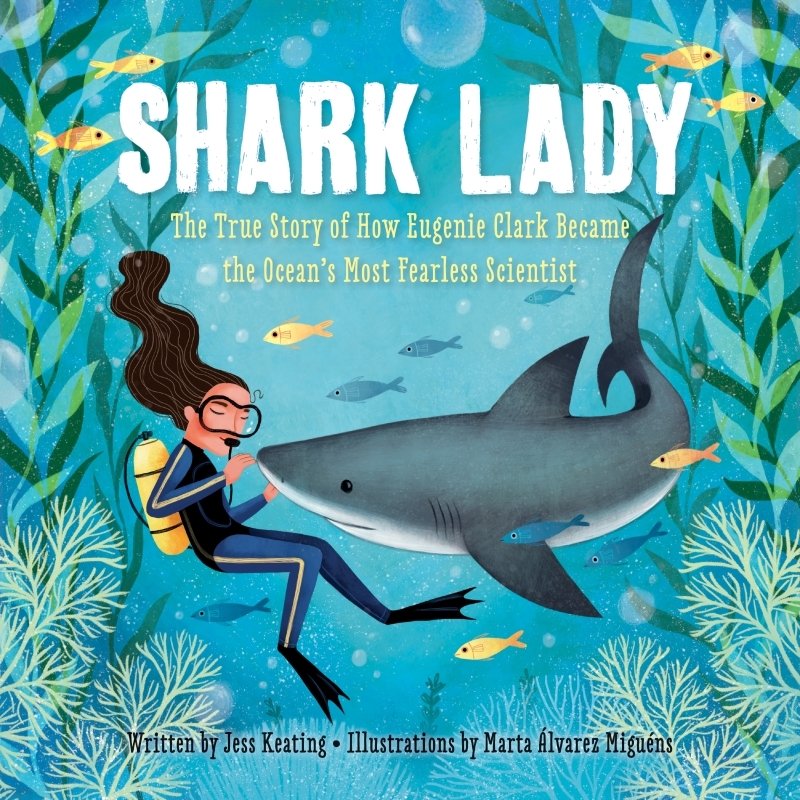
Jess Keating, author
Marta Alvarez Miguens, illustrator

Publisher Summary:
This is the story of a woman who dared to dive, defy, discover, and inspire.  This is the story of the Shark Lady.

Eugenia Clark fell in love with sharks from the first moment she saw them at the aquarium.  She couldn’t imagine anything more exciting than studying these graceful creatures.  But Eugenia quickly discovered that many people believe sharks to be ugly and scary, and they didn’t think women should be scientists.

Determined to prove them wrong, Eugenie devoted her life to learning about sharks…Through her accomplishments, she taught the world that sharks were to be admired rather than feared—and that women can do anything they set their minds to.


Why It’s Fabulous:
This biography presents a fascinating picture of a determined and fearless woman.  Eugenia boldly went where few dared to plunge—in the ocean to study sharks.  In the process, she discovered new ocean species and information about sharks.  She followed her childhood dream, and in the process, changed the way the world saw sharks.  The vivid illustrations add to the engaging story of Eugenia Clark’s accomplishments.


Emily Arnold McCully, author & illustrator

Publisher Summary:
In 1786, Caroline Herschel became the first woman to discover a comet.  She was also the first woman ever to be paid for scientific research.

But no one who knew Caroline as a child could possibly have predicted her stellar future.  Illness scarred her face and stunted her growth.  Her mother didn’t want Caroline to be educated and insisted that Caroline’s role in life was to be the family’s housekeeper.

Through words, including excerpts from Caroline Herschel’s diary, and pictures, bring Caroline’s inspirational story to life.


Why It’s Fabulous:
Despite numerous challenges and constraints, Caroline (along with her brother) laid the foundation for future astronomers.  Their detailed observations and calculations endowed astronomy with a status equal to other fields.  Refusing to settle for just being her brother’s assistant, her work and boldness earned her a salary from the King.  As a result, she is known as the first profession woman scientist.  Her story of overcoming great odds and devoting her life to her passion is sure to inspire readers.


Laurie Wallmark, author
Katy Wu, illustrator

Publisher Summary:
Meet Grace Hopper:  the woman who revolutionized computer coding.

An ace inventor, groundbreaker, and recipient of the Presidential Medal of Freedom, she coined the term “computer bug” and developed the program that taught computers to recognize words and not just endless O’s and I’s.  Laurie Wallmark tells the inspirational story of this brilliant woman who had a passion for science and math and the firm belief that new solutions to problems were not found by those who said, “We’ve always done it this way.”


Why It’s Fabulous:
In a time when woman rarely studied science and math, Grace became a leader in an emerging field—computer science.  She was determined.  Despite some initial set backs in her education and career, she did not give up until she achieved her goals. Also, she had an insatiable curiosity to solve problems.  She fought against conventional thinking.  For instance, she would doodle fantastic creatures to help her think outside the box when she had a problem to solve.  Among other things, her innovations helped programmers write code more quickly.  (Bonus:  You will learn how the term “computer bug” came about.)  Her contributions continue to positively impact both men and women in the field. Grace was an amazing and inspiring figure. 


Robert Burleigh, author
Raul Colon, illustrator

Publisher Summary:
Marie Tharp was always fascinated by the ocean. Taught to think big by her father who was a mapmaker, Marie wanted to do something no one had ever done before: map the bottom of the Atlantic Ocean. Was it even possible? Not sure if she would succeed, Marie decided to give it a try.

Throughout history, others had tried and failed to measure the depths of the oceans. Sailors lowered weighted ropes to take measurements. Even today, scientists are trying to measure the depth by using echo sounder machines to track how long it would take a sound wave sent from a ship to the sea floor to come back. But for Marie, it was like piecing together an immense jigsaw puzzle.

Despite past failures and challenges—sometimes Marie would be turned away from a ship because having a woman on board was “bad luck”—Marie was determined to succeed.


Why It’s Fabulous:
Like the other women on this list, Marie overcame discrimination in her field.  Though she had a job at a prestigious university, she often had to work “beneath” her skills and education.  However, she persevered and made friends. Eventually, she worked in collaboration with other scientists and mapped the ocean floor at a time when little was known about it.  She proved a much-disputed theory of her time—continental drift.  Her contribution to her field helped the world not just gain a map of the ocean floor, but learn more about how the Earth works. 

For more women in STEM biographies, click HERE.

Friday, April 13, 2012

Poetry Friday: Science Verse (by Jon Scieszka and Lane Smith)

I am thrilled to share this week’s poetry collection—Science Verse (by Jon Scieszka and Lane Smith).  These two authors know how to turn things upside down and make your rethink how you look at everything from fairy tales to science!  This collection is no exception.   The book begins with a group of children in class.  Their science teacher tells them that if they listen closely they will “hear the poetry of science in everything.”  One of the students is zapped with a curse of science verse.  He begins to think of everything in the form of a poem.  The poems and pictures that follow are his journey through the world of science and language.   

The duo uses nursery rhymes, popular songs, and famous adult works as models for their entertaining, educational, and, at times, irreverent poetry.  “Lovely” parallels Joyce Kilmer’s “Trees.”

“Lovely”
I think that I ain’t never seen
A poem ugly as a spleen.

A poem that could make you shiver,
Like 3.5 … pounds of liver.

A poem to make you lose your lunch,
Tie your intestines in a bunch.

A poem all gray, wet, and swollen,
Like a stomach or a colon.

Sometimes like your kidney, lung,
Pancreas, bladder, even tongue.

Why you turning green, good buddy?
It’s just human body study.

This next selection follows the rhythm of the children’s song “I’ve Been Working on the Railroad.”

“Food Chains”
“I’ve been working in the food chain,
All the livelong day.
In the middle of the food chain,
I’ve got no time to play.

Can’t you see the green plants growing?
That’s energy, okay?
Consumer eats up the producer,
Predator eats prey.

Who’s for lunch today?
Don’t you just wonder, who’s for lunch today?
Predator or prey.
Predator or prey.
Eat or be eaten, that’s the only way.

Under “Why Scientists Don’t Write Nursery Rhymes” is a “Mary Had a Little Lamb” parody.

“Mary Had A…”
Mary had a little worm.
She thought it was a chigger.
But everything that Mary ate,
Only made it bigger.

It came with her to school one day,
And gave the kids a fright,
Especially when the teacher said,
“Now that’s a parasite.”

As the book comes to a close, it is revealed that the student with the science verse curse was asleep (in class) the whole time!  Science Verse is witty and entertaining, but it also has several educational tie ins.  Subjects covered are evolution, water cycle, human body, space/astronomy, dinosaurs, food chains, chemistry, scientific method, senses, matter, and life cycles.


Teaching Opportunities:
  • Poetry:  students can write their own poems using nursery rhymes, children’s songs, or other poems as models.
  • Sound Devices:  identify rhyme, alliteration, consonance, and so forth
  • Figurative Language:  identify and discuss examples (similes, puns, personification)
  • Science:  use a poem to begin a science lesson or unit study; discuss what is revealed through the poem about the subject
  • Critical Thinking:  look carefully together to distinguish fact from fiction in the poems

 Today is Poetry Friday!  Check out other great poems and anthologies at the round up at Book Talking. 


Monday, March 19, 2012

Picture Books (History): Code Red Series

The Code Red series from Bearport Publishing vividly recreates nine of the worst disasters in modern history.  Using a narrative format, the setting is established and the causes are revealed.  Readers feel the impact of the incident and the aftermath through first-hand testimonies, photographs, and descriptive details.  There are ten books in the series—The Challenger Space Shuttle Explosion, Emergency at Three Mile Island,  Earthquake in Haiti, The Exxon-Valdez’s Deadly Oil Spill, The Great Chicago Fire, The Hindenburg Disaster,  Nightmare on the Titanic, The Texas City Disaster, The Triangle Shirtwaist Factory Fire, and The 2001 World Trade Center Attack.  Here are the highlights of a few of the books I read.


The Challenger Space Shuttle Explosion (by William Caper) 
This disaster is one I remember clearly.  I used to live on Merritt Island where we watched (and felt) the shuttles launch outside of our school buildings or homes.  My mother used to run the banquets for the astronauts.   I remember the shock and disbelief as we watched the coverage on the television at school.   Caper brings out the human side of the space catastrophe by highlighting many of the people on the craft—including how Christa McAuliffe was chosen and trained to be the first civilian and teacher in space.  The narrative concludes with hope—both in the positive changes that were made to the space program and the words of President Reagan.  In his speech he said, “It’s hard to understand, but sometimes painful things like this happen.  It’s all part of the process of exploration and discovery.”    With risks, there are failures—sometimes tragedy.  We should never give up though. 

The Hindenburg Disaster (by Aaron Feigenbaum)  
I had previously heard of this incident, but I did not know any details.  The Hindenburg was one of the early passenger airships.  With nearly 100 people on board, the ship had a smooth trip from Germany to the United States. The passengers enjoyed luxurious accommodations.  As they were in the process of landing, the craft caught on fire.  People were screaming and jumping out of it, many badly burned.  One reporter, on the scene, referred to it as “the worst catastrophe in the world” and “the worst thing [he] ever witnessed.”  The event had a huge impact on the people as they listened to the news reports on their radios.   The age of the airship ended, but man was not discouraged from venturing into flight.


The Triangle Shirtwaist Factory Fire (by Jacqueline Dembar Greene)  
This event was entirely new to me.  I could not help but to think as I read that it was in some ways to New Yorkers in 1911 what the collapse of the Twin Towers was to them in 2011.  The Triangle Waist Company was in the top three floors of the ten-story Asch Building.  It was one of New York City’s new skyscrapers.  When the fire broke out, people (primarily women) were crowded into the noisy building working in harsh conditions, often behind locked doors.  Many people were trapped.  Others fell to their deaths as they attempted to get out using the fire escape. This tragic event led to factories becoming safer, better places to work, and it prompted stricter fire safety codes.  Unfortunately, many lives were lost though.

The Code Red series deals with a broad range of historical events—both recent and long ago.  The books are ideal as supplements to history unit studies, for book reports, or for general background knowledge and reading.  Written for ages 9 and up, the series delves into high-interest, engaging topics that are sure to become favorites in any home, school, or classroom library. 

It is Nonfiction Monday.   Read about other notable non-fiction titles at EMU's Debuts.

Sunday, March 18, 2012

Picture Books (Science): Planet Series (by L. L. Owens)


A Child’sWorld has an impressive series of non-fiction books on the planets in the solar system called Space Neighbors.    Each planet, and the sun, has a book devoted to it.   I reviewed 3 books in the series:  Saturn, Mercury, and Pluto and Other Dwarf Planets. 

Author L.L.Owens begins each book by placing the planet in the night sky.  Key vocabulary words are in bold, such as solar system, orbit, and telescope.  Next, a sweeping two-page layout displays all of the planets in relation to the sun and each other.  In the left-bottom corner, Fun Facts are provided that include distance from sun, size, planet number, and facts unique to the planet.   The follow pages include large, bold pictures of the plant and information about the speed of rotation and revolution, surface, atmosphere, temperature, exploration, and much more. 


Owens uses simple text (second grade reading level) which makes this series fantastic for children in the primary grades (1-4).  She offers context for many of the facts with child-oriented comparisons, like the distance around Mercury’s middle is “longer than 100 million hot dogs placed end to end” or the shape of the planet is “more like a football than a baseball.”  Some of the core information about the definitions of rotation, revolution, and the solar system are reviewed in each book.  The books include a glossary of important terms to build science vocabulary. 

The illustrations and photographs are eye-catching.   The planets are viewed from different angles and distances, extending the written text.  Other photographs and illustrations are included to round out the fascinating facts presented to the young readers.  I recommend the Space Neighbor series for ages 6-10. 


I created a Pinterest board of some amazing ideas on the web to teach about the solar system.  

This post is linked up at Momto2PoshDivas for Sunday Showcase and Science Sunday at Adventures in Mommydom.


Saturday, March 19, 2011

Picture Book: How the Moon Regained Her Shape by Janet Ruth Heller

Inspired by Native American folktales, How the Moon Regained Her Shape personifies the moon as “round and full, proud of her gentle light.”  She is fearless and lively.  One day as she dances across the sky, the sun demeans her.  The moon stops dancing because she is tormented by the sun’s words.  Slowly, her body dwindles until she is just “a sliver of her former self.”  Comet notices the changes in his friend, so he visits her.  He urges her to visit a woman named Round Arms.  The moon is warmly welcomed and comforted in the Native American woman’s hut.  Round Arms leads the moon around to various places and people who value her light and force.  At the final stop, a hundred women are dancing and singing:

We sing to the moon, our sister,
Who pulls the seas to the sands,
Who changes her shape like a magician,
Who lights our paths at night. 
Return to the sky, our sister,
For we miss your gentle beams
And your loving smile.

Her eyes sparkling with joy, the moon returns to the sky.  Even though she still wanes when someone insults her, she always “regains her strength and fullness” because she remembers her crucial job and caring friends.   

Evaluation: 
How the Moon Regained Her Shape is a brilliant example of how ancient people created stories to help them understand the world around them.  The eye-catching illustrations in neutral and muted colors (by Ben Hodson) accompany the stellar storytelling (from Janet Ruth Heller).  The book is a creative way to introduce a lesson or discussion on the lunar phases.  

In addition, the power of words and the effects of bullying are depicted in a powerful but hopeful manner.  Though the moon feels hurt and discouraged, she learns to appreciate her unique value—something everyone needs to learn.  As a result, she is able to overcome adversity.  I highly recommend How the Moon Regained Her Shape for ages 6-11.   Publisher Sylvan Dell has compiled a 38-page Teacher's Guide and other web resources to help build your lesson plans and extension activities around.  

Teaching Oppoturnities:
Moon Phase Website


Oreo Cook Moon Phases (Pinterest and Science Bob's Blog)


A Better Way to Teach Theme: Why I Built the Jory John Now Prove It Series

If you’ve ever taught theme, you know the moment. Students finish a story, you ask “What’s the theme?” — and suddenly you’re flooded with a...