Showing posts with label math. Show all posts

Sunday, February 11, 2018

Elephant & Piggie Like Reading (Early Reader Series)


I recently came across the Elephant & Piggie Like Reading series.   If you have emerging or early readers, these books are worth having on your shelf.  Your children will clamor to listen and to read them over and over.

Here’s what to expect in the series. 

Elephant and Piggie always introduce the book about to be read. The front end paper shows them holding and reading the book together.  On the first pages, they briefly chat back and forth with their energetic wit about the story.


Short sentences are in dialogue boxes. With limited words on each page, early readers will move through the books quickly.  As a result, they will get a sense of accomplishment.  


Common sight words (I, am, is, it) are combined with new words repeated often like shoes, grow, button, press, and cookie. Children will quickly build further reading confidence as well as expand their reading vocabulary. 

Also, lively sound words are incorporated, such as snap, rumble, squish, flop, beep, and honk.  These words make the stories more exciting and the reading experience more dramatic.


The stories include memorable characters interacting—blades of grass, shoes, birds, and a group of animal friends. The authors utilize puns and irony to create humorous situations and dialogue.

At the end of the book, Elephant and Piggie reappear to comment on the story, often using creative word play.  This sandwiching technique adds humor and enthusiasm for the book itself and reading in general.  


Bryan Collier, author and illustrator
A closet of shoes get excited when they know it is time for young girl’s outing with her father.  Each one wonders—will I get picked?  Two shoes get chosen, but the unexpected occurs!


Dan Santat, author and illustrator
Four unlikely friends—a hippo, a crocodile, and two squirrels—try to figure out a way to divide their cookies fairly. Things are complicated by hippo’s nervous habit. 


Charise Mericle Harper, author and illustrator
Yellow Bird is proud to have button that does nothing.  Blue Bird and Red Bird though find it does do something.  However, convincing Yellow Bird is harder than they expected.


We Are Growing!
Laurie Keller, author and illustrator
Eight friends are growing up fast.  As they do, they find that each one is unique in his own way…that is, except Walt. After an unfortunate event, he finds a way to stand out. 

Coming soon...The Itchy Book.

Monday, May 7, 2012

Math, Shapes, and Basic Geometry Picture Books

I have had these book tucked away for Math Monday for a few weeks. It is about time I share them!  Each selection focuses on shapes.  They move from simple to more complex.  I hope you can use these books with your youngsters at home or in school.
This small board book is perfect for little hands and young minds learning or practicing shapes.  There is a basic thread that unifies the book.   It begins with, “In the ocean…”  Each 2-page layout has a short phrase that refers back to the original introductory phrase and describes the action like “Fish swimming,” “Rays gliding,” and “Crabs snapping.”   The layouts include the labeled shape at the top left corner and a framed picture of the ocean scene that sweeps across both pages, such as seen HERE.   The cheery cartoon animals are colorful and charming.  The fun verbs—swimming, snapping, crawling—on each page are perfect for imitating.  The final layout is a review of all the shapes.  Shapes with Ocean Animals is geared for ages newborn to 4.  


Are Eggs Square? (DK Books)
This see through book is entertaining for children who are already familiar with their shapes.   Each sequence begins with a question.  For instance, the first one is:  “Do ladybugs have square spots?”  The facing see-through page shows a ladybug with square spots.  Child readers or listeners may answer the question and "predict" what the correct answer will be.  A turn of the page reveals a ladybug with naturally shaped spots.  It replies:  “No, ladybugs have round spots.”  This pattern is repeated for triangles, stars, squares, ovals, and rectangles.  The easy, predictable text is good for early readers to practice on.  A quick review of shapes is provided at the end.  This fun, interactive book is perfect for ages 3-7. 


Using food and paper, Adler moves beyond basic shape recognition to introduce more advanced math concepts and vocabulary.  First, pieces of cheese and pretzel sticks serve as materials to make triangles of different kinds—scalene, equilateral, and isosceles.   Next, those same pretzel sticks and some paper depict basic angles.  Key vocabulary terms are illustrated such as vertex, right angle, and types of angles (right, obtuse, and acute).  Then, quadrilaterals—trapezoid, parallelogram, rectangle, rhombus, and square—are defined and pictured with paper, pencil, and pretzels.   He finishes off with other polygon shapes using a piece of bread and a knife to create a pentagon, hexagon, heptagon, octagon, nonagon, decagon, hendecagon, and dodecagon.  The illustrations are captivating and interactive.  They will stimulate youngsters to come up with their own foods or household items to create shapes.  Shape Up!  is a fantastic tool for introducing or reinforcing geometric concepts for ages 9 and up.  

Visit love2learn2day for other Math Monday more linked up ideas and resources. 

Monday, March 26, 2012

Picture Book (Math): Seeing Symmetry (Loreen Leedy)

The idea of symmetry had not really consciously crossed my mind until one day I observed a student teacher I was supervising present a lesson on it.  He did an amazing job showing a multitude of real world examples.  Then, he had a PowerPoint presentation in which the students had to determine which objects were symmetrical and which were not.  The lesson was a big success both in student engagement and learning
 
When I saw Loreen Leedy’s new book Seeing Symmetry, I knew I had to review it.   I have rarely seen a trade book on the topic, and this one looked wonderful.   

I love how she begins with a sort of riddle:  

Butterfly wings have it.
Triceratops had it.
The word Mom has it. 

Each subject is illustrated on the page to prompt student guessing what the three items have in common.  Next, the two-paged title page is a fantastic example of symmetry, perfect for keeping the conversation going.  The early pages describe with words and illustrate with pictures the concept of symmetry in simple terms.  After the concept is clearly laid out, Leedy offers a multitude of colorful examples from holidays, buildings, furniture, animals, machines, and other everyday items children will be familiar with. 

For parents and teachers, additional notes are offered in the back to help with instruction, whether formal or informal.  There are two fun activities suggested for practicing the math concept and an explanation on how symmetry is an important math concept.  The book is rounded out with a list of symmetry words and their definitions to help build subject vocabulary.  The book has everything necessary to teach this concept. 

I enjoyed reading and experiencing Seeing Symmetry.  It is much like the superb lesson my student teacher gave—engaging, relevant, and enriching.  I highly recommend this title for school or home.  Children will enjoy the book so much they won’t even realize they are learning an essential math concept! 


I also have Pinterest board on Math Symmetry Teaching Ideas.  I will add more as I come across ideas on the web. 


This post is linked up with Math Monday at love2learn2day.   


Disclaimer: As per FTC guidelines, I received a copy of this book from Holiday House Publishers in exchange for my honest review. I received no monetary compensation. All opinions expressed here are mine and mine alone. 

Monday, February 27, 2012

Picture Book (Math & Science): Multiple on the Fly (by Suzanne Slade)

Summary of Math on the Fly (by Suzanne Slade):
Multiply on the Fly demonstrates that math is a relevant part of our every day experience.   Readers are treated to an insect safari, viewing commonly known bugs like grasshoppers, butterflies, and ladybugs as well as lesser known insects like pirate bugs and spittlebugs.   Each two-page spread illustrates a multiplication riddle, such as:  

Four lovely Luna moths
Rest upon a pine.
Each one spans three inches.
How long is the luna line? 

Underneath the riddles is a multiplication problem. For the aforementioned rhyme it is 4 x 3 = ?  Young listeners are prompted then to solve the problem.   There are three ways to approach, depending on the developmental level of the child(ren).   First, count out the items being multiplied and connect it to the multiplication problem.  Second, count by one of the numbers represented in the problem, like 3’s or 4’s.  The final stage is for the child to be able to look at the page and know right away the answer. 

Evaluation:
Author Suzanne Slade has fashioned a wonderful combination of math and science, fostering an appreciation for the little things of nature.   She use rich adjectives and verbs to describe the physical features and daily activities of insects.  Her high spirited rhymes, which effectively use rhyme and alliteration, are engaging and enjoyable.  Erin E. Hunter (illustrator) has beautifully captured the insects in their habitats.  Her brilliant illustrations draw young readers in to the world of insects. 

Teaching Opportunities:
One of the things I appreciate most about Sylvan Dell publishers is their mission to make math and science exciting and applicable.  To further that mission, they create a FREE teaching guide for all their titles that include activities and ideas for extending the book.  For Multiple on the Fly, you will want to check out their 41-page color guide by clicking HERE.  You are sure to find many activities your child(ren) or students will enjoy! 
                                                                                          
This post is linked with Non-Fiction Monday weekly round up, hosted this week at The Children's War blog and Math Mondays at love2learn2day.  
                                                                                          

Thursday, February 23, 2012

Picture Book: Perfect Square (Michael Hall)

Summary of Perfect Square (by Michael Hall): 

“A perfect square is transformed in this adventure story that will transport you far beyond the four equal sides of this square book” (from end paper of book).  

The perfect square is perfectly happy.  Each day of the week, something unexpected happens which prompts the square to change.  For instance, on Monday it is cut into pieces and poked full of holes.  As a result, it makes itself into a babbling fountain.  On Tuesday it is torn into scraps, but it does not get discouraged.  It makes itself into a garden.  The square embraces the changes that happen to it—like being shredded, shattered, snipped, or crumpled—to becomes more resourceful and creative.  When on Sunday nothing new happens to it, the square initially feels confined and rigid.   In this satisfying ending, the square finds a way to continue to embrace the world around it and to be content in any circumstance. 

Evaluation:
Like his earlier critically acclaimed My Heart is Like a Zoo, author Michael Hall takes a simple concept and makes it something brilliant.  I love the minimal illustrations that depict what has happened to the square and then what it becomes.   In each incident it is difficult to imagine how the square can transform into something amazing, but it never ceases to delight.  Each development has one dominate color to signify a new stage, but for young listeners it is an opportunity to practice identifying colors and for older readers you may discuss why each color was chosen.  Also, the straightforward text and narrative makes this a book that people of all ages can enjoy and appreciate.  A young child will be enchanted by the colors and pictures created with basic shapes.  Older readers will find pleasure in the square's journey.  Despite all manner of circumstance, it never gets discouraged.  Instead, it “thinks outside the box” to make something beautiful out of a seemingly unfortunate situations.  The square’s resilience and contentment are remarkable.   I highly recommend Perfect Square to all ages.  

Teaching Opportunities:
  • Art—Give each child a square and basic paper tools; allow them to make their own creative pictures using only the square, the tools, and minimal pen marks OR prompt them to mimic the art work in the book (see Fun & Engaging Activities for Toddlers blog post for an example)  
  • Math—Identify the shapes on each page (where relevant) and count how many there are of each
  • Colors—Identify the colors together (younger); brainstorm the feelings associated with each color and how they may related to the narrative (older)
  • Calender—Recite the days of the week (younger); teach how the days of the week are used as a narrative framework for the action and to signify the passing of time (older)
  • Writing —Write a story using the days of the week as the framework (from Karen at Layers of Learning)
  • Language Arts—Allow children to summarize the story (younger); discuss how this story uses symbolism (the square going through changes) to illustrate the abstract (how circumstances impact people)--draw parallels between what happens to the square and the lives of people or characters in other books (older)
  • Predicting Skills —As each new change occurs to the square, allow the listener(s) to guess what he might become 
  • Character Development—Discuss the character qualities of the square (resilience, determination, creativity) and how it helped him to be content and fulfilled in all circumstances
This post is linked up at Hope is a Word for Read Aloud Thursday.  Check out other great read alouds HERE.  


This post is up at Enchanted Homeschooling for Enchanted Thursday.  Check out other great reads and activities for home HERE.


Saturday, June 4, 2011

Picture Books: Little Quack (by Lauren Thompson)

Little Quack, illustrated by Derek Anderson, is one of the most adorable picture book characters. This series of books, written by Lauren Thompson, is entertaining, educational, and endearing.  Little Quack and Little Quack’s Hide and Seek are among my favorites.  They both illustrated early math skills and invite listener participation.  I HIGHLY recommend this series for ages 2-7.  As an extension idea, follow up reading with a trip to local lake or pond to feed the ducks!  


Little Quack   
Mama Duck has five little ducklings:  Widdle, Waddle, Piddle, Puddle, and Little Quack.  They have lived securely in their nest, but now it is time to leave.   Mama urges them to paddle on the water with her.  The little ducklings squeeze in close.  One by one, they gather the courage to jump.  Each time the following repetitive text is given before the next duckling plunges in: 

“No, Mama, no!” they cried. “We’re too scared!”
“You can do it,” Mama said. “I know you can.” 

There is onomatopoeia to accompany the ducklings as they enter the pond, such as “splish,” “splash,” and “splosh.”  Along the bottom border, a running quack-u-lator tallies how many ducklings are in the pond. The numeral, a picture illustration of the number, and the numeral word are all included.  The final duckling to take the plunge is Little Quack.  As he splishes and splashes in the water, he cries, “I did it…I really did it!”  His Mama replies, “I always knew you could.” This sweet book is perfect for teaching about courage and confidence as well as onomatopoeia, counting to five, numerals, number words, and pond life. 

One day Mama suggests they play hide-and-seek.  Each duckling is confident that Mama Duck won’t be able to find him.  He will find the “best” place of all.  One by one they find a spot to hide as Mama counts to ten.  (The quack-u-lator on the bottom border illustrates the basic subtraction problem.)  As Mama finishes counting,  Little Quack has not found a place to hide yet.  He stealthily swims up behind her as she seeks out her little ducklings.  The repetitive text states each time:

“Any ducklings down there?"  she called.
(Ducklings respond in various ways as they are found.)
“That’s (number) little ducklings found,” said Mama.
“Who will I find next?” 

Little Quack sure is tricky.  After all the other ducklings are found, Mama Duck cannot locate him.  (Children will enjoy “finding” him though.)   Finally, Little Quack jumps out and yells, “Here I am...Right behind you, Mama!”  She responds, “You did find the best hiding place of all!”  The family all laughs at how Little Quack tricked Mama Duck.  Little Quack’s Hide and Seek teaches adding, subtracting, counting, and numeral words.   It also depicts a family playing and laughing together. 

Other Little Quack Books

For babies and toddlers, there are Little Quack Board Books on ABC's, Counting, Bathtime, Colors, and Opposites.

Wednesday, March 30, 2011

Picture Book (Math): Sort It Out by Barbara Mariconda


Summary of Sort It Out:  
Packy, a pack rat, comes home to his mother and sister with a wagon load of items he found.  His mother instructs him to sort them out and put them away.   Packy marvels at his diverse collection of trinkets and carefully ponders how he will organize them.  In rhyming couplets, he reveals the common attributes he finds in groups of items from his treasure.  Here is a sneak peak!

The turtle, the clover, the skinny string bean,
he placed in a pile made of things that are…green.

The turtle, the egg, and the acorn that fell,
these are all things with a hard outer…shell.

After going through several possible combinations, he realizes that many of his trinkets have vanished.  Baffled, he tells his mom about the missing items.   The next page reveals what happened to them!

Evaluation:
Sort It Out is an enjoyable math “mystery.”  The first time I read it out loud to my son, I was caught up in the playful rhyme and pleasing text.  As a result, the final outcome or “mystery” was a delightful surprise.  My son and I went back and re-examined Sherry Rogers’ adorable illustrations to discover the “clues.”   I love that multi-dimensional aspect of the book.  Barbara Mariconda’s Sort It Out is an ideal set or lead in to a preschool or kindergarten math lesson on sorting.  I love the rhyming couplets.  Not only do they provide a teaching opportunity in rhyming words and sorting, but also in predicting skills.  The final rhyme (and also the way the items are sorted) is not revealed right away.  Instead, it is in a little box on the next page.  Parents or teachers can cover up the word with a finger or sticky note.  Then, allow the child to predict what the word might be.   Whether they are correct or not, they are sure to delight in solving the “mystery.” 

More Teaching Opportunities:
As with all their amazing books, Sylvan Dell provides an across-the-curriculum teacher’s activity guide as well as other resources on their website, including a preview of this outstanding teaching resource.  

Friday, March 18, 2011

Picture Books for Your Day at the Zoo

With spring emerging, many families and classes will be heading to the zoo.   It is a terrific place to visit.  Two of my favorite memories are zoo trips.  On one of them, I was with my boyfriend (now, husband).  I felt like I was walking on air as we held hands, gazed into each other’s eyes, and oh, yea, saw the amazing animals at the Philadelphia Zoo!  The second best one was a class field trip when my daughter was in fourth grade.  I drove three hours with my daughter, her friend, and her friend’s mom.   The trip there and back was as fun as the zoo!   I am always in awe at the diversity and creativity that is reflected in God’s creation.  Zoos are one of the best places to get a glimpse of His work.   

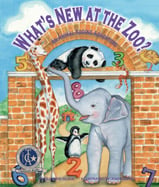
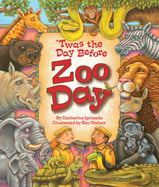
Before you head off for a memorable trip to the zoo, read What’s New at the Zoo?  and ‘Twas the Day Before Zoo Day from Sylvan Dell. 

NewZoo.phpWhat’s New at the Zoo? (ages 2-6) by Suzanne Slade  
A mother and her son are going on an animal adventure at the zoo.  Together, they count the number of animals at each exhibit or habitat.  The two-page spreads depict groups of animals interacting both together and with their environments.  A short poetic riddle describes each location.  Here is a sample: 

Five fuzzy brown bears
Snuggle close and smile.
Two cubs wiggle in.
How many in the pile?

Then, at the bottom of each scene is an addition problem: 5 + 2 =.   There are so many excellent teaching opportunities just from sitting down and reading What’s New at the Zoo?  to your children, such as alliteration, rhyme, animal names (including male, female, and baby), counting, and adding.  Of course, your kids will be inspired to have their own animal adventure as they count animals on your zoo day trip.  Sylvan Dell provides a 50-page Teaching Guide and other resources at its website. 


ZooDay.php'Twas the Day Before Zoo Day (ages 3-8) by Catherine Ipcizade  
This entertaining adaption of the famous ‘Twas the Night Before Christmas poem brings the animal preparations and habits to life.  There is excitement and anticipation in the air.  Meerkats are watching from their dens while nibbling on bugs.  The dirty, naughty elephants spray the zoo keepers with their trunks and frolic in the cool mud.  The llamas are instructed not to spit.  Other animals are more laid back like the lions slumbering with their heads on their paws and turtles hiding in their shells.  Some animals are discontented:  The Zebras feel their stripes have gotten too dull, so they wish to have polka dots.  Each page is written as an amusing, rhyming stanzas:

With big wooly paws and eyes like the night,
the black bears look scary and cause a fright.
But they really like frolicking out in the sun.
It's true they roar loudly, but mostly for fun. 

As the sun goes down, the zookeepers leave the animals to rest up for the big day.  The next morning, a flood of enthusiastic children enter the zoo for Zoo Day.  Read 'Twas the Day Before Zoo Day before you trip to the zoo.  Through the entertaining text and beautiful illustrations, children will learn about animal habits and temperaments, the zoo keeper's job, poetry, and rhyme.  Sylvan Dell provides a 33-page Teaching Guide and other resources at its website to use with your lesson plans or as fun activities. 

Check out SanDiegoZooKids for games, activities, and animal information (pictures, facts, and videos).   

Saturday, January 29, 2011

Ancient World History (Greece): The Life and Influence of Pythagoras

In our study of the ancient world, we have been focusing on the life and influence of Pythagoras, a Greek teacher and philosopher.   Pythagoras has been fascinating to study, especially since there are some noteworthy parallels to his life and that of Buddha’s, our last ancient world figure.   For instance, both had a privileged early life, but they devoted their adult lives to learning truth and knowledge.  They both believed in educating women and in reincarnation.  Pythagoras was more of an elitist though.  He believed in putting his students through a rigorous set of tests to prove themselves.  Only the best and brightest were allowed into his inner circle, though others could study at his school in a limited capacity. 

Mathematics was the thrust behind Pythagoras.  He believed the essence of all things is numbers.   Numbers, he hypothesized, are not just the key to the physical world but also to the spiritual world.  For instance, he thought that each of the first ten numbers (1-10) had a name and a purpose, such as #1 was the origin of everything, #2 represented creation, #4 signified justice, and #8 symbolized friendship.  He used numbers to define shapes and to develop music notes.  Pythagoras even saw a relationship between numbers and morality. 

There are not many juvenile resources on this highly influential man.  The three books I read are the most recent and accessible.  There is one other resource that is not readily available to me, but it may be to others:  Pythagoras: Pioneering Mathematician and Musical Theorist of Ancient Greece (ages 12 and up) by Dimitra Karamanides.


The Life and Times of Pythagoras (ages 10 and up) by Susan Sales Harkins & William H. Harkins  
This biography is divided into five chapters:  Pythagoras’ early life, his schools, his general philosophy, his theories on numbers, and his final years.  The closing pages include a timeline of the major events in his life, a timeline of related historical events, and further resource citations on Pythagoras.   Personally, I found the material fascinating.  My children (10 and 13) thought it was a bit heavy for reading out loud.   I would recommend this book as background knowledge for a teacher or a parent.   I created a handout to help make the material more manageable.  This biographical book could also be used for older children (at least 11 and up) to read independently for a research project or for further knowledge. 

Even if you do not plan to study Pythagoras’ life in any detail, the next two resources are effective in showing how mathematics can be used to assist people with everyday problems.  Use them to accompany a math lesson or to inspire children to value the field of mathematics. 


What’s Your Angle, Pythagoras? (ages 8 and up) by Julie Ellis 
Pythagoras is a curious boy.  He loves to observe problems and to find mathematic solutions for them.  During a trip to Egypt with his father, he learns about right angles which inspires him to develop the idea of square roots.  He uses square roots to help his father figure out the distance between home and his trading destination as well as to adjust a ladder so it is tall enough to reach the roof.  Then, he uses a rope formed into a right angle to help some builders make perfect squares, allowing them to fix the crooked bases of the columns on a temple they are working on.  Pythagoras learns that difficult problems can be solved when looking at them from the “right” angle. 


Pythagoras and the Ratios (ages 8 and up) by Julie Ellis  
Octavius, Pythagoras’ cousin, makes some new pipes to play in a local musical contest.  Unfortunately, they sound awful!  Pythagoras aids his cousin by comparing his sweet sounding pipes with the dreadful sounding ones.  Using ratios, Pythagoras cuts the pipes so they are the same ratio as his own but due to size one sounds deeper and the other is lighter.  He learns that the length of the pipes controls how high or how low the musical notes sound.   Amara, another cousin, is so impressed that she asks him to fix two lyres in the same way.   Using different weighted rocks, Pythagoras manages to adjust the lyres to have the same notes as the pipes.  By standardizing the notes, the group is able to play songs together in perfect tune at the musical contest.  This story, while fictional, is based on historical references to Pythagoras’ experimentation and discovery of the relationship between music and mathematic. 

For other ancient Greek posts, click here.

Tuesday, November 30, 2010

Picture Books: Counting Down to Christmas

These Christmas tales use counting as a platform to tell about holiday traditions.  While they are useful for teaching or reinforcing counting skills, these books are entertaining and enduring in their own right.  Each book illustrates tradition, holiday spirit, and family memories. 


 Counting Christmas (ages 3-6) by Karen Katz  
Three children count down to Christmas Day.  In preparation, they wrap the tree with lights, put out the presents, make cookies for Santa, hang their stockings, and race upstairs.  Once the parents lovingly put them to bed, the children dream of Christmas goodies and gifts.   On Christmas morning they joyfully play with their toys and family.   Teaching Opportunities:  Counting, Numerals, Number Words, Ryhme, Alliteration, Traditions


Christmas for 10 (ages 3-8) by Cathryn Falwell  
A simple counting format frames the festivities of a loving family preparing for Christmas.  The family decorates their tree, plays music, listens to stories, wraps presents, bakes cookies, and strings popcorn.  In addition, they pack baskets for the needy and cheerfully welcome guests.  Christmas for 10 illustrates children, parents, and grandparents making holiday memories together.  Teaching Opportunities:  Counting (backward & forward), Numerals, Family, Traditions


The 12 Days of Christmas (ages 3-8) by Linnea Asplind Riley 
This cumulative picture book illustrates the popular Christmas song by the same name.  It is the story of a young man who gives his true love many unusual gifts, such as two turtle doves, three French hens, four colly birds, and five golden rings.  The vibrant paper cut-out illustrations are appealing.  Teaching Opportunities:  Counting, Numerals, Ordinal Numbers, Vocabulary Building, Music


Ten Little Christmas Presents (ages 4-8) by Jean Marzollo 

Ten presents are sitting in the snow, labeled with an animal's name.  Each two-page spread illustrates an animal with his Christmas present and the number of presents left along with rhyming text.  For instance, "Ten little Christmas presents, in the snow so fine...Mouse gets earmuffs!  Now there are nine."  The pattern continues as each new present is opened.  After all the presents have been revealed, they ask, "Who's our Secret Santa?"  Then, Santa Bear slides down the hill and wishes everyone a merry Christmas.  Teaching Opportunities:  Counting, Numerals, Forest Animals, Vocabulary, Rhyme, Generosity

Under the Star (ages 4-10) by Jane Yolen 
Each two page spread repeats the words, "Under the star, Under the star" on the left. Then, in ascending order (1-10) a countdown of people and animals who would have seen the Star of David on the night Jesus was born are called out.  The final picture is of all the people and animals gathered around Mary, Joseph, and Jesus in the manger.  Teaching Opportunities:  Counting, Number Words, Numerals, Christmas, Bible Story


Snowbear’s Christmas Countdown (ages 5-10) by Theresa Smythe  
On the first day of December, Snowbear starts to prepare for Christmas.  Each day he fulfills one of his holiday traditions.  Snowbear writes out his Christmas cards, makes ornaments, picks out a tree, goes shopping, and wraps his presents.  In addition, he enjoys the winter weather by sledding and ice skating.  On Christmas Eve, Snowbear bakes cookies for Santa and his reindeer.  Readers will enjoy this countdown to Christmas (1-25).  Teaching Opportunities:  Counting, Ordinal Numbers, Weather, Traditions, Bears


Counting to Christmas (ages 4-8) by Nancy Tafuri  
Similar to Snowbear’s Christmas Countdown, a young girl counts down day by day.  Every couple of days she participates in a different activity, such as sending cards, making a gingerbread house, baking cookies, wrapping presents, and stringing popcorn.  Part of her holiday tradition is to prepare a Christmas treat for the animals outside.  Teaching Opportunities:  Counting, Traditions, Numerals  

Beyond the Story: Why Meaningful Nonfiction Belongs in Literature Instruction

Teaching literature involves more than helping students understand what happens in a story. Students also need to understand the ideas, conf...