Showing posts with label sharing. Show all posts

Thursday, July 19, 2018

10 Terrific Picture Books (Perfect for Summer Reading)


Alison Murray, author & illustrator
When Dino Duck is born, he is different than his siblings and doesn’t quite fit in with the other lake animals.  His mother consistently reminds him, “scales or feathers, big or small, we’re a family and there’s room for us all.”  When it is time to fly south for the winter, it is a true test of their family bonds.  This sweet inversion of the ugly duckling fairy tale is a must read! 


Gemma O’Neill, author & illustrator
Poor Geoffrey!  Whatever he tries to do, he is a clumsy mess!  Whether it is tripping over his long, gangly legs or bumping into a group of elephants, Geoffrey’s attempts to make friends falls flat…until, he meets a group of monkeys and a flock of birds.  Then, he realizes he is special just the way he is.     


Ross Burach, author & illustrator
On Giraffe’s first day in the jungle, the other animals mistake him for a chair.  If that is not bad enough, he is captured by a human who takes him home to be…a chair.  Just as Giraffe gets the courage to tell the others he is not a chair, he has an encounter with the most feared animal in the jungle!  The exuberant illustrations are full of humor and irony. 


Kate Banks, author
Simone Shin, illustrator
A young boy revels in the noises of the morning—from the clitter-clatter of playing with his toys to the chitter-chatter of his parents talking. As he plays, there is a “roar” of a lion and a yell from a dragon as well as a “rumble grumble bang!”  After a while, it is quiet time. The boy's imagination continues to take flight—even in the silence of the afternoon.  ull of noise and wonder, this book illustrates the joy of a life unplugged.


Elizabeth Bennett, author
Jane Chapman, illustrator
Big (Bear) and Small (Mouse) are best friends.  As they spend the day together, Small often needs help. Big is always there to lend a hand.  At bedtime, Big needs “a little help, please.”  Of course, Small is happy to do it.  Chapman’s charming illustrations along with Bennett’s sweet text make Big and Small a memorable and heart-warming read about friendship and kindness!


Madeline Valentine, author & illustrator
Mouse and Chipmunk are playing together when they spy a big, beautiful Nut.  They both want it.  They both insist on the other taking it. They both end up stealing it from the other.  After lots of hijinks, humor, and drama, Mouse and Chipmunk come to a valuable realization.


Todd Tarplay, author
Danny Chatzikonstantinou, illustrator
Ethan’s grandma is a ninja.  At first, he loves all the fun and attention they are having.  Then, her power kick deflates his team’s ball and their escapades prevent the family from going out to dinner.  Ethan asks his grandma to stop acting like a ninja.  When she doesn’t take him to school the next morning, Ethan begins missing her and feeling bad for the way he acted.  Grandma shows up though at a vital moment.  Ethan gains a greater appreciation for his grandma—quirks and all. 


Jonathan Bentley, author & illustrator
Where is Bear?  Under the sofa?  In the car?  On the shelf?  As the little boy looks all over the house for Bear, readers catch glimpses him.  This charming book is ideal for preschoolers who are sure to delight in telling the boy where Bear is hiding.  Also, there is a sweet, unexpected ending. 


Angela Dominguez, author & illustrator
Hugo is not your typical bird:  He prefers walking to flying. He is content living on the ground.  Lulu befriends Hugo.  She wants him to fly with her to visit the Eiffel Tower.  Hugo is afraid to admit he not only doesn’t know how to fly, but he is afraid to try.  With the help of a wise friend, Hugo overcomes his fear and learns “the sky is the limit” when he allows himself to be open to change.  


Lauren Castillo, author & illustrator
A boy visits his Nana at her new city apartment.  All the noises and activities make him feel apprehensive.  However, Nana loves the bustling and booming of the city.  The next morning, she gives the boy a fancy red cape.  Together they explore the city, allowing the boy to realize the city is not scary at all.  Instead, there is so much for Nana (and him) to do there.  He comes to the conclusion it is the perfect place for her to live. 

Saturday, April 14, 2018

The Man Who Loved Libraries (Andrew Larsen)


Author:  Andrew Larsen

Illustrator:  Katty Maurey

Target Ages:  5 and up

Genre:  Picture Book Biography

Publisher Summary: 
When you open the door to a library, a world of opportunity awaits.

No one believed this more than Andrew Carnegie.

Andrew Carnegie came to America as a poor, young immigrant.  He worked hard and made the most of his opportunities.  Eventually, he created a steel empire that helped shape modern America.  This made Carnegies a very rich man.  But he never forgot the important role a library played in his success.  Carnegie used his wealth to build public libraries around the world in hopes they’d help others achieve their dreams.

First Lines:
Andrew Carnegie was born in a tiny stone cottage in a small Scottish village.  A large wooden loom took up most of the ground floor.  Andrew and his family lived, ate, and slept upstairs in the attic. 

Evaluation:
Before reading this book, I was familiar with Andrew Carnegie, but I forgot most of what I learned in history class.  This book, though, gave me a deep appreciate for his many contributions to the world—especially in the creation of libraries.  

With is engaging storytelling, author Andrew Larsen focuses on three main parts of Carnegie’s life. 

First, readers are introduced to his childhood.  His parents struggled to make ends meet.  Eventually, they came to America for a chance at a better life.  Andrew worked hard in school and in his factory work.  Despite his humble beginnings and limited educational opportunities, his work ethic and innovative thinking helped him succeed.  His early life demonstrates that success is possible no matter what early opportunities a person is given. 

Next, he did not waste his earnings on materialistic and wasteful items.  Instead, he invested his money.  Small investments led to bigger ones until he made millions.  He reinvested that money into businesses, like steel.   Carnegie ended up with so much money that he did not know what to do with it all.  His early adult life illustrates the importance of saving and investing. 

Finally, he believed his riches were for sharing.  This conviction prompted him to build over 3,500 libraries worldwide.  All of his libraries provided books free of charge to community members.  Carnegie wanted all people to have the opportunity to learn and to better themselves.  He knew literacy was the way to do so.   His legacy is the importance of giving back to the community. 

Each part of his story is illuminated further with Katty Maurey’s illustrations.  She uses a neutral pallet with splashes of dusty blue, deep red, and muted yellow.  The colors further give his life a humble but dignified tone. 

The Man Who Loved Libraries:  The Story of Andrew Carnegie is an inspiring biography of a man who proved the sky is the limit—no matter what your background or privilege. 


Activities and Extension Ideas for Lesson Plans:
  • Writing:  Encourage students to think about how they would use their money to give back to the community if they became rich.  Younger students can fill out a simple sentence:   “If I were rich, I would use my money to ________.” Older ones can write a paragraph. 
  • Math:  Either individually or in small groups, have students pick a stock.  There are many they will be familiar with like Disney, Apple, and Facebook.  The class or family can pretend to buy a set number of shares, such as 10 or 100.  Chart the stock’s progress for a month or more.  How much money did each stock earn?  Give a reward to the winning team or to the top 3 students.   
  • History:  Learn about other important contributions Carnegie made like Carnegie Hall and the Golden Gate Bridge.  Connect this story to a study of the Industrial Revolution. 
  • Compare and Contrast:  Possible areas to compare and contrast—school then vs. now, teen life then vs. now, and educational opportunities then vs. now.
  • Geography:  Identify on a map the places listed where Carnegie opened libraries. 
  • Character:  Identify and discuss habits that helped him become successful—reading, work ethic, innovative ideas, saving and investing, and so forth.
  • Reading Comprehension:  Use this Reading Guide for The Man Who Loved Libraries for question ideas.
For more great picture book recommendations, visit the Perfect Picture Book Friday Round Up.


Sunday, February 11, 2018

Elephant & Piggie Like Reading (Early Reader Series)


I recently came across the Elephant & Piggie Like Reading series.   If you have emerging or early readers, these books are worth having on your shelf.  Your children will clamor to listen and to read them over and over.

Here’s what to expect in the series. 

Elephant and Piggie always introduce the book about to be read. The front end paper shows them holding and reading the book together.  On the first pages, they briefly chat back and forth with their energetic wit about the story.


Short sentences are in dialogue boxes. With limited words on each page, early readers will move through the books quickly.  As a result, they will get a sense of accomplishment.  


Common sight words (I, am, is, it) are combined with new words repeated often like shoes, grow, button, press, and cookie. Children will quickly build further reading confidence as well as expand their reading vocabulary. 

Also, lively sound words are incorporated, such as snap, rumble, squish, flop, beep, and honk.  These words make the stories more exciting and the reading experience more dramatic.


The stories include memorable characters interacting—blades of grass, shoes, birds, and a group of animal friends. The authors utilize puns and irony to create humorous situations and dialogue.

At the end of the book, Elephant and Piggie reappear to comment on the story, often using creative word play.  This sandwiching technique adds humor and enthusiasm for the book itself and reading in general.  


Bryan Collier, author and illustrator
A closet of shoes get excited when they know it is time for young girl’s outing with her father.  Each one wonders—will I get picked?  Two shoes get chosen, but the unexpected occurs!


Dan Santat, author and illustrator
Four unlikely friends—a hippo, a crocodile, and two squirrels—try to figure out a way to divide their cookies fairly. Things are complicated by hippo’s nervous habit. 


Charise Mericle Harper, author and illustrator
Yellow Bird is proud to have button that does nothing.  Blue Bird and Red Bird though find it does do something.  However, convincing Yellow Bird is harder than they expected.


We Are Growing!
Laurie Keller, author and illustrator
Eight friends are growing up fast.  As they do, they find that each one is unique in his own way…that is, except Walt. After an unfortunate event, he finds a way to stand out. 

Coming soon...The Itchy Book.

Saturday, January 13, 2018

Ling and Ting Series (Grace Lin)


Author:  Grace Lin

Illustrator:  Grace Lin

Target Ages:  4-8

Level:  Early Reader Chapter Book/Passport to Reading Level 3

Genre:  Realistic Fiction

Evaluation:
Ling and Ting is currently a four book early reading series. Each page has a combination of illustrations, simple text, and short sections, making the series ideal for youngsters wanting to move to the challenge of chapter books. 

The books are divided into six short story chapters. The first five stories are all connected to the same theme.  In the first three books, the last one is a story (usually silly and/or imaginative) that one of the girls creates from her perspective.  The final story is either a mash up of the details in the previous five or a contrasting narrative.  In the fourth book, this formula was not followed. Instead, all six chapters were stories about the weather.

The characters are kind, thoughtful, and inquisitive.  The author effectively conveys the girls’ animated and infectious personalities in the limited vocabulary and vivid snapshot illustrations. Their relatable experiences and charming personalities will draw children in while the positive themes and admirable character qualities will impress parents. 

One of my favorite characteristics of the series is how it celebrates reading and writing.  Ting and Ling are often found with books or reading. Also, each book encourages the characters (and readers) to become part of the storytelling.  The girls depict reading, creating, and writing as both fun and engaging. 

Here are the first four books in the series.


Each chapter reveals (both directly and indirectly) the ways the Ling and Ting are different.  Ling sits still during her haircut, but Ting is wiggly (which causes a slight problem).  Similarly, one girl eats with ease using her chopsticks while the other struggles with hers.  The final chapter is a story that Ting tells to Ling using the elements of the narrative, but in an embellished, mixed up way. 

Extension Ideas
  • Discuss how each girl is different. Look closely not only at the text but at the illustrations for clues.
  • Using a graphic organizer or chart, show the similarities and differences between the two girls. 
  • Compare the details in the “Mixed Up” chapter with what really happened in the story. 
  • Write a mixed up stories using this story’s (or another one's) details. 
  • Here is an educator's guide for the Ling and Ting series from the publisher. 


Ling and Ting celebrate their birthday together.  They buy gifts, bake cakes, make birthday wishes, and open presents.  They end their day with an alternate birthday tale. 

Extension Ideas
  • Build on the previous book discussion on how the girls are similar and different.   
  • Evaluate the different ways the girls show kindness and compassion to one another. 
  • Compare the “Birthday Story” chapter with the birthday story of the previous five chapters. 
  • Practice predicting skills in each chapter:  Which color shoes will girls each pick?  What gifts will they buy each other?  What will happen when they make their own birthday cakes?  What will their birthday wishes be? What will happen when the girls exchange gifts?
  • Compare their birthday traditions to your own. 


The focus is on silly stories the girls imagine and act out. For instance, Ting plants cupcakes in the garden in hopes of growing a cupcake tree (wouldn’t we all love that!).  The girls have an imaginary swing contest that takes them up above the trees and beyond. My favorite though is their elaborate plan to convince monkeys to pick apples for them! Like the other two books, it ends with a story the girls created using the elements of the previous chapters in a unique way.  In this one, there are several illustrations of handwritten pages with pictures they drew. 

Extension Ideas
  • Build on the previous book discussion on how the girls are similar and different.
  • Compare the fantasy or silly elements with reality or realistic elements. 
  • Come up with an imaginative plan to accomplish a goal or chore (like story 4). 
  • Write and illustrate a silly story (like story 6).


Together in All Weather
Beginning with a lightening storm and ending with a double rainbow, the girls experience all 4 seasons.  In the summer they set up a lemonade stand, and in the fall they rake leaves.  My favorite is the winter story though. Ling comes up with a creative way to prove Ting is not too sick to shovel the snow.  The final two stories involve playing in the spring rain and finding a rainbow. Like the first three books in the series, the stories are sweet and entertaining. They also often have a witty or ironic ending.  

Extension Ideas
  • Build on the previous book discussions on how the girls are similar and different.
  • Before reading, brainstorm the reader's (or readers') favorite activities in each season.  How does it compare to Ling and Ting's?
  • Pick a season. Together write (or tell it orally) a story about the girls experiencing the seasons in a different way, such as sledding in the snow, planting a garden, going to the pool, or carving a pumpkin.  
  • Compare the pictures to the text in story one.  What is revealed?
  • Like the mixed up stories in the previous books (in chapters 6), create one for this book.  Write down all the main events.  Mix them up.  Pick one from the pile and embellish it.  Keep going until all the events have been used up.

All children love to celebrate their birthdays, to use their imaginations, to participate in seasonal activities, and to play with their siblings/friends.  All children can show compassion and actively share.  In short, this multicultural series focuses on what makes us similar rather than different.  

The Ling and Ting series deserves a place in your primary classroom or home library.  Your children will enjoy reading and re-reading it.  

Sunday, June 26, 2016

10 Picture Books That Will Make You Smile (and Laugh)

This list is for everyone who loves an twisty, turny, funny, ironic, laugh out loud picture book. Each one is sure to warm your heart as you snuggle with your little ones during story time, share in your classroom, or read independently because you are a picture book junkie like me. Be sure to check out these 10 picture books on your next trip to the library or bookstore. They will make your day a whole lot brighter as well as elicit smiles and giggles from the kids in your life.  


I Am Bear by Ben Bailey Smith and Sav Akyuz
Publisher Summary:
“This is Bear.  He was bare.  Now he’s wearing…purple hair.  His favorite thing is playing tricks. He makes trouble just for kicks. “

What’s to Love: 
This book had me laughing out loud.  The rhyming text is quick and snappy. The humor is primarily in the discrepancy between the words and the pictures (situational irony).  For instance, Bear says he does magic which prompts a pile of fish to appear.  However, it is clear that the wand has a fishing line on it.  He reveals his favorite game is cops and robbers, but it is quite different than what the reader expects. Kids may not fully understand irony, but they will recognize the humor.  (Do not hesitate to identify the ironies to young listeners.  They will likely catch on to this concept quicker than you think.)


Publisher Summary: 
“Everyone likes hugs, especially when Bear gives them!  Everyone, that is, except for Skunk.  Bear really gets on Skunk’s nerves.  He’s too happy…and he’s always giving way too many hugs!  Skunk has the perfect plan to keep Bear from giving any more hugs.  Will it work?”

What’s to Love: 
Skunk tries three different tricks on Bear, each with a hilarious and unfortunate end—for Skunk.  Kids are sure to giggle as Skunk gets skunked. Bear continuously offers Skunk a hug, but he adamantly declines it.  Bear always replies, “It’s okay.  I’ll save you one for later.”  When Skunk finally changes his mind, Bear really wants to save it for later—and for good reason. 


Publisher Summary: 
“Clemmie the Cat knows everything about how to catch a mouse—and she would prove it, too, except that she’s never actually seen a mouse! Perhaps, she thinks, they’re all afraid of her.  But wait…is that a pink tail? And a whiskery nose?” 

What’s to Love: 
Clemmie sees a long pink tail.  She creeps up, thinking it is a mouse.  Instead, it is a ribbon on a hat.  The same sequence happens with two round ears (a stuffed bear) and whiskery, pointy nose (a spider).  She is convinced she has scared away all mice.  However, there is a mouse lurking around craftily.  This story has potential for interaction as children look for and guess along with Clemmie as well as point out the sneaky mouse.  The ending is a fun surprise. 


Publisher Summary: 
“Sandwich?  What sandwich? Oh, that sandwich. Right. Um. Well. It all stated with the bear…”

What’s to Love: 
The bear’s journey from the forest into the “jungle” of a city is worth the read.  The illustrations add so much energy and humor as the bear scratches his back on a tree (light post), squishes in the mud (wet cement), and finds interesting smells (trash cans).  His experience finding, eating, and retreating is a rollicking fun time.  What got me, though, was the end.  I laughed out loud (but I won’t ruin the surprise).


How to Share with a Bear by Eric Pinder and Stephanie Graegin
Publisher Summary: 
“The perfect thing to do on a chilly day is to make a cave.  But, of course, a comfy cave never stays empty for long.  What’s a boy to do when a bear takes over his cave?  Try to distract him with a trail of blueberries?  Some honey? A nice long back scratch?”

What’s to Love: 
The protagonist comes up with several solutions to his “bear” problem, showing resourcefulness and creativity.  The illustrator does an excellent job with blocking, so the reader does not see what is really going on until the end.  This imaginative text is so sweet you will not be able to help but smile real big. 


Publisher Summary:
“Meet Max.  Max the Brave, Max the fearless,  Max the Mouse-catcher.  But, in order to be a Mouse-catcher, Max needs to know what a mouse is.”

What’s to Love:
Following a similar format as “Are You My Mother?” Max asks each animal if he is a mouse.  The hilarity begins when he actually meets Mouse.  After a couple quick twists and turns, there is a satisfying and clever ending. 


Publisher Summary: 
“Two bears. Three yaks. Four seals. Six cats. All of them have one thing in common: They hate to share. But here comes a pack of twenty pigs—count on them to prove that sharing makes everything twice as fun.”

What’s to Love: 
This concept book teaches counting and number words while illustrating the importance of sharing in a comical way.  It is the most energetic concept book I have seen.  Word play includes onomatopoeia, alliteration, and rhyme.  The illustrations are fantastic.  Sharing and underwear are taken to a whole new level. 


Publisher Summary:  
“I am my own dog.  I fetch my own slippers, curl up at my own feet, and give myself a good scratch.  But there’s one spot in the middle of my back, that I just can’t reach.” 

What’s to Love:  
This story is told through the dog’s perspective, mimicking many of the phrases associated with them, but in unexpected ways.  The “little guy” who follows him home is the man pursuing the dog.  The ones “yapping” are the people as the dogs looked annoyed.  Of course, he has to clean up all the man’s messes.  Dog lovers will smile and chuckle at this inversed story full of irony and humor. 


Publisher Summary
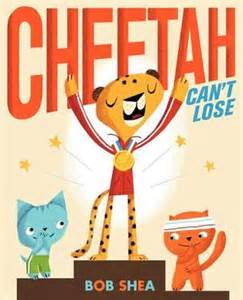
"It's race day, and once and for all, it's time to determine the better feline:  little cats or big cheetah.  Cheetah might be bigger, taller, stronger, faster...but the little cats have some tricks up their sleeves, so don't count them out." 

What’s to Love: 
Cheetah is, let's say, an over-achiever.  He has to win and to be the best at everything!  The sly little cats let him win several challenges but have an ulterior motive.  While Cheetah has no clue, the reader can infer what is really going on.  Full of humor and action, this story will be a winner with readers or all ages.   


How to Cheer up Dad by Fred Koehler
Publisher Summary
"Little Jumbo's dad is having a bad day. Little Jumbo has no idea why.  Luckily, he does know just how to cheer up Dad with some of his--ahem, his dad's--favorite things!"

What’s to Love: 
This endearing story about a boy and his loving dad is sweet.  The adorable pictures capture the mischief and energy typical in preschool-aged children.  I laughed in a couple places and smiled all the way through. The pictures and the words convey different ideas, making this one ideal for teaching inference and irony.  

A Better Way to Teach Theme: Why I Built the Jory John Now Prove It Series

If you’ve ever taught theme, you know the moment. Students finish a story, you ask “What’s the theme?” — and suddenly you’re flooded with a...