Showing posts with label numerals. Show all posts

Saturday, April 7, 2018

Don’t Ever Look Behind Door 32 (B.C.R. Fegan)


Author: B.C.R. Fegan

Illustrator:  Lenny Wen

Target Ages: 4-8

Genre:  Concept Picture Book

Amazon Summary: 
The magical Hotel of Hoo is a mysterious place with some very unusual occupants. As our guests explore the strange hotel, they are invited to experience everything it has to offer with just one warning… don’t ever look behind door 32.

First Lines:
Welcome to the magical
Hotel of Hoo.
Where I’ll be your host,
Mr. Nicholas Noo.


Evaluation:
Along with the protagonists, readers take a fantastic tour of the hotel. The rooms have different types of guest from the mythical (zombies, goblins, mermaids) to the realistic (knights, clowns, monkeys) to the silly (tea-loving monsters, miniature giants, grey-haired villains). Some rooms are places for guests (golden bathroom, museum, library, dinning hall) while others are unconventional places (a maze, a dark room, a treasure room). Characters and rooms are scary in a silly, child-like way. 


The narrative encourages children to practice counting to 32 as they take a tour of the hotel.  During the tour, they are often reminded not to look behind door 32.  As they get closer and closer, anticipation is built.  With so many “scary” characters, what might be in room 32? (Fortunately, it is a humorous twist.)

It seems like 32 rooms would be tedious to count down to.  However, in this magical place and with the entertaining rhyming verse, time flies by.

Don’t Look Behind Door 32 works well for classroom reading and learning as well as bedtime story or as a Halloween tale.

Activities and Extension Ideas for Lesson Plans:
  • Predicting Skills:  In the first read, ask children to predict what is in Room 32.  In later readings, ask children to anticipate what is coming next.
  • Math:  Practice counting to 32. 
  • Story Extension:  Either draw or write about what is in room 33. Or write/discuss alternate endings to what could be in room 32.  
  • Writing Numbers:  Younger children can practice writing out the numbers in shaving cream or other substance.  Older children can write them out on paper.  
  • Writing:  With such a colorful cast of characters, children can write about their favorite one.  Younger children can fill in a simple sentence like:  “My favorite character is ______ because ________.”
  • Figurative Language:  Introduce the terms oxymoron and irony.  Discuss the examples in the story, like miniature giants (oxymoron) and wingless dragons and grumpy clowns (irony). 
  • Literature:  Read about some of the mythical characters like mermaids, fairies, and goblins.
  • Art: Create a diorama room to add to the hotel.  Or provide a hotel template like HERE or HERE.  Students can draw their own creative rooms.

Thursday, February 28, 2013

Best Die Cut Picture Books

Die cut picture books are a lot of fun.  They are interactive and, often, innovative.  What are die cut books?  Simply, books that use cut out shapes in the story telling or visual learning. Here is a list of some of my favorite books that utilize die cut pages. 


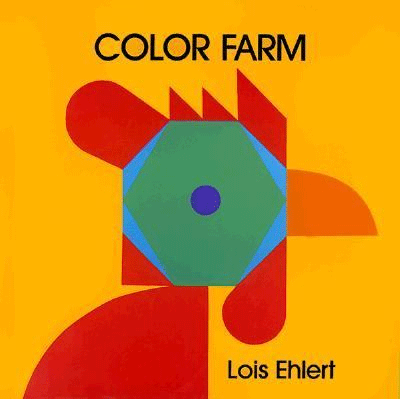
Lois Ehlert is a creative storyteller who often uses shapes, die cuts, and collage.  Color Zoo and Color Farm stack window die cut shapes on top of each other to create animals.  Young children can guess the animals and begin to identify the corresponding spelling of the word because the word is included, large and bold. Each page is also a color the children can recite.  As the reader turns each page, the due cut shape on top is revealed (as is the name, again for early word recognition building).  Ehlert’s books are wonderful for interaction and learning!


Two additional books use animal shapes.  Cock-a-Doodle Who? (Martine Perrine) uses the die cut shapes and patterned papers to create a fun, interactive book.  For instance, the book begins with a solid black page with a die cut of a cow.  The pattern underneath is black and white flowers.  The text reads, “Mooing cow, for whom do you wait?”  children can make a guess.  The next page reveals a large lady with a dress (black and white flower pattern).  The die cut cow is now on top of a pattern with black and white splotches (keeping with the look of the cow).  The text reads, “This maid stepping with a very quick gait.”   The book continues with the same format, each with a die cut animal and a question to answer.  Predicting skills and identifying rhyming words are both essential early reading skills. 


Also, Whoo? Whoo? (by David A. Carter) utilities simple shapes.  Each sequence begins with a solid white page.  One side has a questions mark while the other has a bunch of due cut shapes.  Readers must guess what animals these shapes will create.  The next page reveals the animal, the name, and the sound.  The end of the books depicts all the animals on one page making noise at night which is making at least one person none too happy.  Each of the aforementioned books is ideal for accompaniment with an art lesson.  With various sizes, colors, and shapes, children can be encouraged to create their own real or imagined animals. 


I love Ed Emberley’s imaginative use of storytelling and die cuts.  In Bye-Bye Big Bad Bullybug, suspense is built effectively.  As a UFO comes along, several bugs anticipate with words like “uh-oh!” and “He’s getting closer.”  The enormous bug emerges slowly in the dark of night.  The die cut pages slowly reveal the bug.  First, this three mean green eyes appear.  The next page shows his green eyes with his sharp white teeth.  Each page turn depicts another feature until he is fully realized and it declares, “And now, I’m going to eat you all up!”  Not to worry, the reader can squash it with a big shoe!  Similarly, Go Away, Big Green Monster,  a monster slowly emerges but then disappears with each page turn .  I love the way the child has control the monster’s presence, which translates well to helping children learn to control their fears and imagination.  


I Spy Under the Sea (by Edwards Gibbs) combines the “I spy” game with the die cut window guessing game.   The text begins with “I spy with my little eye…”  The facing page a small description.  For example, the first one states, “something with stripes.” A small circular window reveals a small part of the underwater animal.  In this case, it is an part of a clownfish.  The child-reader makes a prediction.  The next page is the “big reveal.”  There are different numbers of animals for counting practice.  The numeral, number word, and animal name are included on the reveal page.  This book is a fun way to learn about ocean life and numbers.  


Likewise, Cat and Mouse: The Hole Story (by Christyan and Diane Fox) delights youngsters with a determined feline on the prowl to catch an adventurous rodent.  Each window gives a glimpse of the mouse’s activities as he seeks out a piece of cheese while the cat tries to sneak up on him. 


The final two books combine numbers and die cut windows.  One Boy (by Laura Vaccaro Seeger) is an entertaining beginning reader.  In the first sequence, a picture is framed.  The text reads “1 one boy.”  A turn of the page uses part of the previous text to read “All alone.”  The picture is a boy sitting all alone with empty chairs all around him.   One Foot Two Feet (by Peter Maloney & Felicia Zekauskas) combines teaching numbers and singular/plural words.  For instance, a die cut window frames one mouse.  With the turn of a page, three mice are shown.  Children learn about irregular plural words.  

Saturday, June 4, 2011

Picture Books: Little Quack (by Lauren Thompson)

Little Quack, illustrated by Derek Anderson, is one of the most adorable picture book characters. This series of books, written by Lauren Thompson, is entertaining, educational, and endearing.  Little Quack and Little Quack’s Hide and Seek are among my favorites.  They both illustrated early math skills and invite listener participation.  I HIGHLY recommend this series for ages 2-7.  As an extension idea, follow up reading with a trip to local lake or pond to feed the ducks!  


Little Quack   
Mama Duck has five little ducklings:  Widdle, Waddle, Piddle, Puddle, and Little Quack.  They have lived securely in their nest, but now it is time to leave.   Mama urges them to paddle on the water with her.  The little ducklings squeeze in close.  One by one, they gather the courage to jump.  Each time the following repetitive text is given before the next duckling plunges in: 

“No, Mama, no!” they cried. “We’re too scared!”
“You can do it,” Mama said. “I know you can.” 

There is onomatopoeia to accompany the ducklings as they enter the pond, such as “splish,” “splash,” and “splosh.”  Along the bottom border, a running quack-u-lator tallies how many ducklings are in the pond. The numeral, a picture illustration of the number, and the numeral word are all included.  The final duckling to take the plunge is Little Quack.  As he splishes and splashes in the water, he cries, “I did it…I really did it!”  His Mama replies, “I always knew you could.” This sweet book is perfect for teaching about courage and confidence as well as onomatopoeia, counting to five, numerals, number words, and pond life. 

One day Mama suggests they play hide-and-seek.  Each duckling is confident that Mama Duck won’t be able to find him.  He will find the “best” place of all.  One by one they find a spot to hide as Mama counts to ten.  (The quack-u-lator on the bottom border illustrates the basic subtraction problem.)  As Mama finishes counting,  Little Quack has not found a place to hide yet.  He stealthily swims up behind her as she seeks out her little ducklings.  The repetitive text states each time:

“Any ducklings down there?"  she called.
(Ducklings respond in various ways as they are found.)
“That’s (number) little ducklings found,” said Mama.
“Who will I find next?” 

Little Quack sure is tricky.  After all the other ducklings are found, Mama Duck cannot locate him.  (Children will enjoy “finding” him though.)   Finally, Little Quack jumps out and yells, “Here I am...Right behind you, Mama!”  She responds, “You did find the best hiding place of all!”  The family all laughs at how Little Quack tricked Mama Duck.  Little Quack’s Hide and Seek teaches adding, subtracting, counting, and numeral words.   It also depicts a family playing and laughing together. 

Other Little Quack Books

For babies and toddlers, there are Little Quack Board Books on ABC's, Counting, Bathtime, Colors, and Opposites.

Tuesday, November 30, 2010

Picture Books: Counting Down to Christmas

These Christmas tales use counting as a platform to tell about holiday traditions.  While they are useful for teaching or reinforcing counting skills, these books are entertaining and enduring in their own right.  Each book illustrates tradition, holiday spirit, and family memories. 


 Counting Christmas (ages 3-6) by Karen Katz  
Three children count down to Christmas Day.  In preparation, they wrap the tree with lights, put out the presents, make cookies for Santa, hang their stockings, and race upstairs.  Once the parents lovingly put them to bed, the children dream of Christmas goodies and gifts.   On Christmas morning they joyfully play with their toys and family.   Teaching Opportunities:  Counting, Numerals, Number Words, Ryhme, Alliteration, Traditions


Christmas for 10 (ages 3-8) by Cathryn Falwell  
A simple counting format frames the festivities of a loving family preparing for Christmas.  The family decorates their tree, plays music, listens to stories, wraps presents, bakes cookies, and strings popcorn.  In addition, they pack baskets for the needy and cheerfully welcome guests.  Christmas for 10 illustrates children, parents, and grandparents making holiday memories together.  Teaching Opportunities:  Counting (backward & forward), Numerals, Family, Traditions


The 12 Days of Christmas (ages 3-8) by Linnea Asplind Riley 
This cumulative picture book illustrates the popular Christmas song by the same name.  It is the story of a young man who gives his true love many unusual gifts, such as two turtle doves, three French hens, four colly birds, and five golden rings.  The vibrant paper cut-out illustrations are appealing.  Teaching Opportunities:  Counting, Numerals, Ordinal Numbers, Vocabulary Building, Music


Ten Little Christmas Presents (ages 4-8) by Jean Marzollo 

Ten presents are sitting in the snow, labeled with an animal's name.  Each two-page spread illustrates an animal with his Christmas present and the number of presents left along with rhyming text.  For instance, "Ten little Christmas presents, in the snow so fine...Mouse gets earmuffs!  Now there are nine."  The pattern continues as each new present is opened.  After all the presents have been revealed, they ask, "Who's our Secret Santa?"  Then, Santa Bear slides down the hill and wishes everyone a merry Christmas.  Teaching Opportunities:  Counting, Numerals, Forest Animals, Vocabulary, Rhyme, Generosity

Under the Star (ages 4-10) by Jane Yolen 
Each two page spread repeats the words, "Under the star, Under the star" on the left. Then, in ascending order (1-10) a countdown of people and animals who would have seen the Star of David on the night Jesus was born are called out.  The final picture is of all the people and animals gathered around Mary, Joseph, and Jesus in the manger.  Teaching Opportunities:  Counting, Number Words, Numerals, Christmas, Bible Story


Snowbear’s Christmas Countdown (ages 5-10) by Theresa Smythe  
On the first day of December, Snowbear starts to prepare for Christmas.  Each day he fulfills one of his holiday traditions.  Snowbear writes out his Christmas cards, makes ornaments, picks out a tree, goes shopping, and wraps his presents.  In addition, he enjoys the winter weather by sledding and ice skating.  On Christmas Eve, Snowbear bakes cookies for Santa and his reindeer.  Readers will enjoy this countdown to Christmas (1-25).  Teaching Opportunities:  Counting, Ordinal Numbers, Weather, Traditions, Bears


Counting to Christmas (ages 4-8) by Nancy Tafuri  
Similar to Snowbear’s Christmas Countdown, a young girl counts down day by day.  Every couple of days she participates in a different activity, such as sending cards, making a gingerbread house, baking cookies, wrapping presents, and stringing popcorn.  Part of her holiday tradition is to prepare a Christmas treat for the animals outside.  Teaching Opportunities:  Counting, Traditions, Numerals  

Monday, November 29, 2010

Concept Books: General (Learning Numbers & Counting)

Even though counting books are geared for preschool aged children, older kids will often enjoy them too.  My nine year old looked at One Boy several times because it is so creative and entertaining.  He also enjoyed Over at the Castle and One Tractor.   Check out my favorite counting books (general). 

One Boy by Laura Vaccaro Seeger
Using a peek-a-boo window, children can practice counting, identifying words with in words, and predicting.   This clever book begins with a simple phrase on the left side and a window looking on to the next page on the right side.  As you turn the page, the phrase creatively continues and uses parts of the previous one.  In addition, more of the original picture is revealed.  It is sure to bring children back over and over!  Teaching Opportunities:  Counting, Numbers, Numeral Words, Prediction, Words with in Words  *My Top Pick 

Over at the Castle by Boni Ashburn
Using the familiar “Over the Meadow” folk song, a picture of castle life is illustrated.  A mother dragon and her child wait for the right moment to make their entrance.  Meanwhile, groups of lords, servants, chefs, weavers, knights, and others are seen doing their daily work.  Written in beautiful rhyming quatrains and coupled with vivid pictures, the dragons appearance makes a glorious glow in the sky.  Teaching Opportunities:  Counting, Numeral Words, Rhyming, Alliteration, Poetry, Castle Life, Middle Ages, Dragons

One Tractor by Alexandra Siy
Little boys will love this imaginative counting book!  A boy sees a toy tractor on this grass which he imagines is out of gas.  From there, he imagines his interaction with other forms of transportation like planes, boats, dump trucks, trains, and buses.  Each are in groups from two to ten with pirates (and a single mouse) driving, flying, running, swimming, hoisting, and more.  Teaching Opportunities:  Counting, Numbers, Numeral Words, Transportation, Pirates, Rhyme, Alliteration, Poetry, Imagination 

One Sister Smiling by Lucy Coats
From breakfast with one smiling sister to pick-up timeby ten happy parents, a joyful preschool day is described with lots of fun activities and happy faces in the illustrations.  The children are seen painting with five pots, eating six donuts, skipping in a group of seven, and much more.  Teaching Opportunities:  Counting, Numbers, Numerals Words, Rhyme, Alliteration, Onomatopoeia, Poetry, School, Daily Schedule  

This delectable book counts to a baker’s dozen, thirteen.  A baker is illustrated with creating his delicious desserts, such as four sticky buns, five gingerbread cookies, six jelly rolls, seven heart-shaped tarts, and so forth.  Then, all the desserts are shown again for more counting practice.  Teaching Opportunities:  Counting, Numbers, Numeral Words, Rhyme, Baking, Shapes 
 
Various construction vehicles are shown in action, such as earthmovers scraping up a load, bulldozers reshaping the ground, and backhoes scooping up the gravel.  Little boys will love watching these amazing vehicles in action in this backwards counting story.  Teaching Opportunities:  Counting, Construction Vehicles, Transportation 

Carlo Likes Counting by Jessica Spanyol
Carlo, a giraffe, loves counting.  He walks around to many different places like a farm, a toy store, a park, a diner, a garden, and a construction site.  In each scene there are several groups of items for one specific number.  Teaching Opportunities:  Counting, Number Words, Animals, Vocabulary Building (each group of items is labeled) 

Ten Red Apples by Virginia Miller
Bartholomew Bear loves his apple tree.  He climbs it, hugs it, swings on it, and shakes it as he watches the apples ripen.  Watch as a new apple turns red on each page until there are ten in all (Children can also feel the smooth texture of the red ones!).  Then, Bartholomew and his mother make an apple pie with them and enjoy it together under the tree.  Teaching Opportunities:  Counting, Number Words, Bears, Baking, Apple Picking

One Beautiful Baby by Martine Oborne  
A mother is seen waking her baby boy for the day's activities.  The first thought is his one sweet smile.  As she feeds him, she thinks of his two adorable eyes.  She counts things for him like three bananas at breakfast and four diaper during changing time.  The baby plays with his five soft toys before his mother buttons him up for a trip to the park to feed eight ducks and have a picnic.  When you put all of these parts of his body and day together, the end result is "one beautiful baby!"  Teaching Opportunties:  Counting, Number Words, Ducks, Park, Body Parts

City Lullaby by Marilyn Singer
In this backwards counting tale, a baby is sleeping while being strolled through a noisy city.  Horns beeping, cell phones ringing, dogs barking, and trash cans bashing are amoung the many loud sounds the baby sleeps soundly through.  Ironically, when a single bird twitters, he awakens with a smile.  Teaching Opportunities:  Counting, Numerals, Onomatopoeia, Rhyme


You Might Also Enjoy:
Circus 1-2-3 by Megan Halsey  
Beginning with a dynamic ringmaster, members of circus acts are grouped from two to ten.  Two spunky mice lead the way through the acts as elephants do somersaults, bears dance, acrobats defy gravity, seals balance, clowns amuse, and much more.  Each page has a number and a single word describing the acts.  Teaching Opportunities:  Counting, Numerals, Circus Acts, Vocabulary Building 

A Better Way to Teach Theme: Why I Built the Jory John Now Prove It Series

If you’ve ever taught theme, you know the moment. Students finish a story, you ask “What’s the theme?” — and suddenly you’re flooded with a...