Showing posts with label bullying. Show all posts

Sunday, April 21, 2019

Finding Langston (Lesa Cline-Ransome)


Target Ages:  9-13

Genre:  Historical Fiction

Awards:  Coretta Scott King Honor Book, 2019 Scott O'Dell Award for Historical Fiction,  Junior Library Guild selection

Publisher Summary: 
When eleven-year-old Langston’s mother died in 1946, he and his father move from Alabama to Chicago’s Bronzeville.  Langston must leave behind everything he cherishes:  family, friends, Grandma’s Sunday suppers, even the magnolia trees Mama loved so much.  The northern city is noisy and hectic, and their kitchenette apartment is just a lonely room with old newspapers covering up holes.  At school Langston is tormented for being too country.  But his new home has something his old one did not:  unlike the whites-only library back home, the George Cleveland Hall Library welcomes everyone.  There, hiding out after school, Langston discovers another Langston, a poet whose words are powerful.  In one of his poems lies a secret that will bring Langston closer to his mother’s spirit. 

First Lines:
“Never really thought much about Alabama’s red dirt roads, but now, all I can think about is kicking up their dust.  I miss the hot sun on the back of my neck and how now the racket of cicadas, seems like not sound at all.” 

Memorable Moment:
“I get to thinking how much I didn’t know about my Daddy when we lived in Alabama.  With Mama there, he barely spoke to me, and I didn’t know what to say to him.  But now, with just us two in Chicago, I know Daddy better than I ever hoped to” (103).

Evaluation:
Finding Langston would fit well into a middle grade classroom.  The post-World War II setting focuses on black Americans who are a part of the Great Migration.  People at different places in the process from second generation to newly arrived illustrate the successes and struggles. 

The influence of Harlem Renaissance, especially its poetry, is shown as the renewed pride in black culture and literature impacts the protagonist, Langston.  As he discovers the connection of his name to the beloved poet Langston Hughes and his mother’s secret passion, the protagonist begins to understand himself, his mother, and his heritage on a deeper level.

The story and characters connect well with middle grade readers.  Short chapters, well-paced plot, and relatable experiences will keep them turning the pages. 

Langston deals with many common middle grade trials.  He experiences loss—both of his mother (and another dear relative) as well as his home when he moves away.  These situations make him feel lonely and isolated.  As the new kid, he tries to fit in, but instead he is mercilessly bullied.  Langston struggles in his relationship with his father, who is a good man dealing with his own loss and trying to make a better life for his son.

Langston learns to see people in a more multi-faceted way.  He is willing to re-examine his initial impressions, allowing him to come to appreciate others.  In addition, he finds positive ways to cope with his loss and loneliness, which helps him make friends with others and become more connected to his new community.

I highly recommend Finding Langston for middle grade teachers and readers.

Historical Connections:
Great Migration
Harlem Renaissance
Langston Hughes Poetry

For other great middle grade book suggestions, visit Always in the Middle for the Marvelous Middle Grade Monday Round Up.

Saturday, April 13, 2019

10 Perfect Picture Books to Read Now


Steve Antony, author & illustrator
Blip, the robot, loves being on her computer  She learns new things, plays fun games, dances to music, and visits faraway places. When she accidently gets “unplugged” and tousled far from home, she realizes there are other ways to learn new things, play fun games, dance to music, and visit faraway places.  Eventually, Blip plugs back in, but all she can think about is the fun of being unplugged.  This wonderful, timely story reminds us of the importance of really living in the moment—away from electronic devices. 


Deborah Diesen, author
Kris Aro McLeod, illustrator
Izzie and Mama playfully blow kiss to each other and catch them.  When Izzie misses one of her mom’s kisses, she runs as fast as she can to catch it.  Nevertheless, it glides away with the wind.  Mama shares a secret: ”No matter how far they have to go, no matter what they have to get through, and even if they get lost along the way, Mama-kisses ALWAYS come find you.”  Sure enough, the missed kiss finds its way to Izzie.  This sweet mother-daughter story is full of love, affection, and, of course, kisses.


Susan Hughes, author
Carey Sookocheff, illustrator
The protagonist experiences bullying on a daily basis.  Using an original story prompt format, the internal conflict and external coping are revealed in a raw and realistic way.   The child is called weirdo and laughed at, which causes feelings of isolation and insignificance.  After talking the situation over with his/her mother, the protagonist feels empowered to confront the bully.  The situation does not miraculously change, but it does improve. This picture book is ideal for discussing bullying, relationships, and empathy.


Troy Cummings, author and illustrator
In this adorable book, Arfy, a stray dog, writes letters to each house and business on Butternut Street, asking to be their dog.  He makes arguments for why he would be an ideal fit for them—potty trained, can work with cats, will clean the floor, can fetch boots, and so forth.  In return, he gets letters back on why he cannot stay there. After he feels all his options have been exhausted, Arfy gets a letter from an unexpected person asking: Can I be your person?  Can I Be Your Dog is full of charm, personality, and wit. 


The Fan Brothers, authors and illustrators
Finn misses his grandfather.  To honor him, he builds a boat to go on a long journey—one he had planned with his grandfather.  As the journey begins, he encounters a great golden fish, a library island, an island of giant shells, and a sea of moon jellies dancing.  Finally, he reaches the place of his grandfather’s stories: A magical place where ocean meets sky.  Breath-taking illustrations and imagination fill every page in this story about loss and coping. 


Grace Lin, author and illustrator
Little Star bakes a big, yummy mooncake with her mama.  She promises her mama she will not eat any yet.  In the middle of the night, though, she tiptoes toward it.  Little by little, she nibbles on it—until it has disappeared!  Now, mother and daughter must work together to make a new one.  With striking illustrations, the phases of the moon are explained in a memorable and imaginative way. 


Eve Bunting, author
Will Hillenbrand, illustrator
A little duck is afraid to swim in the water with her mom and siblings.  After some encouragement and practice, she finally takes the plunge!  Perfect books for kids with fears of water or other things. 


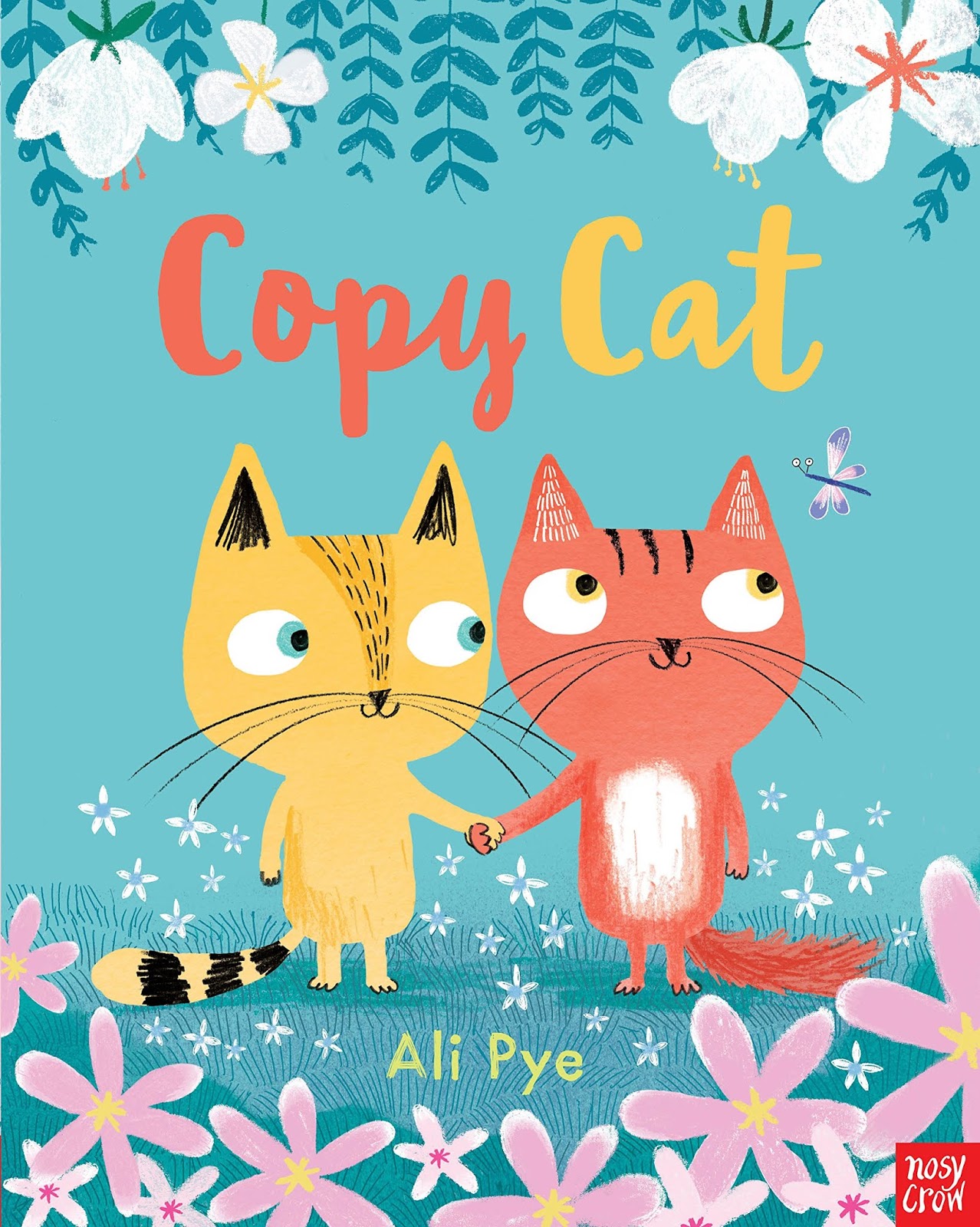
Ali Pye, author and illustrator
Bella wants to be just like her friend, Anna—only sometimes it does not work well for one or both of them.  After a disagreement, Anna stomps off, leaving Bella feeling lost and alone with no one to copy.  Bella learns to do her own thing.  Soon after, Chloe is watching her and wanting to join in.  The girls learn how to cooperate and to collaborate with each other, making for a more satisfying playtime together. Copy Cat is a delightful book about bring a good friend and being your own person.


Richard Byrne, author and illustrator
The chalks love drawing pictures.  Someone keeps erasing them though!  With the help of their teacher and Sergeant Blue, they look at the evidence and solve the case.  However, they realize the issue is not so black and white.  This fun mystery has a creative and inclusive ending. 


The Greatest Adventure
Tony Piedra, author and illustrator

Eliot loves adventure!  Living in the city means using lots of imagination to find it.  When his grandfather comes home from his real adventures at sea, Eliot is ready for a REAL adventure too.  Together, they find that imaginative ones can be just as real.  Stunning illustrations and brilliant imaginative text round out this amazing picture book experience.

Sunday, February 11, 2018

All’s Faire in Middle School (Victoria Jamieson)


Illustrator:  Victoria Jamieson

Target Ages:  9-13

Genre:  Realistic Fiction Graphic Novel

Publisher Summary:  
Growing up with a family who works at the Renaissance Faire, Imogene has always been sure of who she is:  A brave and noble knight.  But now, after being homeschooled, her whole life, she is about to embark on the epic adventure of…middle school!

Evaluation: 
The storytelling is superb.  Three narrative layers run through simultaneously. 

First, each chapter begins with a short paragraph foreshadowing the Imogene’s experiences.  It is written like she is in an epic story.  The ideas carry through in the real world.  For instance, she depicts difficult situations as dragons.  Also, she uses the code of chivalry as her motto.  The roles of medieval and renaissance people—knight, hermit, princess, and squire—are played out in a modern way.

Next, much of Imogene’s life and experience happens at the Renaissance Faire.  The workers are her extended family.  They encourage and support her both as she takes on a new role in the Faire as well as during her school difficulties.  In this place, Imogene begins to find her strengths and learns to make amends.

The final layer is life outside of the Faire. This part consists of her experience at middle school and in her family. The depictions of middle school angst are realistic and relevant.  Imogene tries to figure out all the rules and expectations set by her peers.  Throughout, she deals with confusion, bullying, and isolation.  The author successfully conveys the tumultuous feelings often experienced during these years.  Fortunately, Imogene has a strong family.  With all the emotional havoc of school, she sometimes acts out against her parents and younger sibling.  In response, they provide guidance and boundaries while being loving and supportive.

Imogene is a realistic character. While she is mostly kind and responsible person, she makes some poor choices. However, she repents and makes amends. Unfortunately, there are long lasting consequences. She has to work to regain trust and to rebuild relationships. Important lessons are learned during these experiences, such as selflessness, kindness, forgiveness, and perseverance.

There are two especially memorable lessons. Imogene learns that she can choose happiness and that life is not about her. Then, she puts these ideas into practice. Overtime, she regains her confidence and makes some true friends. In reality, there is too much emphasis on being a victim of your feelings and circumstances. I love that Imogene is empowered to overcome her bad attitude and difficult circumstances with her choices.  I hope others will be inspired as well.

There is much to love from storytelling to characterization to motifs. The situations are sure to resonate with young readers.  I highly recommend All’s Faire in Middle School. 

Memorable Lines:
You are not a bad person.  We all have a little dragon inside of us. It’s just a matter of keeping it tamed.

The princess volunteers to get eaten by a dragon!  She walks bravely into the very mouth of danger with nary a thought for herself.  She’s not looking for fame, or to be a hero—she’s just a nice person trying to save her village.  Kindness is the truest form or bravery.

I choose to be happy.

That’s why I wear this symbol, to mind myself of the revolutionary concept of the heliocentric model...meaning [I] am not the center of the **** universe.  

Historical and Literary Connections:
  • Renaissance
  • Galileo Galilei
  • Nicolaus Copernicus
  • Saint George and the Dragon

Visit Always in the Middle for more middle grade recommendations. 


Sunday, January 21, 2018

Out of My Mind (by Sharon Draper)


Title:  Out of My Mind

Author Sharon Draper

Target Ages:  10 and up

Genre:  Realistic Fiction

Publisher Summary:
Eleven-year-old Melody has a photographic memory. Her head is like a video camera that is always recording. Always. And there's no delete button. She's the smartest kid in her whole school—but no one knows it. Most people--her teachers and doctors included--don't think she's capable of learning, and up until recently her school days consisted of listening to the same preschool-level alphabet lessons again and again and again. If only she could speak up, if only she could tell people what she thinks and knows . . . but she can't, because Melody can't talk. She can't walk. She can't write.

Being stuck inside her head is making Melody go out of her mind--that is, until she discovers something that will allow her to speak for the first time ever. At last Melody has a voice . . . but not everyone around her is ready to hear it.

From multiple Coretta Scott King Award winner Sharon M. Draper comes a story full of heartache and hope. Get ready to meet a girl whose voice you'll never, ever forget. 

First Lines:
I’m surrounded by thousands of words.  Maybe millions…

Words have always swirled around me like snowflakes—each one delicate and different, each one melting untouched in my hands. 

Deep within me, words pile up in huge drifts.  Mountains of phrases and sentences and connected ideas. Clever expressions.  Jokes. Love songs…

But only in my head. 

I have never spoken one singe word.  I am almost eleven years old. 

Evaluation: 
Growing up, I rarely saw anyone who was disabled.  When I did, I was uncomfortable and confused.  I did not have any significant encounters until well into adulthood, mostly working as a regular substitute teacher in special education classrooms. I am grateful for that experience.  I still do not fully understand though all that is involved with working with special education students, let alone understand what is going on inside them.  This book though brought me a little closer.

To me, a good book should broaden my experience and challenge my worldview.  Both prompt greater empathy and understanding. The middle grade novel Out of My Mind did all of that for me.

First, I could not help but think multiple times as I read, I wish I would have read novels like this as a student and especially as a novice teacher. It was so astonishing to get into the head of someone like the protagonist, Melody.  I realize each person has different abilities. However, I never much thought about the possibility that someone so physically disabled could have such a sharp mind and hidden abilities.

A main motif of the story is Melody’s desire to communicate. There are probably many disabled children (and adults) who yearn to express themselves, but cannot. She “acts out” because she wants to communicate something, but she incapable. Melody thinks, “But sometimes that’s how I feel—like wouldn’t it be cool if I had somebody to write the words over my head so people would know what I’m thinking?  I could live with that—large bubbles above me, speaking for me” (87).  Her feelings of frustration and isolation are depicted vividly, but the story never plunges into hopelessness.

The novel chronicles Melody’s many social highs and lows.  She longs to fit in with her peers.  In fifth grade, she begins some mainstream classes.  When another student whispers in her ear during class about an upcoming trip together, she reveals, “I felt like a real girl” (117). I do not think that most people, and especially not most children, think about the possibility that disabled students may desperately want to be “normal” and be accepted by them.  The novel is an excellent springboard for that discussion.

There are many other ways the novel challenges how people think about those with physical limitations.  For instance, Melody fears (and rightly so) that her peers think her “brain is messed up like the rest of” her (153). Many people speak as if she does not understand them and even worst speak in front of her as if she were an imbecile.  Several of her teachers demonstrate in word and deed that they do not think she has much going on in her brain.  Mr. Dimmings, her geography teacher, announces to the class that the quiz questions were not difficult enough because Melody got them all correct. Another teacher drills the same couple letters of the alphabet over and over with her even though Melody can read proficiently and has a photographic mind.  I felt angry at the other characters while simultaneously challenging my own preconceived notions of the disabled. 

One of the best parts of the book is Melody’s resilience in the midst of circumstances most of us cannot imagine.  She faces bullies with humor, and she respectfully stands up to teachers who belittle her.  Her best quality is her determination to “delete, delete, delete” negative words from others as well as her own self-talk. Some pretty harrowing incidents occur (especially toward the end of the novel). However, Melody makes a concerted effort to face them head on and to persevere gracefully.

Another highlight is the many people who endlessly support and challenger her.  My favorite is Mrs. V, her neighbor and caregiver.  Hours and hours are spent with Mrs. V, learning vocabulary, history, geography, and so forth. She does not allow Melody to get away with tantrums or to feel sorry for herself.  She treats her like a "normal" kid, which causes Melody to thrive.

Out of My Mind is a must-read middle grade novel.  I recommend this book to students, young adults, teachers, parents, grandparents, and everyone else.  After his novel, you will not see people the same way. 

Ideas for Extension Activities at Home or Lesson Plans for Teachers:
Study Guide with Discussion Questions, Writing Prompts, and Activities


For other Middle Grade Recommendations, visit Always in the Middle.


A Better Way to Teach Theme: Why I Built the Jory John Now Prove It Series

If you’ve ever taught theme, you know the moment. Students finish a story, you ask “What’s the theme?” — and suddenly you’re flooded with a...