Showing posts with label family. Show all posts

Saturday, February 1, 2020

Across the Bay (Carlos Aponte)


Title:  Across the Bay

Author:  Carlos Aponte 

Target Ages:  4-10

Genre:  Realistic Fiction Picture Book

Award: Pura Belpre’ Illustrator Honor

Publisher Summary:  Carlitos lives in a happy home with his mother, his abuela, and Coco the cat.  Life in his hometown is cozy as can be, but the call of the capital city pulls Carlitos across the bay in search of his father.


Memorable Moment:
When Carlitos loses his only picture of his father, a park ranger helps him cope with his loss. 

Evaluation:
Carlitos has a loving home with his mother, abuela, and cat.  Nevertheless, he is spurred to search for what is missing—his father.  

After an unsuccessful quest to locate his father, Carlitos finds contentment in his circumstances.  He learns, “No matter the storm, the sun always returns.”  As he journeys back home, he has a renewed appreciation for the loving people in his life and they home they have created for him.  

Through Carlitos’ quest, author Carlos Aponte aptly conveys the heartache and loss a child feels when a parent is no longer in the home—especially when that parent is completely absent.  The story subtly but powerfully shows the longing and loss through the juxtaposition of Carlitos’ circumstances with those of other young boys who are sharing every day experiences with their father—in the neighborhood, the barbershop, and the city.  

The illustrations show the beauty and diversity of Puerto Rico as Carlitos traverses the ancient city of Old San Juan and his more modern hometown of Catano.  From the colorful foliage to the vast array of people and activities, young readers get a glimpse of island life. 

Across the Bay reminds us of the quiet desperation many children around the world feel for a missing parent. This poignant narrative is both heartbreaking and uplifting, a blast to the heart and a spark of delight. 

Interview with Carlos Aponte 

Saturday, April 13, 2019

10 Perfect Picture Books to Read Now


Steve Antony, author & illustrator
Blip, the robot, loves being on her computer  She learns new things, plays fun games, dances to music, and visits faraway places. When she accidently gets “unplugged” and tousled far from home, she realizes there are other ways to learn new things, play fun games, dance to music, and visit faraway places.  Eventually, Blip plugs back in, but all she can think about is the fun of being unplugged.  This wonderful, timely story reminds us of the importance of really living in the moment—away from electronic devices. 


Deborah Diesen, author
Kris Aro McLeod, illustrator
Izzie and Mama playfully blow kiss to each other and catch them.  When Izzie misses one of her mom’s kisses, she runs as fast as she can to catch it.  Nevertheless, it glides away with the wind.  Mama shares a secret: ”No matter how far they have to go, no matter what they have to get through, and even if they get lost along the way, Mama-kisses ALWAYS come find you.”  Sure enough, the missed kiss finds its way to Izzie.  This sweet mother-daughter story is full of love, affection, and, of course, kisses.


Susan Hughes, author
Carey Sookocheff, illustrator
The protagonist experiences bullying on a daily basis.  Using an original story prompt format, the internal conflict and external coping are revealed in a raw and realistic way.   The child is called weirdo and laughed at, which causes feelings of isolation and insignificance.  After talking the situation over with his/her mother, the protagonist feels empowered to confront the bully.  The situation does not miraculously change, but it does improve. This picture book is ideal for discussing bullying, relationships, and empathy.


Troy Cummings, author and illustrator
In this adorable book, Arfy, a stray dog, writes letters to each house and business on Butternut Street, asking to be their dog.  He makes arguments for why he would be an ideal fit for them—potty trained, can work with cats, will clean the floor, can fetch boots, and so forth.  In return, he gets letters back on why he cannot stay there. After he feels all his options have been exhausted, Arfy gets a letter from an unexpected person asking: Can I be your person?  Can I Be Your Dog is full of charm, personality, and wit. 


The Fan Brothers, authors and illustrators
Finn misses his grandfather.  To honor him, he builds a boat to go on a long journey—one he had planned with his grandfather.  As the journey begins, he encounters a great golden fish, a library island, an island of giant shells, and a sea of moon jellies dancing.  Finally, he reaches the place of his grandfather’s stories: A magical place where ocean meets sky.  Breath-taking illustrations and imagination fill every page in this story about loss and coping. 


Grace Lin, author and illustrator
Little Star bakes a big, yummy mooncake with her mama.  She promises her mama she will not eat any yet.  In the middle of the night, though, she tiptoes toward it.  Little by little, she nibbles on it—until it has disappeared!  Now, mother and daughter must work together to make a new one.  With striking illustrations, the phases of the moon are explained in a memorable and imaginative way. 


Eve Bunting, author
Will Hillenbrand, illustrator
A little duck is afraid to swim in the water with her mom and siblings.  After some encouragement and practice, she finally takes the plunge!  Perfect books for kids with fears of water or other things. 


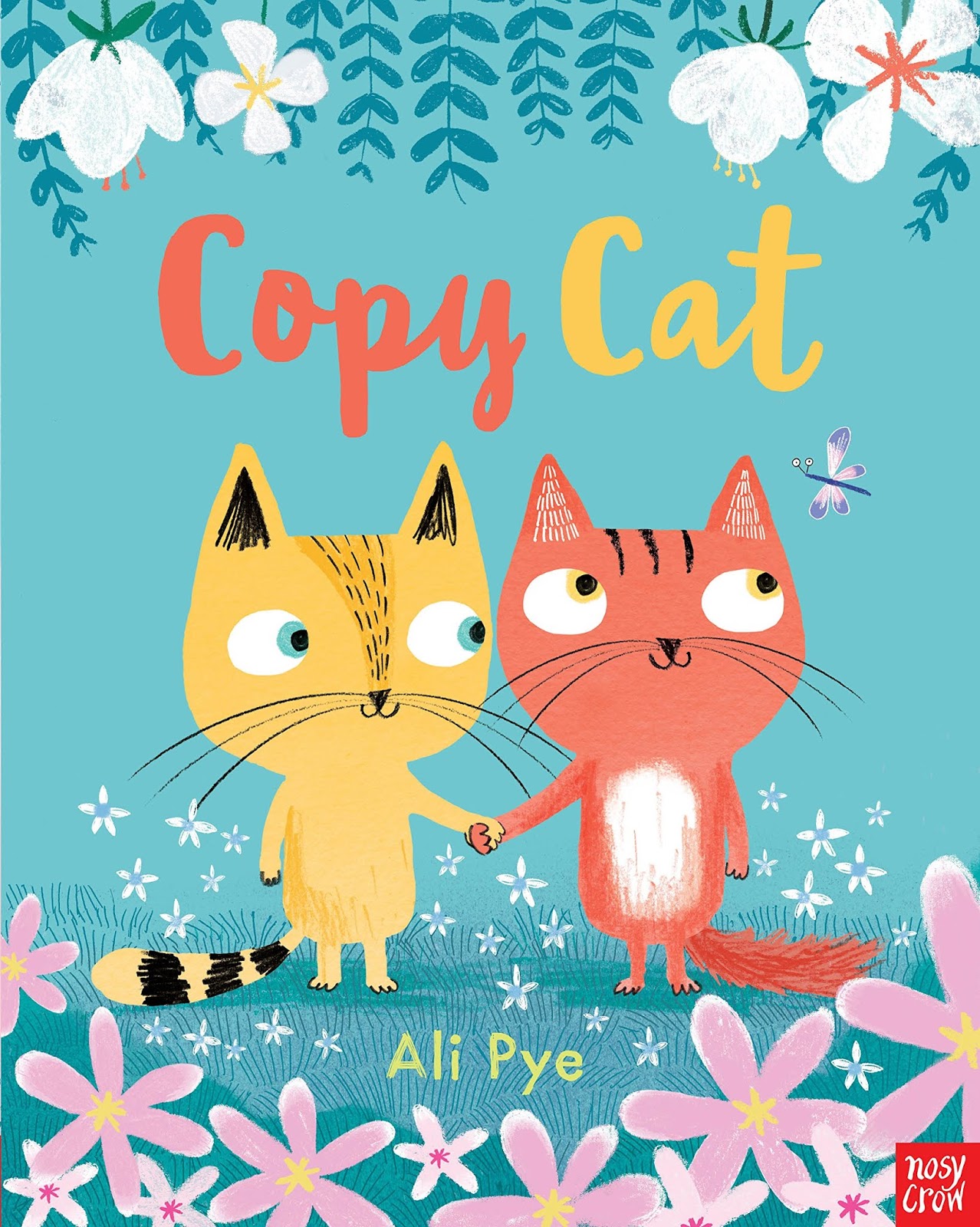
Ali Pye, author and illustrator
Bella wants to be just like her friend, Anna—only sometimes it does not work well for one or both of them.  After a disagreement, Anna stomps off, leaving Bella feeling lost and alone with no one to copy.  Bella learns to do her own thing.  Soon after, Chloe is watching her and wanting to join in.  The girls learn how to cooperate and to collaborate with each other, making for a more satisfying playtime together. Copy Cat is a delightful book about bring a good friend and being your own person.


Richard Byrne, author and illustrator
The chalks love drawing pictures.  Someone keeps erasing them though!  With the help of their teacher and Sergeant Blue, they look at the evidence and solve the case.  However, they realize the issue is not so black and white.  This fun mystery has a creative and inclusive ending. 


The Greatest Adventure
Tony Piedra, author and illustrator

Eliot loves adventure!  Living in the city means using lots of imagination to find it.  When his grandfather comes home from his real adventures at sea, Eliot is ready for a REAL adventure too.  Together, they find that imaginative ones can be just as real.  Stunning illustrations and brilliant imaginative text round out this amazing picture book experience.

Sunday, August 5, 2018

Stella by Starlight (Sharon M. Draper)


Target Ages:  8-12

Genre:  Middle Grade Historical Fiction

Publisher Summary:
Stella lives in the segregated south—in Bumblebee, North Carolina, to be exact about it.  Some stores she can go into.  Some stores she can’t.  Some folks are right pleasant.  Others are a lot less.  To Stella, it sort of evens out, and heck, the Klan hasn’t bothered them for years.  But one late night, later than she should ever be up, much less wandering around outside, Stella and her little brother see something that they’re never supposed to see, something that is the first flicker of change to come, change not welcome by any stretch of the imagination.  As Stella’s community—her world—is upended, she decides to fight fire with fire, and learns that ashes don’t necessarily signify the end…

First Lines:
Nine robed figures dressed all in white.  Heads covered with softly pointed hoods.  Against the black of night, a single wooden cross blazed.  Reflections of peppery-red flames shimmered across the otherwise dark surface of Kilkenny Pond.

Two children, crouched behind the low-handing branches of a hulking oak tree on the other side of the pond, watched the flickers of scarlet in the distance in fearful silence.  Dressed only in nightshirts, Stella Mills and her broker Jojo shivered in the midnight October chill.

Evaluation: 
I am writing this review months after I finished the novel, so it is not fresh in my mind.  However, I want to share some of my thoughts and impressions of the book.  

Coming from my perspective as an English teacher, I especially enjoyed the protagonist's struggle with writing. It borders on cliché that so many protagonists are inspired or gifted writers.  Unfortunately, it gives young and old the impression that writing is a inborn gift—some have it, and some don’t.  Stella has good ideas.  Like most people, though, she has difficulty expressing them.  Nevertheless, she finds a quiet place to practice her writing.  Stella does not just wait for a school assignment.  Instead, she writes about what is going on in her life and town to help her improve her school writing.

Readers get a glimpse as she writes, struggles, and revises.  For instance, early in the narrative, she tries to write for a school assignment.  Nothing is coming to her.  Stella makes a decision, “If she [is] gonna really write with honesty she ought to start, like Mrs. Grayson said, with herself.”  It takes her five tries, but she finally succeeds.

Stella uses writing as a way to cope with difficulties.  Spoon Man for instance encourages her to “Trust the words.  Maybe that image will fade.”  She takes his advice and writes about that night she saw the KKK bonfire as well as her observations about racism, which is cathartic for her.

The writing struggle is valuable for middle grade readers to see.  They need to realize writing does not come naturally or easily for most people.  However with practice and determination, their skills can improve dramatically.

The novel depicts a strong sense of community and family.  For instance, when the Spoon Man arrives in town, everyone comes together for a potluck.  Later, when a family’s house is on fire, dozens of people rush to help put it out.  More importantly, neighbors give the family a place to stay and help them rebuild. 

There are some deeper, more serious issues as well.  The most prominent is the racism of the historical era.  As previously noted, Stella witnesses a Klan rally.  Later, she travels with her father to register to vote, where they are met with hostile resistance.  Afterwards, the Klan burns down a family’s home.  When her mother is bit by a poisonous snake, the town’s white doctor refuses to help her.  The evil actions that come out of racism are illustrate in a genuine way while being age-appropriate in detail.

Even though racism is an underlying issue from beginning to end, the narrative stays hopeful.  There are kind white people who do work together with the African American community.  Her teacher tells inspiring stories that instill strength and pride—even in racist and difficult times.  Stella (and others) empower themselves through education, self-discipline, and good character—which are the pillars of making personal and social change. 

The only aspect of the novel that I felt did not ring 100% authentic is the ending.  Stella ends up saving the daughter of the racist and cruel town doctor.   The positive aspect is the daughter is not racist like her father, which is hinted at in other parts of the novel as well. Nevertheless, it seemed too “neat” to have her drowning with Stella walking by right after Stella's mother is refused medical care by the girl's father.

Overall, I found the characterization and the storytelling engaging. I highly recommend Stella by Starlight for middle grade readers.

Ideas for Extension Activities at Home or Lesson Plans for Teachers:
  • Writing:  Model for students or children the writing process.  Let them see you free writing and then going back to revise.  Then, encourage them to do the same.  Praise them for the improvements and effort more than the initial draft.
  • History:  Include this novel in a study of 1930’s, segregation, and/or Jim Crow laws.
  • Research and Analysis:  Pull in one or more non-fiction texts that describe one of the historical aspects depicted in the novel.  (Older students can do their own research.)  Compare and contrast the non-fiction with the fiction for authenticity. 
  • Figurative Language:  Hyperbole and tall tales are used.  Discuss each one and their overall significance in the storytelling/culture.

Historical Connections:
Civil Rights
African American Voter Registration
Segregation
Klu Klux Klan
Presidential Election 1932


Sunday, July 29, 2018

The Breaking News (Sarah Lynne Reul)


Author:  Sarah Lynne Reul

Illustrator:  Sarah Lynne Reul

Target Ages:  5-10

Genre:  Realistic Fiction Picture Book

Publisher Summary:
When devastating news rattles a young girl's community, her normally attentive parents and neighbors are suddenly exhausted and distracted. At school, her teacher tells the class to look for the helpers—the good people working to make things better in big and small ways. She wants more than anything to help in a BIG way, but maybe she can start with one small act of kindness instead . . . and then another, and another. Small things can compound, after all, to make a world of difference.
First Lines:
I remember when we heard the bad news.
Suddenly Mom is glued to the television.
Dad can’t stop checking his phone.
They whisper and I pretend not to hear.
It is more than a little scary.

Memorable Moment:
Small things don’t solve everything.
The bad new is still there, after all.
But then again…so…are…we.
(Sweeping illustration of neighbors working to make the community a better place.)

Evaluation: 
The Breaking News aptly captures our contemporary 24-hour new cycle, where not only do we hear about all the tragedies that occur—the information is played over and over, dissected into small parts, and heavily sensationalized.  If the situation isn’t bad enough, the news coverage is sure to depress you.

As a society, we do not think often enough about how all this news impacts children.  I grew up in a world of relative innocence.  I was not aware of tragedies.  As a result, I spent my days cheerful and free, playing outside.  The first tragic event I remember was the assassination attempt on President Reagan when I was 9 years old.  My teacher yelled at the class about it (as if we had something to do with it).  Outside of that incident, I had no idea how my parents and community felt or what was going on.  They did not let the news--something I had no control over--impact me.  I am glad they didn't.  

The devastating event is generic--no specific details are given.  The reader just knows an event occurred that is making people sad.  As a result, the story can be read to young children and applied to any news event or personal situation.   Teachers and parents can use it to begin a conversation on age-appropriate, positive coping tools.  

I was challenged to consider many questions:  How much should I expose my children to?  How is my response impacting them?  If the adults are angry, distressed, or depressed, how are the children going to learn positive coping?

Author Reul gives us a starting point: “Even when the news is bad, you can still find good people trying to make things better in big and small ways.”  This insight prompts the child protagonists to make a difference in their own way—helping out, being silly, brainstorming solutions.  When the parents do not initially cheer up, the children do not give up. (I love their resilience.) Eventually, not only do their parents pick themselves up and make an empowering change, the whole community does. 

I love the message of the story—you do not have to solve the world’s problems to make a positive impact and to be joyful. Keep doing good. One task at a time…even if you feel small and discouraged. Overcome your feelings with positive actions.  

I highly recommend The Breaking News for libraries, schools, and homes.  The story is insightful and optimistic--two qualities we desperately need.  

Ideas for Extension Activities at Home or Lesson Plans for Teachers:
  • Gratitude:  As part of the daily class or home routine, practice being grateful.  Not just grateful for the “good” but for the “bad.”  Not just grateful for what is solved now, but for what will be solved.
  • Current Events:  Next time there is a tragic event, begin the day reading The Breaking News. Then discuss ways children can be empowered.  Limit children’s exposure to the news coverage, especially if the children are in elementary school or younger.
  • Communication: Encourage children to express their fears and concerns about the event.
  • Community Service:  Brainstorm ways students or the family can make a positive difference.  In a class, have the children bring in a picture of something they did to help out a person in need at home or in the neighborhood.  Or volunteer to do a task in the community or around the school—pulling weeds, picking up trash, or cleaning up the lunch room.  Make something for people in need.  For instance, replant flowers in small pots.  Visit a hospital or nursing home to give out.  Draw pictures or write a note to someone in the hospital or in need.
Historical Connections:
No one event is mentioned, but it can be applied to a discussion on any tragic event like...
9/11
School Shootings
Terrorist Attacks

Friday, July 27, 2018

The Way a Door Closes (Hope Anita Smith )


Illustrator:  Shane W. Evans

Target Ages:  8-12

Genre:  Poetry Narrative Picture Book Format

Publisher Summary: With a click, a bang, a whisper—or no noise at all.  There are so many ways that a door can close, but it’s not just the closing; it's the knowing.  And thirteen-year-old C.J. knows too much—about disappearing father, his family’s pain, and especially about what it means to hold things together when times are tough. 

Sample Poem:
“The Way a Door Closes”
When Grandmomma comes through a door
it closes quietly.
It is whispered shut
by the breath of God—
who acts as a doorman for
one of His good and faithful servants.
When my brother and I
go out the door,
it closes like a clap of thunder.
We are always in a hurry
to be somewhere.
My little sister closes the door
just so.
As if there were a prize for
getting it right.
My momma likes doors open.
It's her way of inviting the world in.
But last night
Daddy said,
“I’m going out,”
and he stood buttoning his coat
just so.
As if there were a prize for
getting it right. 
Then he looked at each of us
 a moment too long.
And when he went out the door
he held on to the knob.
The door closed with a
click.
I felt all the air leave the room
and we were vacuum-sealed inside.
I shook it off.
I told myself it was nothing
but
somewhere deep inside
I knew better.
I can tell a lot by
the way a door closes.

Evaluation: 
The poet uses startling and profound imagery to convey a wide-range of emotion and experience, all in just 34 poems. Each one centers around 12 year old C.J.’s family experience.  They read like journal entries, giving snapshots of what is going on and what he is feeling at each moment of time.  The early poems depict a strong, close family—at least by all appearances.

Then, the cracks begin to show when his father loses his job and struggles to find a new one.  The protagonist’s conflicting emotions about his father come out when he says, “He gives me words, each one a gem, words I wish someone had given him.”  At this point, no definite reason is give for this passive aggressive hostility. 

The next poem entry, which discusses various fears and pain, reveals C.J. is praying for his dad to get another job.  As time goes on and “each day bring nothing,” the tension thickens to the point the father leaves the family. 

C.J. does what he can to hold it together for his family and his own well being.  He struggles with feeling jaded.  On his birthday, he refuses to make a wish because he knows “how much it hurts when wishes don’t come true.”  On the other hand, he tells his friend, “My dad is coming back.”  When his friend says, “that only happens one in a blue moon,” C.J. responses with “but it happens.”   He feels angry, hurt, lost, and broken.  Despite all of it,  he holds on to hope.  C.J. desperately wants his family back together. 

The poems aptly illustrate the loss and pain that comes from a broken home in a realistic way as well as the facets of dealing with it—within the individual, the family, and the community.  This picture book is ideal for the elementary and middle school classroom because it is concise, yet powerful.  Many children and tweens will be able to relate to the experience and feel solace that they are not alone.

I highly recommend The Way a Door Closes as a profound look at the modern family in crisis.

There is also a sequel, Keeping the Night Watch, which I hope to read soon.

Poetry Friday is being hosted by Reading to the Core today.


Tuesday, July 24, 2018

Carlos and Carmen Early Reader Series


I just received set 1 of the Carlos and Carmen early reader series.  I was immediately impressed with the quality of the illustrations and the books’ durable construction.  Then, I read them.  I am officially a fan of this superb series! 

The Carlos and Carmen books are available in Spanish and English.  I read the English version.  However, Spanish words are sprinkled throughout which provides two learning opportunities. First, children are exposed to a second language.  With as many as 50 million people speaking Spanish in the United States, it is valuable for English-speaking children to be exposed early to common Spanish words. In addition, the foreign words allow children to practice using context clues.  They can figure out what the unknown word is by identifying clues in the text and by looking at the illustrations.  There is also a Spanish to English key at the back of each book. 

Each book is divided into five short chapters.  The text is written at a second to third grade reading level.  McDonald does not make the stories feel like a Basal or easy reader though.  She incorporates suspense, humor, and personality into each chapter. 

The series is family oriented.  The parents are active and present. When the twins are running around the backyard, the parents are looking on.  When their yard floods, the parents play in the water and mud with their children. When Carlos and Carmen are concerned about a noise in the night, their dad takes it seriously and investigates. The family sits down together at mealtimes.  Extended family members come over to help out or to spend time with the twins.  The Garcias are a warm and close family.

Author Kirsten McDonald has created multi-faceted young Latino protagonists who have qualities parents want their children to emulate.  They are kind, fun, inquisitive, respectful, and helpful.  They demonstrate a wide range of experiences from fear and boredom to enthusiasm and playfulness. 

Erika Meza’s illustrations are vivid and gorgeous.  The actions are lively, and the facial expressions are wide-ranging.  The best part is how the parents are represented.  They are shown working and parenting side by side.  Their expressions toward each other convey love, playfulness, and admiration.  The illustrations work in perfect harmony with the text.

I highly recommend the Carlos and Carmen series—in Spanish and in English—for public and elementary school libraries.   Parents and teachers should also consider adding these books to their classroom or home collection. 

There are currently 16 books in series.  I read the following four.  I have included the publisher’s summaries.


Carlos and Carmen get some unexpected news. They're moving to a new house. The new house is big, red, and has one tire. What! A house with one tire?! The twins worry and worry but soon discover a house with one tire can be fun.


Carlos and Carmen have a hard time falling asleep in separate rooms. Once they solve that problem, they're kept awake by a spooky noise. The twins get their mom and dad to help them solve the mystery of the noise, which turns out to be something not very scary at all.


It's been raining and raining and raining. When the sun finally peeks out from behind the clouds, Carlos and Carmen find their entire backyard is one big puddle. But the twins don't mind once they discover it's not just a puddle of water--it's a puddle of fun!


The Green Surprise
Tío Alex is joining the Garcia family for a cookout, and he's bringing a surprise. A big green surprise. At first, Carlos and Carmen are disappointed in the lumpy green surprise. But with their mom's help and a few poles and stakes, the lump becomes a green surprise filled with fun. 


A Better Way to Teach Theme: Why I Built the Jory John Now Prove It Series

If you’ve ever taught theme, you know the moment. Students finish a story, you ask “What’s the theme?” — and suddenly you’re flooded with a...