Showing posts with label cooperation. Show all posts

Friday, April 19, 2019

First Star: A Bear and Mole Story (Will Hillenbrand)


Title:  First Star:  A Bear and Mole Story


Illustrator:  Will Hillenbrand

Target Ages:  3-8

Genre:  Picture Book Fiction

Publisher Summary: 
Up, up, up climb Mole and Bear.  They are on the way to Camp Tiptop to see the stars.  But as the sun sets, Mole is scared.  What if they get lost in the dark?  Luckily, Bear has the perfect story to calm Mole’s fears. 

Later, the sky has its own surprise in store for the two campers.

First Lines:
Mole gazed up.

“May we sleep under the sky tonight?” asked Mole.

“I want to see the stars turn on.”

Memorable Moment:
Bear comforts Mole, “Dark is not so dark if you know where you are.”


Evaluation:
The cover art is adorable! It previews perfectly the theme—friends using their strengths to help each other out. 

A simple plot focuses on a camping trip.  Mole and Bear work together to pack up for the journey, to help each other out on the way up, to set up camp, and to spend the evening outdoors. 

The story within a story framework is utilized.  As night moves in, Mole is afraid of getting lost in the dark (a bit ironic for a mole).   To comfort him, Bear tells the story of how the moon and stars were added to the sky to give them light and direction. 

Hillenbrand’s signature illustrations use soft shades in contrast with bright colors.  The story moves from close up shots of the characters to sweeping views of the sky, emphasizing a strong intimacy of friends and family in the vast and spectacular universe.

These characters are memorable and endearing.  Bear has great physical strength, but he also is kind and gentle.  I love how he uses these qualities to help his small, meek friend, Mole feel safe and overcome his fears.  Overall, their friendship exemplifies the importance of using our strengths—whether physical, emotional, spiritual, or mental—to help each other.   

First Star:  A Bear and Mole Story a sweet story of lasting friendship and overcoming fears.

Also, check out Hillenbrand’s Spring Is Here and Down by the Barn. 

Activities and Extension Ideas for Lesson Plans:
  • Literature:  Read other creation stories.  Compare and contrast them.  See Picture Book Connections.
  • Writing:  Write an original creation myth about the moon and stars or something else in nature.
  • Science:  Learn about the moon and its phrases.
  • Life Skills:  Allow students to share their camping experiences. What supplies did they need?  What did they do on the trip?  How did they get around at night? 
  • Field Trip:  Plan a camping trip (even one in the backyard).  Have the whole family (or class) determine what supplies are needed and pack them up together.  For a class, it could be a picnic outside school. 

Picture Book Connections (Creation Stories and Myths):


A Big Mooncake for Little Star
This heartwarming modern folktale explains how the moon ends up in the sky—as well as the reason for its phases. 


The Star-Bearer: A Creation Myth from Ancient Egypt
Creation begins when Atum, the god child, emerges from the bud of a lotus. Stories build off his family that explain how the world and other gods came to be.


Anansi the Spider: A Tale from Ashanti
When Anansi falls into trouble, his six sons come to the rescue. This trickster tale explains the origin of the moon. 


Why the Sun & Moon Live in the Sky
The story explains why the moon and her children the stars only appear at night when Sun is not around.


Why the Sun and Moon Live in the Sky: An African Folktale
Like the aforementioned story, the origin of the moon in the sky is explained.


The Woman who Fell from the Sky: The Iroquois Story of Creation
As a sky woman falls from a floating island high in the sky, she creates the earth, creatures, and sky. 


Piecing Earth and Sky Together: A Creation Story from the Mien Tribe of Laos
A brother and sister duo from heaven make a bet.  The brother weaves a majestic sky while the sister a glorious earth. When they put them together, the world is created. 


Visit Susanna Leonard Hill for Perfect Picture Book Friday.

Wednesday, January 31, 2018

Author Spotlight: Grace Lin


Grace Lin is the author of more than 20 children’s books, ranging from picture to middle grade fiction.  She covers a wide array of subjects from animal stories to Chinese-American realistic fiction to myths and fairy tales.


The first book I read was the middle grade fantasy fairy tale Where the Mountain Meets the Moon.  I could not put this book down!  It is a beautiful mingling of myth and fiction, sacrifice and friendship.  The two follow ups, Starry River of the Sky and When the Sean Turned to Silver, are on my reading list!


She has also written the Pacy Lin series of contemporary realistic fiction for middle graders, featuring a Chinese-American family.


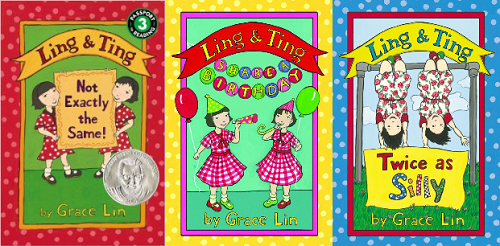
Next, I spent time with her delightful series—Ling and Ting. The text and illustrations exude positive motifs like cooperation, creativity, and kindness. You will want to add this adorable duo to your Early Reader library. 

Some of her picture books feature animal characters learning valuable lessons.


In Olvina Flies, a chicken learns to overcome her fear of flying. 


In the follow up, Olvina Swims, the protagonist deals with her fear of the water and swimming the ocean. 


Finally, Okie-Dokie, Artichokie stars a Marklee the monkey.  He initially misjudges a neighbor, but he realizes his mistake before it is too late. 


My favorite of her picture books is The Red Thread: An Adoption Tale.  A king and queen have a beautiful and peaceful land, but they have a relentless pain in their chests.  A peddler’s magical spectacles reveal the red thread pulling at their hearts, leading them to the baby they are destined to adopt.  This adoption fairy tale illustrates the parental love that begins long before a child comes to live with his adoptive parents and the important bond that connects them.

Grace Lin has written several picture books celebrating Chinese-American culture.  Her stunning illustrations use rich colors, expressive faces, and energetic children.  The text is minimal, but Lin always includes additional information for teachers and parents to read or to expand on in lesson plans.


Bringing in the New Year.  This lovely picture book illustrates the New Year traditions of many Chinese and Chinese-Americans, such as getting a fresh hair cut, making dumplings, carrying lanterns, and welcoming the dragon.  Simple text and energetic pictures provide an ideal introduction to the holiday. 


Kite Flying. Flying kites is a beloved past time in many Asian countries, including China, Japan, Thailand, and India.  In this picture book, a family works cooperatively to make a kite. Then, they take it to a nearby park to fly. 


Dim Sum for Everyone.  A family visits a dim sum restaurant in Chinatown.  Dumplings, cakes, buns, and tarts are presented to them on rolling carts.  They each have to pick what to eat from the many delicious traditional dishes. (Sharing is encouraged.)


Thanking the Moon: Celebrating the Mid-Autumn Moon Festival.  With lanterns and the full moon glowing, they eat sweet mooncakes and drink warm tea.  Join Mei-Mei and her family for this festival celebrating gratitude, prosperity, and community. 


Fortune Cookie Fortunes.  While visiting a Chinese restaurant, each family member receives a fortune cookie. The sisters disagree whether the fortunes will come true or not.  One sister learns to see the world (and the fortunes) in a different way.  This fun tale ends with fascinating background information on the origin of the fortune cookie.  

Tuesday, April 2, 2013

Picturebook Author Spotlight: Jan Thomas

I was so delighted with The Doghouse by Jan Thomas that I was inspired to check out her other books.  I find myself frequently revisiting and sharing them with others.   My local library recently added her latest book, prompting me to share some of my favorites with my fellow picturebook lovers on the blog-o-sphere.

Jan Thomas has a charming style which is both memorable and interactive.   Children (and adults) are drawn to the simple illustrations and reoccurring characters—animals and dust bunnies.  These characters are often emotionally charged with cheerful excitement or playful fear.  The simple vocabulary, rhyming words, and repetition are ideal for building early reading skills and for practicing early readers.  Her stories often have an ironic twist or humorous situations.   Best of all, the books make the readers and listeners feel like important participants in the story experience.  Check these books out on your next trip to the library or the bookstore. 


Four adorable dust bunnies—Ed, Ned, Ted, and Bob love to rhyme all the time!  While the other three are distracted with their exuberant rhyming game, Ed tries to warn them of impending danger.  Instead of listening to him, they correct him.  For instance, they inform him:   “No, Bob…’Look!’ does not rhyme with car!”  Even when he finally gets his whole message out (“Look out! Here comes a big scary monster with a broom!”), the others still do not understand…that is until they see it coming toward them!   They are not out of danger yet though.  Kids will want to rhyme right along with these original characters while enjoying the fun plot turns. 


When the rhyming dust bunnies meet Big, Mean Dust Bunny, they ask him to join their rhyming game.  He declines.  They urge him on anyway.  The Big Mean Dust Bunny lives up to his name…he makes every rhyming round an opportunity to bully the others.  Until, the big fat cat “spats” him.  The others come to his aid (while maintaining their rhyming game), warming his heart and winning him over.  The end pages have a cute twist…and a possible clue for a sequel. 

The book begins with the question, “Will Fat Cat sit on…the cow?”  The concerned cow replies, “Moo?”  The next page reveals, “No!  Fat Cat will not sit on Cow!”  The question continues in a similar fashion with each of the animals until the mouse helps find a solution.  With that resolved, the next question is, “What will Fat Cat have for lunch?”  This query prompts the animals to all flee.  I love the playful banter between the animals, the melodramatic looks, and the exaggerated suspense.  Children are sure to have a blast with this question and answer book. 


A cheery ladybug invites readers/listeners to join in a game of pretend.  They are asked to imagine there is a tiny bug on their nose, in their mouth, and on their shirt (among other things).  When that pesky bug refuses to come off (even after a round of the chicken dance), the ladybug asks readers/listeners to pretend a giant hungry frog is coming to eat the pest.  An unexpected visitor arrives, so she pleas to the participants to make a scary face!   That scary face has a surprising outcome!  Not only does this book encourage interaction, it is sure to elicit giggles and grins.


Out on the prairie, the cowboy tells two cute little cows it is “Time to hit the hay.”  Looking sleepy and content, they listen as the cowboy sings:

It’s time
for little cows
to rest their head.
It’s time
for little cows
to go to bed.
It’s time
for little cows
to sleep so tight.
It’s time
for us to say…

On the next page, the cowboy shrieks, “Eeeeek!”  He sees a shadow and thinks it is a huge hairy spider.  The cows show him it is only a flower.  They try the lullaby again.  Each time, the cowboy becomes frightened by something that turns out to be nothing scary at all.  Until a big giant wolf shows up.  It is okay though.  He LOVES lullabies too.  They all sleep happily ever after.  Kids will love to read a long with this bedtime story, which reassures them there is nothing to fear.  

Wednesday, January 23, 2013

Lady Hahn and her Seven Friends (by Yumi Heo)

Summary of Lady Hahn and her Seven Friends (by Yumi Heo):
"Long, long ago when tigers still smoked pipes, there lived Lady Hahn."  Her job was to sew shirts and skirts with the help of her friends--Mrs. Ruler, Newlywed Scissors, Young Bride Needle, Young Bride Red Thread, Old Lady Thimble, Young Lady Flatiron, and Little Miss Iron.  One day, they each boasted about their talents, declaring "I am the most important of all."  After being scolded by Lady Hahn, they hid from her. Lady Hahn wisely brings them all back together--but not until she learns an important lesson herself.    

                                 Evaluation:
This folktale tale comes from a classical Korean essay.  While the story creatively personalizes the essential items needed to sew, it teaches some important lessons about human nature.  First, the characters begin with self-centered and boastful attitudes which are reflected in Lady Hahn’s response as well. She declares they are all silly because she is the most important.  Without her hands, they would all be superfluous. Next, the story illustrates how quickly people can turn to fussing and complaining when things don’t go their way or when they feel unappreciated.  Finally, Lady Hahn and her sewing friends realize that each one of them is necessary to successfully create a new garment. She states:  “I forgot how important all of you are.  A shirt cannot be made if one of you is missing.”  Ultimately, everyone’s input and cooperation are necessary for success and harmony.  

The illustrations, created with rich oil colors and pencil drawings, primarily use playful shapes and patterned backgrounds.  A range of emotions is captured well to reflect the narrative.  For instance, when Lady Hahn is attempting to sew a sleeve without her seven friends, her face is distressed in various stages of the process the circular shapes and random placement of figures effectively portray frustration.   When the friends return, everything on the page is orderly and cheerful. 

I recommend Lady Hahn and her Seven Friends for ages 4 and up.   The story is multicultural, educational, and entertaining.  

Thursday, May 10, 2012

Chapter Book (Biography): Lincoln, A Photobiography (Russell Freedman)

I am thrilled that I have finally found a subject to write my first book on.   The subject is a biography of a person I have admired for many years.  I seriously considered naming my child after this person.  Unfortunately, there were way too many others giving their child this first name (not necessarily because of this historical person though).   I will reveal my subject once I get a draft done.  :)


I have read some really fantastic biographies lately.  Russell Freedman has always been, to me, the epitome of great biographical writing for children.   As I am preparing to begin work on my first biography, I turned to his works.  This week I reread Lincoln: A Photobiography.   

Freedman has amazing storytelling skills.   As I read, I felt as if Lincoln’s life was unfolding before me.   Often, he is painted heroically, larger than life, savior of the union, champion of freedom.   These things are no doubt true of him.   Lincoln is much more.   Most know he came from humble beginnings, but even into adulthood he struggled with many of our contemporary issues—depression, rejections, debt, money problems, malicious gossip, loss, failure, and feelings of inadequacy.   More than anything, he should be admired for overcoming these often overwhelming adversities.  No doubt they each had an impact on him that prodded him to succeed to the highest office and to become a man of great compassion and diplomacy. 

Freedman uses photographs in his story telling.  Each one gives a glimpse of Lincoln, his loved ones, his rivals, and his world.  Several depict soldiers—planning, fighting, and dying on the battlefield.   Surely, the war and its losses weighed heavily on a man who experienced it all too often at a personal level. Also, there are some popular political cartoons berating him.  In one he is depicted as a villainous coward sneaking into Washington for his inauguration.  Another one portrays him childishly playing tug-a-war with a map—a poke at him fighting over the union.  The illustrations add depth and reveal the criticism he faced and the complex political climate he navigated through.

Freedman uses quotes effectively.  Seamlessly, quotes by Lincoln and others of his time are interwoven to make this narrative personal and poignant.  For instance, when discussing Lincoln’s inner-conflict on when and how to free the slaves, quotes are interspersed that reveal both sides of the issue.    Eventually, Lincoln decides:  “Fellow citizens, we cannot escape history.  We of this administration will be remembered in spite of ourselves…In giving freedom to the slave, we assure freedom to the free—honorable alike in what we give, and what we preserve.”  Shortly after, he declared his view and policy in the Emancipation Proclamation.  

It is difficult to read this book and not develop an even deeper respect for our 16th president.   This respect does not merely occur because of his outstanding words and acts that made him famous.  Instead, it comes from his quiet struggles, his personal growth, his courage of conviction, and his great love for his family.   I highly recommend Lincoln: A Photobiography for ages 8 and up. 

This post is linked up with Read Aloud Thursday.  Visit Hope is the Word for other great read aloud books for children.  

Wednesday, June 8, 2011

Picture Book: Michael's Golden Rules (by Deloris Jordan)

The team has two outs.  The bases are loaded.  Jonathan is up at bat, nervously waiting for the next pitch.  The ball whizzes passed him.  He strikes out.  Even though his team members try to assure him it is okay, Jonathan wants to run from the dugout.   After the game, he walks home with his best friend, Michael, and his Uncle Jack.  Jonathan is discouraged because they lost the game.  Uncle Jack encourages him that the game is not about winning or losing.  Instead, it is about how you play.  Jonathan is still not convinced, so Uncle Jack agrees to share his golden rules of baseball with him:

1.     Know the game.
2.    Pay attention to the coach at all times.
3.    Know your opponent.
4.    Be a team player.
5.    Practice a winning attitude.
6.    Find out what you do best.
7.    Find out what you need to work on.
8.    Practice, practice, practice.
9.    Learn from your mistakes.
10.  Have fun!

The two friends enjoy an afternoon trading and looking at baseball cards.  As they talk about the great players, they remember the golden rules of baseball. The boys decide to go outside to practice what they need to improve on because there is a big game the following day.  

The next day, Jonathan keeps those golden rules at the forefront of his mind.  For instance, he acts as a team player, first by helping someone out and then forgiving a team mate for rude comments.   He listens to his coach's advice while at bat, resulting in a base hit!  Even though there are some mistakes in the game, Jonathan keeps a winning attitude.  Unfortunately, his team does not win.  This time, his perspective is much different.  Jonathan has learned not only to play a better game but also to have a great outook. 

Evaluation:
I love books like Michael’s Golden Rules.  Deloris Jordan (author of Salt in His Shoes and Michael Jordan’s mother) does a wonderful job depicting a common experience in childhood sports.  The protagonist is discouraged because he is not a strong player.  He struggles with a negative attitude and even with a little bullying.  I appreciate how it is an adult that comes along side Jonathan to mentor and encourage him.  The author does a wonderful job unfolding the character development and depicting Jonathan’s positive changes, despite obstacles.  These types of examples are essential for helping children learn how to problem solve their individual circumstances.  Roslyn M. Jordan, the illustrator, captures well the tensions, setbacks, and victories on the field as well as the personal interactions.  I  highly recommend this book for ages 7-11. 

Saturday, April 16, 2011

Catching Fire by Suzanne Collins

Summary of Catching Fire:  
From the Barnes and Noble website
Against all odds, Katniss Everdeen has won the annual Hunger Games with fellow district tribute Peeta Mellark.  But it was a victory won by defiance of the capital and their harsh rules.  Katniss and Peeta should be happy.  After all, they just won for themselves and their families a life of safety and plenty.  But there are rumors of rebellions among the subjects, and Katniss and Peeta, to their horror are the faces of that rebellion.  The Capital is angry.  The Capital wants revenge. 

Evaluation: 
As soon as I finished The Hunger Games, I was anxious to begin Catching Fire, the sequel.  Suzanne Collins is a master storyteller.  She brings her dystopian world to life in a dynamic way.  The narrative is highly creative and engrossing.  Throughout the book, I was on the edge of my seat wondering—what is going to happen to Katniss, Peeta, and Gale, and most importantly, who is Katniss going to end up with. 

The Hunger Games prompted me to think, and I enjoyed the character dimensions that are explored.  Collins’ characterization is consistent and credible between the novels.  Unfortunately, she does not genuinely delve into the characters any deeper in Catching Fire.  I would have liked to see more facets to them.

The book continues the motifs of self-absorption and excess in the Capital while the districts suffer from want and hunger.  This discrepancy, along with Katniss’ visible rebellion, prompts the districts and others to begin the surge of defiance that has been lying dormant, waiting for an opportunity.  Collins carries the motifs over from The Hunger Games.   She does not introduce new ones or significantly expand the previous ones.  I felt there is less literary “meat” to Catching Fire. 

Despite library and school recommendations to the contrary, I suggest the Hunger Games series for ages 13 and up.  The content is too heavy for younger readers.  Another aspect to consider is that while the books temper the desciptiveness of the violence and it ultimately is meant to be a lesson in totalitarianism, soon there will be movies depicting all of it.  Reading something and seeing it are very different experiences.  If you allow younger children to read the books in this series, they are going to want to see the movies.  I have no doubt the films will be as graphic as possible while still being within a PG-13 realm.  Today, PG-13 violence can be pretty intense.  Aside from the movie aspect, I strongly caution parents to read the books themselves and carefully consider the appropriateness for children under 13. 

Like The Hunger Games, Catching Fire is a action-packed page turner you will not want to miss!  I have already excitedly started the final book in the series--Mockingjay

Sunday, March 13, 2011

A Very BIG Bunny (Marisabina Russo)

Summary of A Very BIG Bunny
Amelia is a bunny, a very big bunny.  Lovingly, her parents attempt to encourage her about her size by pointing out that she stands out in a crowd and that she is the star of the show.  Amelia does not want either of those things though.  She just wants to be a bunny that fits in with her peers.  At school, she is the biggest student in the class.   Her classmates tell her she is too tall for jump rope, her feet are too big for hopscotch, and her weight is too heavy for the seesaw.   Standing by the fence at recess and walking home alone after school, she finds creative ways to amuse herself.  She is lonely though. 

A new bunny, a very small bunny, joins the class.  Her name is Susannah.  Classmates call her pip-squeak, peanut, and shrimp.  They claim she is too small for everything.  Susannah walks over to Amelia at the fence and attempts to make friends with her.   Caught up in her own lonely world, she ignores her.  Each day, Susannah works to befriend Amelia, despite her rebuffs.   Then, Susannah lures her in with an original idea for picture day that helps both girls learn to accept their differences and each other.  Susannah realizes that standing out in the crowd can be a positive experience. 

Evaluation:
I like A Very BIG Bunny because it illustrates common childhood insecurities, such as being too big, too small, or too _____ from peers.  Many students experience bullying, isolation, and loneliness as a result of their differences.  Author Marisabina Russo realistically depicts the way children deal in diverse ways with bullying and their reluctance to trust others.  There is also a credible ending. The girls’ peer problems are not magically solved, but they are moving in a positive direction by embracing their individuality and growing in their friendship together.  Children ages 4-8 will enjoy this story and illustrations. 

Teaching Opportunities:
  • Art—Create unique tiaras or necklaces (girls) or hats and ties (boys)
  • Friendship—Brainstorm qualities of a good friend and discuss how to be one
  • Self-Worth—Think up ways students can feel good about themselves 
  • Comparison—Compare and Contrast the two girls on areas like why they are bullied, how they cope with it, and what character qualities they possess 
  • Bullying—Read other stories on bullying and teach about the signs and solutions for it

For other books on bullying, click here. 

Wednesday, February 9, 2011

Picture Book: Weslandia by Paul Fleischman


Summary of Weslandia:  
Wesley is an outcast in his rigid suburban-like civilization.   He is not interested in the same hobbies, styles, and foods as his peers.  Fleeing his many tormentors is a daily occurrence.   A single idea from school—each civilization has a staple crop--sets Wesley off on a summer project.   After a chance incident, the backyard transforms into garden with an unusual-looking fruit.   Wesley is fascinated by this new plant for which there is no previous documentation.  Using various parts of the plant and different preparation techniques, he is able to produce all the food he needs.  He uses other parts of the plant to create clothes and a hat.  The plant's seeds produce an oil, effective as a sunscreen and an insect repellent.  Wesley begins selling the oil to his neighbors.  Soon, the inquisitive neighborhood children begin to participate in his newly-formed recreational activities.  Much of his time, though, is spent building and creating the items he needs for daily living.  Topping off all his inventions, Wesley develops his own 80-letter alphabet to record the history of his civilization.  In the fall when he returns to school, he has no shortage of friends (or followers). 

Evaluation:
Weslandia (by Paul Fleischman) is an excellent book for recreational or educational purposes.  The illustrations are vibrant and inviting.  The story is well-written and imaginative.  Weslandia is ideal for a multitude of teaching opportunities.   First, use it to accompany a study of ancient civilizations or communities.   Students can be challenged to make parallels to the formation of Weslandia and other early cultures as well as to create their own culture or some aspect of it (writing, sports, foods).  Next, like Stand Tall Molly Lou Mellon, this narrative depicts a boy who is bullied for being different.  Instead of becoming bitter or discouraged, he uses his unique talents and interests to create something that others want to be a part of.   Finally, Wesley exhibits many character qualities worthy of study and discussion.  He is hard-working, persevering, and forgiving.  Ingenuity and business smarts are also depicted in his summer project.  Children can identify these (and other) character qualities and examples of them in the story. 

A Better Way to Teach Theme: Why I Built the Jory John Now Prove It Series

If you’ve ever taught theme, you know the moment. Students finish a story, you ask “What’s the theme?” — and suddenly you’re flooded with a...