Showing posts with label Olympics. Show all posts

Monday, May 7, 2012

Ancient World History (Greece): The Greek News

For  Nonfiction Monday, I am revisiting one of my favorite subjects:  Ancient Greece.   I spent months studying it with my own children while homeschooling.  I love teaching about it in college World Literature courses.    If you plan to study it formally or read about informally with your children, check out The Greek News: The Greatest Newspaper in Civilization.  It was one of my favorite resources.  

Summary of The Greek News:  The Greatest Newspaper 
in Civilization
Authors Anton Powell and Philip Steele present life in ancient Greece through the medium of the newspaper.  Articles are broken into sections: The News (focusing on battles), Army Life, Navy Life, Sparta: A Special Report, Trade News, Sporting News, Building News, The Gods: A Special Report, and School Life as well as pages on Politics, Women, Theater, Housing, Heath, Philosophers, Food, Farming, and Fashion.  Topics are covered in a variety of ways from first person accounts, interviews, editorials, and third-person reporting.  Advertisements, maps, political cartoons, diagrams, and colorful illustrations add another dimension for gaining insight into this ancient culture.  Some of the highlights are the coverage of the Olympics,  the theater, and living conditions.   

Evaluation:
The variety of methods used to convey the historical information make this book highly engaging.   Not only is there the opportunity to discuss the facts, but also the methods used.  Many articles are written in the first person perspective, making them more personal and appealing.   The layout has makes it easy to read in small increments or to focus on particular areas of interest.  The only downside is I found the discussion of the battles a little confusing sometimes.  The rise of democracy is covered, but the book would be strengthened with a more detailed explanation.   A fascinating documentary on the topic is The Greeks:  The Crucible of Civilization.  A "special report" on Athens would have been a nice compliment to the one on Sparta.


The book is over sized which makes it easy to share for large or small group reading times.  The text is appropriate for about a third-grade level student to read independently.   I highly recommend The Greek News:  The Greatest Newspaper in Civilization for ages 7 and up. 

Teaching Opportunities:
  • Unit Study:  Add to a unit or study of ancient Greece or ancient civilizations
  • Writing:  Discuss different types of writing--editorial, news reporting, interview, and so forth; allow students to practice them on academic or personal topics
  • Art:  Create a political cartoon or draw a picture of favorite aspect of Greek life
  • Journalism:  Create a newspaper about the family, school/class, or other topic; allow students to practice layout and editing skills
  • Comparison:  Choose one or more areas of Greek life and compare/contrast in chart or paragraph form 
  • Point of View:  Identify and discuss the different point of views; teach how to identify which point of view is being used and the various advantages/disadvantages to each one
Head over to The Swimmer Writer for more noteworthy Non-Fiction Monday selections.  

Sunday, May 29, 2011

Ancient World (Greek Myths): Atalanta’s Race (by Shirley Climo)

In most of the Greek myths and tales, women are relegated to a subservient role, portrayed as a temptress, or depicted as a monster (literal or figurative).  The story of Atalanta is in stark contrast to most of these narratives.  Atalanta is independent, resourceful, and brave.  Here is her story.

King Iasus of Arcadia only lacks one thing in life:  a son.  He prays often to the god Zeus to fulfill his greatest wish for an heir to his throne.  When a baby is finally born to his wife, though, she is a girl. The Queen sees her as a gift from the gods and names her Atalanta.  King Iasus is so outraged; he gives the baby to a guard and commands him to “cast her on the highest slope of Mount Cyllene.”   Instead, the guard carries the baby up the snowy mountainside and places her inside the mouth of a cave where a she-bear lives.   The she-bear cares for the baby along with her two cubs. 

A year later, a hunter named Ciron finds Atalanta in the dark cave as he seeks out the bear for her skin.   Ciron teaches Atalanta all about hunting, and her swift feet make her the talk of the land.  King Iasus, now bent with age and loneliness, requests to meet the remarkable, young woman.  During her visit, he learns that she is his daughter.  Now full of grief and humility, the King asks her to stay with him.  She accepts his offer.   Atalanta wants for nothing in the palace and becomes the “pride and pleasure” of Iasus. 

Yearning for a grandson who could take over his kingdom after his death, the King insists that Atalanta finds a husband.  No one suits her, though, so to put off (hopefully permanently) making a marriage commitment, she proclaims that she will marry the man who can defeat her in a footrace.  Any man who challenges her but does not win will be put to death.  Despite the possible consequences, many men come forward.  None are able to outrun her…until a young Greek warrior, Melanion, comes along.  With the help of Aphrodite, Melanion is able to win the race and Atalanta’s love.   The compatible couple lives happily together and provides a future heir for the kingdom.  Their happiness and pride prompt a surprising punishment from the Aphrodite. 

Evaluation: 
Author Shirley Climo has created a indispensable retelling of this famous myth.  She depicts a strong but flawed Atalanta as well as portrays well the character changes in Iasus.  Artist Alexander Koshkin used watercolors, tempera, and gouache for the illustrations which wonderfully capture the ancient Greek world and compliment the text perfectly. I recommend Atalanta’s Race: A Greek Myth for a unit or study of the ancient world or Greek myths.  Atalanta’s story is especially pivotal because it centers on a competent female protagonist—a rarity in ancient literature.  Also, this story compliments well with a study of the ancient Olympics.  Despite being a superior athlete, Atalanta would not have been able to compete.  The story prompts a discussion of that rule, the role of women in the ancient Greek world, and the example of Atalanta to women past and present.  Atalanta’s Race: A Greek Myth is geared for readers 8 and up. 

Teaching Opportunities:

  • Journal—Do you think Atalanta let Melanion win?  Why or why not?
  • Physical Fitness—Hold races within the class (or between classes) or neighborhood/family.  Experiment with different types like three-legged, sack, and foot.  Replicate the race of Atalanta and Melanion.  Allow one runner to throw down three objects that another runner (preferably stronger) must pick up during the race.  See who wins.
  • Social Studies—Discuss the role of women in the ancient world/Greece.   Compare it to the role or women in the modern world. 
  • History—Learn about the first Olympic games and the traditions/competitions in the ancient Olympics.
  • Literature—Read and compare/contrast Atalanta’s narrative with other Greek myths.
  • Reading Skills—Identify the sequence of events and cause/effect relationships in the story. 

Monday, April 11, 2011

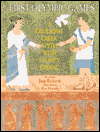
Ancient World History (Greece): The First Olympic Games (Myth)

Tantalus, demi-god and son of Zeus, is invited to a great feast with the gods of Olympus where he experiences the finest clothing and most exquisite food.  Wanting to match the gods’ grandeur, Tantalus decides to sacrifice the thing he loves most:  His Son, Pelops.  He chops him up to serve him as a stew to the gods—who see what he has done.  As punishment, he is sent to the Underworld where he is forever tortured with the feeling of thirst and the sight of sweet berries that he cannot reach.  The gods restore Pelops, give him a horse with a chariot, and instruct him to find a kingdom.  He finds one, but there is a terrible risk.  Pelops must beat the King of Elis at a chariot race.  If he wins, he marries the king’s daughter, Hippodamia, and inherits the kingdom.  If he does not win, he loses his head!   Pelops wins the race when the king’s chariot wheel falls off.  The king dies.  To honor the king, Pelops and Hippodamia invited all the heroes of ancient Greece to take part in athletic games and races.  Pelops decreed that every four years the best men of Greece should gather in the fields of Elis for the Olympic Games. 

The final pages briefly connect the myth to the modern day Olympic Games. 

Evaluation:
Let’s get the possible objectionable material out of the way first.  The text of The First Olympic Games: A Gruesome Greek Myth with a Happy Ending is a bit graphic for the squeamish and the young.  Unfortunately, many of the ancient stories (including some in the Bible) are disturbing.  The following references are brief but potentially bothersome:  Pelops being chopped up, heads being cut off/displayed at the city gate, and the king dying. The only mildly objectionable illustration is of the heads of the 12 men who attempted before Pelops to win the chariot race.  There is no blood or gore.  The picture just shows heads with no bodies.  Though there is a reference to Pelops being chopped up, the text goes no further, and there are no illustrations to accompany it.  I still recommend that parents/teachers read the text and review the illustrations to judge if it is appropriate for young readers/listeners. 


Jean Richards’ narrative is based on an ancient Greek myth that precedes the King Iphitus’ story.  It is well-told and interesting.  This myth does reflect the violent nature of the culture and highlights the activities/interventions of the gods. Tantalus’ deed is clearly condemned.  He is forced to eternal torture, a favorite consequence of the gods. Kat Thacker uses warm colors for the core action contrasting with some orangish earth tones for concurrent action on the page.  The pictures offer a wonderful imaginative glimpse into the ancient Greek world.   I recommend this book for ages 9 and up, but encourage adults to review it before sharing with young children.

Sunday, April 10, 2011

Ancient World History (Greece): The Ancient Olympic Games

In our study of the ancient world, we spent a lot of time on the early Greek Olympics.  This popular subject is important for several reasons. 

For instance, it reveals the values and culture of the ancient Greeks.  Athletes competed in the nude because they valued a fit body.  Physical strength and athletic prowess were esteemed for their beauty and accomplishment.  Since the Greek city-states often fought with one another as well as with other Mediterranean powerhouses like the Persians, strength and athleticism were, also, essential for the battlefield. 

There was only a first-place winner.  Everyone else was equally a “loser.”  There were no gold medals or cash prizes/endorsements, just a wreath of olive leaves and bragging rights.  Most winners were honored and treated well by the citizens of their city-state though. 

The Olympics reveals another common thread in the Greek culture:  Religion.  At Elis, one of the Seven Wonders of the Ancient World was housed—The Statue of Zeus.  It was a 43-foot figure made of ivory and gold, softened by reflected light to create the illusion that it was living.  Before, during, and after the games, there were sacrifices and visits to the temples in the area called the Altis.  The ancient Greeks believed the games brought the gods pleasure. 

Their gender, class, and social prejudices are apparent.  Women (especially married ones) were generally not allowed to attend.  Only free Greek men could compete—as long as they were not overweight, unfit, or criminals.  Slaves rode in the horse events, but the owners received the glory.  Rich spectators brought elaborate tents and supplies for entertaining guests while the average person slept in modest tents or outside on the ground.  The Olympics were a time when all these classes gathered together to enjoy the same events and rituals. 

The following two books on the ancient Olympics are excellent resources for background information or reading aloud.


Olympia: Warrior Athletes of Ancient Greece (ages 8 and up) by David Kennett  
Kennett begins with the background on how the games began.  According to legend, King Iphitus watched as his country and all of Greece was torn apart by war.  He consulted the Oracle at Delphi who told him to host an athletic competition open to all Greeks as a way to bring the people together in a competitive by peaceful activity.  Messengers were sent to every city-state.  The Greek men flocked to the games to demonstrate their fit, athletic bodies and warfare skills—which all the events were related to. They chose Olympia (Elis) because it was a sacred place and already associated with competitive games.  The worship and temple of Zeus is narrated along with a description of the activities that took place on each of the five days of competition.  Most pages have numerous drawings illustrating (in color and in black n white) the activities, the architecture, and layout of the area.  The men are shown wrestling, boxing, and racing in the nude.  A few backsides are shown, but the “private” area is always covered. 


The Ancient Greek Olympics (ages 8 and up) by Richard Woff  
Woff uses more of a formal approach in The Ancient Greek Olympics.  Each area is broken into clearly defined sections for easy reference.  The illustrations are primarily from ancient Greek pottery and art interspersed with some photographs and drawings.  The ancient art work does not shy away from nudity, but it is not obtrusive.   Background on the origins of the games even before King Iphitus as well as the process of getting ready for the games is covered.  The bulk of the text is written is short, engaging sections divided up by day. With the exception of Day 1, there are four fascinating pages of text devoted to each day outlining the competitions, religious ceremonies, spectator activities, and interesting accounts.  The final pages discuss women as athletes, other ancient competitions, and the conclusion of the original games.  The text is written in short sections or paragraphs which make it easy to stop to discuss or to break up into multiple reading sessions.    

A Better Way to Teach Theme: Why I Built the Jory John Now Prove It Series

If you’ve ever taught theme, you know the moment. Students finish a story, you ask “What’s the theme?” — and suddenly you’re flooded with a...