Friday, April 8, 2011

Picture Book: Dog Wants to Play (by Christine McDonnell)


Summary of Dog Wants to Play:  
An enthusiastic brown and white dog wants to play.  With great vigor and glee, he approaches each of the animals on the picturesque farm.   The text follows this pattern:

Dog wants to play.
When?
Today!

The animals make excuses.  The first one says:

“Oh, no,” says the kitten.
“I might get bitten.” 

Another one answers:

“I don’t dare,” says the hare.
“I’m too easy to scare.” 

Each encounter ends with the phrase, “Poor Dog.”  The adorable canine also invites a lamb, a chick, a pig, and a calf to play.  They all turn him down in a similar manner.  Finally, he meets a boy and receives the response he is longing for:

“Yes,” says the child.
“I love to be wild.
I’ll play…ALL DAY!”

In the final picture, the dog is ecstatically licking the smiling boy. 

Evaluation: 
I picked up Dog Wants to Play because of the cover art, featuring the smiling protagonist holding a ball.  Jeff Mack’s illustrations are charming and animated.  He captures the enthusiasm and playfulness of the dog as he approaches each character.  In all the pictures, the pup has a ball.  Sometimes it is balancing on his head or feet while other times he has it on his back or paw.  He is clearly ready to play ball.  The illustrations also reveal his temporary disappointment when he is turned away—sad look in his eyes, low posture.  Every page is a delight to look at! 

I also chose this book for the story structure by Christine McDonnell.  Its enthusiasm and disappointment stimulates voice inflection and liveliness.  The patterned text will quickly become familiar to young children.  The repetitive phrases invite youngsters to become involved in the reading process which is essential in creating life-long readers.   I urge parents and teachers of children ages birth to 7 to add Dog Wants to Play to their libraries. 

Teaching Opportunities;

  • Rhyme—Identify the rhyming words and brainstorm other words with the same ending
  • Character—Discuss how the dog is disappointed but he is also determined; he does not give up until he finds a playmate
  • Unit Study—Add to a unit study on farm animals or dogs
  • Punctuation—Point out the different punctuation marks highlighted in the first three sentences—period, question mark, and exclamation point; discuss how they help the reader understand and read the story
  • Types of Sentences—Older students can learn about the three types of sentences—declarative, interrogative, and exclamatory
  • Journaling—Ask the students to finish this sentence, “If I were the main character, I would want to play ________.”  Then, allow them to draw a picture of the activity.
  • Reading—Rotate this story into your reading time regularly; encourage your children to “read” along with you
  • Choral Reading—Teach small or class groups to read the repetitive parts in unison
For other books with repetition or choral reading, click HERE and HERE.

Wednesday, April 6, 2011

Picture Book: Ten Big Toes and a Prince’s Nose by Nancy Gow


Summary of Ten Big Toes and a Prince’s Nose:  
There once was a princess who was lovely, charming, and sweet.  She had one daunting flaw…gigantic feet!   Princes would stop by to meet her, but they ran out the door before they even took the time to greet her.  She remained optimistic though, for her mother sang to her this rhyme each night:

I am what I am and that’s all right with me.
I don’t have to be different, I just have to be.
I don’t want to be somebody else.  No sir-ree!
I am what I am and that’s all right with me.

Far, far away, there was a young prince who was warm, kind, and intelligent.  He, also, had one off-putting flaw…a nose like a barn!   All the maidens quickly rebuffed him at the sight of his enormous nose!   Fortunately, he had a father who recited to him the same inspiring “I am what I am” rhyme.   

While skiing in France, the princes and princess met.   Her feet were stealthy disguised as skis while his nose was covertly covered with a large scarf.  They talked, smiled, and laughed until they fell madly in love with one another!  As the day came to a close, both felt a great deal of anxiety at the thought of revealing their “defect” to the other.  The moment came.  He stared at her humongous un-princess-like feet as she gazed at his enormous un-princely nose.  Their response:  “They laughed and they giggled, and then he proposed.”

The couple happily rode off to his castle.   The reader is advised:

So if, one fine day, you should happen to meet
a guy with a schnoz and a gal with big feet,
don’t jump to conclusions, try not to be mean…

…for you might have bumped into
a king and a queen!

Evaluation:
Ten Big Toes and a Prince’s Nose immediately captivated me!  I adore Stephen Costanza’s warm, pastel illustrations.  The vivid colors of the characters contrast beautifully with the soft background shades.  Nancy Gow’s rhyming text is smooth and sweeping.  This satisfying story illustrates the importance of accepting who you are—flaws and all—and waiting for the right prince (or princess) who is willing to accept you as well.  Remarkably, it was the parents who conveyed to the protagonists that essential truth.  Readers are urged to not judge people by their outward appearance.  Ultimately, it is character and personality that make people worthwhile and interesting. 

Teaching Opportunities:

  • Rhyme—Identify rhyming words and brainstorm other words that rhyme with them
  • Character Education—Discuss the character qualities that make a good friend/person
  • Literature—Examine other princess tales and evaluate the role of appearance vs. the role of character/personality in the people falling in love
  • Art—View several pieces of art on a PowerPoint or in a gallery; allow students to evaluate their beauty with a score of 1-5 and discuss the results
  • Sociology—Older students/children can discuss the role of media and culture on the definition of beauty
  • Philosophy—Research: How did Socrates define beauty?  How do we/I define beauty?  Use the Socratic method to help students create a strong definition of beauty.

I believe picture books can be used as teaching tools for all ages.  Pick the activities that are appropriate for your children’s level.  Don’t be afraid to try something “above” them.  You may be surprised at what they understand and can accomplish!

Tuesday, April 5, 2011

Using Cows Can't Jump to Teach Children Essential Literacy Skills


Reading aloud to babies, toddlers, and preschoolers is essential.  Interacting with the books during story time is even better.  Mem Fox, literacy advocate and children's book author, states:

Because words are essential in building the thought connections in the brain, the more language a child experiences—through books and through conversation with others, not passively from television—the more advantaged socially, educationally, and in every way the child will be for the rest of his or her life (17-18).

Reading aloud not only contributes to language and social development, but it also prepares children for reading independently in grade school. During the early childhood years, books that have recurring phrases/lines and repetitive sentence patterns are especially beneficial because they build several foundational pre-reading skills, such as word recognition, predicting skills, vocabulary development, and grammar/sentence models. 

Use your reading aloud experiences as natural spring boards (no lesson plan or teaching degree required) for talking about language and character.   Each time you read the same book together, you can repeat prior concepts, expand them, or cover different areas as they are developmentally appropriate for your child.  

Dave Reisman’s Cows Can’t Jump is an excellent book with a repetitive sentence pattern.  It begins with a perplexed cow eyeing a hurdle.  The sentence states: 

Cows can’t jump… (turn page) …but they can swim. 

Across from the swimming cow, there is a gorilla looking terrified at the idea of swimming in a lake.  The next sentence states:

Gorillas can’t swim… (turn page)…but they can swing.

Until the final page, this same sentence pattern is followed with various other animals.   

Illustrator Jason A. Maas uses lively creatures and soft, uncluttered backgrounds, perfect for youngsters.  As they listen and interact with Cows Can’t Jump, on a basic level they are learning to identify animals in the pictures.  Also, children are expanding their sight and oral vocabulary of animals and verbs.  The book offers an excellent opportunity to talk/ask about what other animals can swing, fly, swim, hop, scurry, and so forth.   

Next, there is the reoccurring sentence pattern.  (Animal/noun) can’t (verb), but they can (verb).  This sample sentence can stimulate fun word play important in speaking and writing development.  Create your own sentences, and allow your toddler or preschool child to fill in the blank.  For instance, say, “Birds can’t slither, but they can _____.”  (A follow up question can be:  What animal does slither?) Or you can switch it around and say, “Birds can’t ________, but they can sing.”  Challenge your child to fill in one of the verbs from the book or from his own vocabulary.

You can also just begin with the first part.  Say, “Cats can’t ________.”   Child fills in the blank.  Together, brainstorm several things he can't do--cook, make a bed, drive a car, and so forth.  As his language develops, challenge him to finish it.  Cats can’t talk, but they can ______ (purr, stretch, sleep, cuddle).  Prepare your child for filling in the blank by labeling the cat’s activities throughout the day.  “Aww, look at Fluffy stretching.”  “Do you hear her purr?”  “What is Fluffy doing?  She is sleeping.”  Then, when the child encounters this sentence pattern, he will have several words to put into it.  Continue this amusing word play (at home, in the car, or while waiting in line) with other familiar animals or objects. 

Also, there are some key sight words being repeated: can’t, but, they, and can.  Reading these words over and over again will prompt your child to start recognizing them—first auditorily and, eventually, visually.  It is excellent preparation for independent reading. 

Another aspect I love about Cows Can’t Jump (and other books with repetitive sentence patterns) is the opportunity to practice language and predicting skills.  Older children listening to this book for the first time can be encouraged to guess what the animals CAN do.  (Give lots of praise even for incorrect answers.)  After reading the book a couple times, children (particularly younger ones) can anticipate and verbalize what is on the next page. 

Finally, this book teaches a valuable character lesson: individuality. Each animal is created to do certain skills or tasks. They are unique creatures.  Similarly, God made each person in a special way.  Teach your child that he doesn’t have to be like a sibling or a friend who may do a skill or task better.  Instead, he just needs to be true to how he is fearfully and wonderfully made.  As a result, children can be encouraged to respect individual differences. 

I challenge you to read aloud three stories a day—one favorite, one familiar, and one new.  Add Cows Can’t Jump to your home or school library which is sure to become both a familiar and a favorite.  It is available as a board book (ideal for babies and toddlers) and as a paperback. 

Works Cited
Fox, Mem.  Reading Magic:  Why Reading Aloud to Our Children Will Change Their Lives Forever.  Harcourt:  San Diego, 2001.

Monday, April 4, 2011

Picture Book (Science): Ocean Seasons by Ron Hirschi

Summary of Ocean Seasons:  
Similar to the seasonal changes in plant and animal life on land, there are ones in the ocean as well.  The ocean bursts with color in the spring as sea plants stretch and multiple their foliage.  Like on the land, baby animals are born in the spring and summer when there is abundant food and optimal weather.  Plankton sparkles in the sunlight.  Marine life grows bigger and stronger in preparation for the colder months ahead.  As the autumn winds blow across the ocean, plankton begin to die.  Salmon trek back toward the fresh water where they swim upstream, driving many animals to their migration to hunt them. The winter prompts the humpback whale to swim to warmer waters until the spring weather returns.  Ocean Seasons is set in the Pacific Ocean, but it reflect comparable changes in oceans around the world. 

Evaluation:
Using a distinctive, seasonal format, author and biologist Ron Hirschi brings to light the habits and changes in the ocean, providing an excellent teaching occasion to draw parallels to seasonal changes on land. The dynamic, meticulous illustrations (by Kirsten Carlson) offer a glimpse into this mysterious underwater world from the salmon swimming upstream to the humpback whales leaping through the air.  Many other fascinating marine creatures and plants are introduced, such as puffins, urchins, plankton, and orcas.  In a natural, narrative approach marine food chains and habitats are also revealed.  The food web cards provided in the book allow children the chance to recreate the food chains to demonstrate and to increase their knowledge.  Ocean Seasons is ideal for children ages 4-8. 

Teaching Opportunities: 
Sylvan Dell has created a 24-page across the curriculum teaching guide as well as quizzes and other resources at their website. 

This post is part of the Non-Fiction Monday blog hop hosted by L.L. Owens.  Check out other non-fiction titles at her website

Sunday, April 3, 2011

Picture Books: Spring and Easter (Early Childhood)

In many picture books, especially for early childhood (ages birth-5), spring and Easter are intertwined.  There are numerous wonderful books on this subject.  I have chosen five of my favorites to share.  They celebrate spring by appreciating the beauty of new life—both in the plants and the animals.  Others celebrate the benefits of Easter—church, new clothes, baskets, and treats.  All of them are offer opportunities to talk about and to identify signs of the season and of the holiday. 


Painted Eggs and Chocolate Bunnies (ages birth-3) by Toni Trent Parker 
It’s springtime!  It’s Easter!  The children are celebrating this time of year.  Each spread has a merry, rhyming verse, such as:

Look at me.
I’m an Easter bunny!
With these rabbit ears,
I look sooo funny!

Corresponding with the verses are full-sized vibrant photographs of smiling boys and girls.   The children are shown dressed in their Sunday best, wearing silly rabbit ears, holding a chocolate bunny, grasping some yellow flowers, and showing off an Easter basket.   Youngsters will be thrilled with this colorful book and sweet poetic text.  Teaching Opportunities:  Rhyme, Easter, Imagination, Poetry


Kitten’s Spring (ages birth-3) by Eugenie Fernandes 
The vivid, multi-dimensional illustrations make Kitten’s Spring a must see!  There is so much to point out and discuss on each page like flowers, insects, colors, habitats, animals, and so forth.  The illustrations and text follow Kitten as she explores the farm and barnyard.  The minimal, rhyming text teaches animal sounds and baby names. 

Cow moos,
Calf winks.

Pig oinks,
Piglet drinks.

After a lively day of exploring, Kitten returns home to nap, where inside signs of springtime are illustrated with seeds and planting supplies lying about.  Teaching Opportunities:  Animals Baby, Animals Farm, Habitats, Spring, Rhyme


 Easter Babies (ages birth-5) by Joy N. Hulme 
Both the illustrations and text reveal the signs of spring that are evident everywhere on a farm!  From the newborn foal walking for the first time on wobbly legs to the ten ducklings paddling in the nearby stream, there are animal babies everywhere.  Other animals are brooding hens on their nests, playful kids jumping over a fence, bunnies playing under a tree,  nestlings screeching to be fed, cheeping chicks pecking up food, lambs frolicking in the grassy meadow, piglets wiggling in to find a place to eat, and nine kittens nuzzled together.  Next, it switches to a group of children on an Easter egg hunt in a park and Easter bells ringing in the churches around town.  The purpose of the bells is”to celebrate the signs that spring has brought new life to everything.”   The collage illustrations of digital art and oil paints are precious and inviting.  Teaching Opportunities:  Rhyme, Alliteration, Numerals, Counting, Animals Forest & Farm, Easter, Spring


Happy Easter, Biscuit! (ages 1-4) by Alyssa Satin Capucilli 
Biscuit and a little girl go on an Easter egg hunt together.  They look all around--in the garden, the backyard, the tall grass, and the little stream.  As the hunt comes to an end, the little girl realizes all the eggs are gone!  She finds them though…hiding in Biscuit’s dog house.  Every page has a flap for small fingers to interact with by opening and uncovering what is underneath like colorful eggs or other fun discoveries (bunny, kitten, mouse, squirrel).  Encourage toddler and preschool aged children to guess what is under each flap.  Then, give ample praise for their efforts.  Read it over and over again to allow lots of chances for success.  Teaching Opportunities:  Counting, Predicting, Easter, Animals


Looking for Easter (ages 2-7) by Dori Chaconas  
As Little Bunny comes out of his burrow, he smells something unfamiliar in the air.  His friend, Beaver, tells him it is Easter.  Little Bunny wants to know what Easter is.  Beaver tells her it is a basket.  He offers to make one for Little Bunny if he helps him gather branches for his lodge.   Happily, Little Bunny helps his friend and hops off.   He also assists Woodchuck and Mouse with their springtime activities, and each one adds something to Little Bunny’s understanding of Easter.  When Robin needs a nest, Little Bunny helps out by offering his basket full of fresh grass and berries.  After several days of rain, Little Bunny returns to the meadow where his friends show off their new families.  The most special of all is Robin who is raising her three offspring in Little Bunny’s basket.  Bunny asks, “Is this Easter?”  Wren tells her, “Easter is new life…Easter is all around us today!”  As Little Bunny looks around, he realizes he has finally found Easter.   Even though there is not a direct religious connection, Christian parents can relate it to the resurrection and the new life of a believer.  Teaching Opportunities:  Counting, Animal Babies, Helping Others, Easter, Spring

Saturday, April 2, 2011

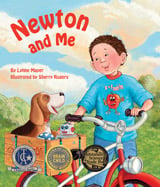
Picture Book (Science): Newton and Me

Newton.phpSummary of Newton and Me
It is Saturday morning.  A young boy is awakened by his playful dog, Newton.  They decide to spend their day playing and exploring outside.  Together, they demonstrate simple experiments in force and motion.  For instance, they roll a ball on different surfaces/areas and observe differences in speed and pathway.  Next, they throw the ball up in the air at different forces. The duo, also, try pushing and pulling experiments with toy and full-size trucks as well as a wagon, a bike, and a rope.  As the day comes to a close, the boy realizes:

Playing with Newton gave me the notion
that pushing and pulling are forces of motion.

Evaluation:
Newton and Me is the perfect combination of realistic fiction and scientific facts.  The young boy conducts experiments using everyday items in common activities.  Through his observations, he is able to draw scientific conclusions.  This book is ideal to induce experimentation and curiosity or to introduce a unit or lesson on force and motion.  The bright colorful pictures (by Sherry Rogers) with the smooth, rhyming text (by Lynne Mayer) will captivate young readers.    

Teaching Opportunities:
Sylvan Dell has developed a 25-page across the curriculum teaching guide.  The book page also includes various quizzes and other resources. 

Friday, April 1, 2011

Picture Book: Thumb Love by Elise Primavera

Thumb LoveSummary of Thumb Love
Lulu, a  recovering thumb sucker, begins by asking four key questions.  If you answer “yes” to any of these questions, you may have experienced the heartbreak of Thumb Love.  She offers to help you learn how to quit being a sucker!  First, she tells her story.  Lulu and her Thumb are happy.  They do everything together—go places, read, sleep, and watch TV.  At her fourth birthday party though, some family members encourage her to stop sucking her thumb since she is too old and because it will ruin her teeth.  Lulu sees people, both real and imagined, who are laughing and jeering at her.  Even her cousin Lili, also a former thumb lover, laughs at her!  After a frightening buck toothed nightmare, Lulu decides to develop a program for quitting.   Now, she is encouraging others to stop sucking their thumbs. 

Evaluation: 
Elise Primavera’s Thumb Love is an inspirational and humorous read.  Lulu’s struggle does not have an easy solution or resolution.  She really has to work at quitting.  Sometimes she fails.   It is through perseverance, encouragement, and problem solving that she is finally successful.   Lulu’s witty personality and creative ideas make the story entertaining.  I love the infomercial beginning and the 12 step program at the end.   The Thumb is personified to create a comical dialogue and to illustrate Lulu's internal struggle to let go.   While this story is about Thumb Love, it can be used as an example of overcoming obstacles/bad habits, perseverance, and other positive character qualities. 

A Better Way to Teach Theme: Why I Built the Jory John Now Prove It Series

If you’ve ever taught theme, you know the moment. Students finish a story, you ask “What’s the theme?” — and suddenly you’re flooded with a...