Saturday, March 19, 2011

Picture Book: How the Moon Regained Her Shape by Janet Ruth Heller

Inspired by Native American folktales, How the Moon Regained Her Shape personifies the moon as “round and full, proud of her gentle light.”  She is fearless and lively.  One day as she dances across the sky, the sun demeans her.  The moon stops dancing because she is tormented by the sun’s words.  Slowly, her body dwindles until she is just “a sliver of her former self.”  Comet notices the changes in his friend, so he visits her.  He urges her to visit a woman named Round Arms.  The moon is warmly welcomed and comforted in the Native American woman’s hut.  Round Arms leads the moon around to various places and people who value her light and force.  At the final stop, a hundred women are dancing and singing:

We sing to the moon, our sister,
Who pulls the seas to the sands,
Who changes her shape like a magician,
Who lights our paths at night. 
Return to the sky, our sister,
For we miss your gentle beams
And your loving smile.

Her eyes sparkling with joy, the moon returns to the sky.  Even though she still wanes when someone insults her, she always “regains her strength and fullness” because she remembers her crucial job and caring friends.   

Evaluation
How the Moon Regained Her Shape is a brilliant example of how ancient people created stories to help them understand the world around them.  The eye-catching illustrations in neutral and muted colors (by Ben Hodson) accompany the stellar storytelling (from Janet Ruth Heller).  The book is a creative way to introduce a lesson or discussion on the lunar phases.  

In addition, the power of words and the effects of bullying are depicted in a powerful but hopeful manner.  Though the moon feels hurt and discouraged, she learns to appreciate her unique value—something everyone needs to learn.  As a result, she is able to overcome adversity.  I highly recommend How the Moon Regained Her Shape for ages 6-11.   Publisher Sylvan Dell has compiled a 38-page Teacher's Guide and other web resources to help build your lesson plans and extension activities around.  

Teaching Oppoturnities:
Moon Phase Website


Oreo Cook Moon Phases (Pinterest and Science Bob's Blog)


Friday, March 18, 2011

Picture Books for Your Day at the Zoo

With spring emerging, many families and classes will be heading to the zoo.   It is a terrific place to visit.  Two of my favorite memories are zoo trips.  On one of them, I was with my boyfriend (now, husband).  I felt like I was walking on air as we held hands, gazed into each other’s eyes, and oh, yea, saw the amazing animals at the Philadelphia Zoo!  The second best one was a class field trip when my daughter was in fourth grade.  I drove three hours with my daughter, her friend, and her friend’s mom.   The trip there and back was as fun as the zoo!   I am always in awe at the diversity and creativity that is reflected in God’s creation.  Zoos are one of the best places to get a glimpse of His work.   

Before you head off for a memorable trip to the zoo, read What’s New at the Zoo?  and ‘Twas the Day Before Zoo Day from Sylvan Dell. 

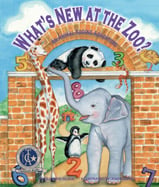
NewZoo.phpWhat’s New at the Zoo? (ages 2-6) by Suzanne Slade  
A mother and her son are going on an animal adventure at the zoo.  Together, they count the number of animals at each exhibit or habitat.  The two-page spreads depict groups of animals interacting both together and with their environments.  A short poetic riddle describes each location.  Here is a sample: 

Five fuzzy brown bears
Snuggle close and smile.
Two cubs wiggle in.
How many in the pile?

Then, at the bottom of each scene is an addition problem: 5 + 2 =.   There are so many excellent teaching opportunities just from sitting down and reading What’s New at the Zoo?  to your children, such as alliteration, rhyme, animal names (including male, female, and baby), counting, and adding.  Of course, your kids will be inspired to have their own animal adventure as they count animals on your zoo day trip.  Sylvan Dell provides a 50-page Teaching Guide and other resources at its website. 


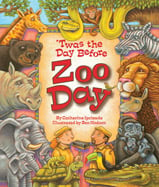
ZooDay.php'Twas the Day Before Zoo Day (ages 3-8) by Catherine Ipcizade  
This entertaining adaption of the famous ‘Twas the Night Before Christmas poem brings the animal preparations and habits to life.  There is excitement and anticipation in the air.  Meerkats are watching from their dens while nibbling on bugs.  The dirty, naughty elephants spray the zoo keepers with their trunks and frolic in the cool mud.  The llamas are instructed not to spit.  Other animals are more laid back like the lions slumbering with their heads on their paws and turtles hiding in their shells.  Some animals are discontented:  The Zebras feel their stripes have gotten too dull, so they wish to have polka dots.  Each page is written as an amusing, rhyming stanzas:

With big wooly paws and eyes like the night,
the black bears look scary and cause a fright.
But they really like frolicking out in the sun.
It's true they roar loudly, but mostly for fun. 

As the sun goes down, the zookeepers leave the animals to rest up for the big day.  The next morning, a flood of enthusiastic children enter the zoo for Zoo Day.  Read 'Twas the Day Before Zoo Day before you trip to the zoo.  Through the entertaining text and beautiful illustrations, children will learn about animal habits and temperaments, the zoo keeper's job, poetry, and rhyme.  Sylvan Dell provides a 33-page Teaching Guide and other resources at its website to use with your lesson plans or as fun activities. 

Check out SanDiegoZooKids for games, activities, and animal information (pictures, facts, and videos).   

Moon over Manifest by Clare Vanderpool

Summary of Moon over Manifest
From Barnes and Noble website
Abilene Tucker feels abandoned. Her father has put her on a train, sending her off to live with an old friend for the summer while he works a railroad job. Armed only with a few possessions and her list of universals, Abilene jumps off the train in Manifest, Kansas, aiming to learn about the boy her father once was. Having heard stories about Manifest, Abilene is disappointed to find that it’s just a dried-up, worn-out old town. But her disappointment quickly turns to excitement when she discovers a hidden cigar box full of mementos, including some old letters that mention a spy known as the Rattler. These mysterious letters send Abilene and her new friends, Lettie and Ruthanne, on an honest-to-goodness spy hunt, even though they are warned to “Leave Well Enough Alone.” Abilene throws all caution aside when she heads down the mysterious Path to Perdition to pay a debt to the reclusive Miss Sadie, a diviner who only tells stories from the past. It seems that Manifest’s history is full of colorful and shadowy characters—and long-held secrets. The more Abilene hears, the more determined she is to learn just what role her father played in that history. And as Manifest’s secrets are laid bare one by one, Abilene begins to weave her own story into the fabric of the town.  

Evaluation:
Moon over Manifest is the winner of the 2011 Newbery Medal.   I have read many Newbery winning novels.  Nearly all of them are outstanding.  This book is no exception.  Moon over Manifest is a fascinating blend of fact and fiction.   Many of story elements are based on newspaper articles, family anecdotes, and historical happenings.  The complex and well-written story is engaging.  The narrative moves fluidly between the present (1936) and the past (1917).  The story of the town in 1917 in many ways mirrors life in 1936 which creates an added intricacy.  Author Clare Vanderpool helps to connect the two time periods using a box of mementos, letters, newspaper clippings, and storytelling, all generating allure and mystery.  Vanderpool has created some remarkable, multi-dimensional characters.  They take on a deeper significance as they are seen through both the past and the present.   As the reader, I became invested in the lives of many of the characters, such as Abilene, Jinx, Ned, and Miss Sadie.  

The main protagonist is 12 years old, but the story is as much about the teens and adults in the town.   Based on the complex non-linear plot line and story content, I recommend this book for ages 12 and up. 

Teaching Opportunities:
·         Writing—Find an interesting newspaper article (past or present); write a short story using the details as a spring board—add your own details and dialogue
·         Plot—Define linear vs. non-linear; discuss how the author uses a non-linear plot to create mystery, depth, and complexity
·         Characterization—Compare Abilene to Jinx and Miss Sadie to Ned or Parallel Abilene’s search with Miss Sadie’s
·         History—Research events mentioned in the novel, such as Bone Dry Bill of 1917, orphan trains, Spanish influenza, World War I, the Depression, and immigrants
·         Geography—Examine the geographical features of Kansas
·         Literature—Read short stories or poems written/set during 1917 and/or 1936; look for connections to the events in the story
·         Social Studies—Research mining and mining conditions

Wednesday, March 16, 2011

Picture Book: Always and Forever by Alan Durant


Summary of Always and Forever:  
A group of animals—Fox, Otter, Mole, and Hare—live together in a house in the woods.  Each member has a special role to play in the family.  They dearly love one another.  During the autumn months, Fox falls ill.  He grows thin and pale.   One day, he goes out alone, but he does not come back.  His family finds him still and cold beneath a tree.   The trio bury him under his favorite willow tree.  A wintery sadness consumes their once happy home.   There is an emptiness where Fox once dwelled—physically and emotionally.  The little family is silent and heart-broken.  As spring begins to peak out, the trio gets a visit from Squirrel who reveals that their other friends miss them.  Mole tells him they have been too sad to go out.  Squirrel urges them that life has to go on.  Otter asks, “How can it, without Fox?”  Despite their sorrow, they ask Squirrel to stay for dinner.  Preparing a meal together, they fondly recall what a terrible cook Fox was.   While doing the dishes, they remember other comical stories about him.  Soon, the house is filled again with laughter.  The animals use their talents to build a special place under the willow tree where they remember their beloved friend and companion. 

Evaluation:
Always and Forever is a touching story.  Author Alan Durant depicts the stages of grief and a healthy recovery after a tragic loss.  The sweet pictures by Debi Gliori are a beautiful companion to the text.  This story could be therapeutic for young people who have lost a loved one because they often believe no one understands how they feel.  Always and Forever is an ideal narrative to begin talking about grief.  The animals start to heal when they remember amusing stories about their friend and when they create a special memorial for him.   Constructing a special place or memorial as well as talking about the lost loved one can help children to heal.  Even if a child is not dealing with a loss, reading and discussing different situations help to build empathy or tools for later life experiences. 

Though this story is not necessarily one for educational instruction, I want to include books like this for families or educators who need to help children through emotionally trying situations. 

Picture Book: Mean Soup by Betsey Everitt


Summary of Mean Soup
Horace has had a bad day at school.  He is so frustrated when he arrives home that he stomps on a flower.  When his mother greets him, he hisses and growls.   His mother acts silly to cheer him up, and she suggests they make some soup together.   After filling a pot with water, she fancifully throws some salt in.   Then, she adds the ingredients!  Taking a deep breath, she screams into the pot.  She tells Horace, “Your turn.”  He stands on a stool and screams too.  His mother screams louder, and Horace growls and bares his teeth.  As the water starts to boil, they repeatedly stick out their tongues.  Horace bangs on the pot with a spoon and breaths his best dragon breath.  Finally, they both smile.   Horace wants to know the name of the recipe.  His mother reveals it is called, “Mean Soup.”  Side by side, they stir the bad day away.   

Evaluation:
The whimsical illustrations add to the tone and the characterization in Mean Soup (by Betsy Everitt). Horace’s feelings of embarrassment and anxiety are depicted as well as the mother’s free-spirited and quirky response.  For instance, she puts spoons up by her ears and dances around as Horace angrily lies on the ground. The simple text portrays a common childhood struggle of dealing with emotions. I have a child who sometimes gets emotionally worked up like Horace.  I appreciate how the mother finds a creative and positive way to deal with her son’s emotions.  Sometimes children are too worked up to talk about their feelings or to reason with.  I was inspired by Mean Soup to come up with imaginative ways to help my children when they are feeling frustrated or angry.  Use this book as a springboard to talk to your children (or students) about ways to deal with intense emotions or to brainstorm ways you can help your children when they are having a rough day.  Chances are, they can help you come up with a recipe for your own "Mean Soup."

Tuesday, March 15, 2011

Picture Book: Sneaky Sheep by Chris Monroe


Summary of Sneaky Sheep
Rocky and Blossom live in a picturesque meadow on a mountain with 147 other sheep and Murphy, the sheep dog. High above them, there is another meadow that looks plush and green.  Rocky and Blossom incessantly ask Murphy if they can go there. The wise sheep dog is well aware of the twosome’s past poor choices (illustrated in the book).  He also knows about the dangers on the mountain.  As a result, they are prohibited from going to the other meadow.   Unfortunately, Rocky and Blossom cannot stop thinking about that meadow!  Each time they attempt to sneak off, watchful Murphy catches them and brings them back to the fold.  One day while Murphy is busy assisting an injured sheep, the determined duo escapes into the forest.  Much pleased with themselves for their independence and stealth, they rest a while.  They are startled when a wolf appears. The situation looks bleak, but Murphy tracks them down before any real harm is done.  Blossom and Rocky are relieved and thankful.  They obediently stay with the other sheep…at least for a while.

Evaluation:
My ten year old picked out another good one!  Sneaky Sheep illustrates some core human conflicts and struggles in a natural and entertaining manner.  Blossom and Rocky represent children (and adults) who think the grass is greener on the other side.  They allow temptation to lure them away from safety and sense.  I love how wise and protective the sheep dog is, much like parents and teachers.  He tries to keep them on the path and away from hazards, but they are determined to do things their own way, resulting in a brush with serious danger.  It is much like children who ignore caution and instruction. The story is a great object lesson in the importance of obedience.  On a higher level, the sheep dog parallels how God tries to keep his people out of harm’s way.  In the Bible, the Lord is often depicted as a shepherd.  Unfortunately, after a while the sheep forget about their near death experience.  They begin to long for the meadow again.  Similarly, some people keep repeating their mistakes.   I love when a picture book speaks on many levels.  People of all ages can learn from some of the best of them.   Sneaky Sheep has a fantastic story, entertaining pictures, and a meaningful theme. 

Teaching Opportunities:

  • Journaling/Writing—If I were Murphy, I would…
  • Social Studies—Learn about sheep, shepherding, and sheep dogs as well as cultures that this profession is still pivotal
  • Bible—Read Psalm 23 and other passages that depict the Lord as a shepherd; connect it to Murphy as a shepherd
  • Math—Brainstorm all the way you can group items to make 147 or the number of ways to make $1.47 with coins
  • Art—Create sheep using pillow stuffing, tissue paper, or other supplies
  • Pretend Play---Using costumes, puppets, or action figures, students can act out the adventures of Blossom and Rocky or create new ones
  • Character Education—Discuss good choices vs. poor choices; give age appropriate scenarios and devise way to deal with them wisely

Sunday, March 13, 2011

Ancient World History (Greece): The Myth of King Midas and the Golden Touch

There are many versions of the myth of King Midas and his golden touch.  Here are some of the best picture book retellings. 

King Midas and the Golden Touch (ages 5 and up) by Kathryn Hewitt 
In this version of the Midas story, the king has only one love other than his gold—his daughter.  While he sets time aside for her each day, he spends most of his time locked in his treasure chamber polishing and admiring his gold.  When a stranger visits him and offers one wish, Midas is determined not to make a foolish one.  Ironically, it is just what happens.  Like the other retellings, he jovially turns everything to gold.  When his daughter becomes a golden statue, Midas begs to lose his magical touch which is granted.   The ending depicts Midas with his, now, grown daughter and her many children as he tells them the story of a man with a golden touch.  The children laugh in disbelief that anyone could be so foolish.   Midas now hates “the sight of all gold except their [his grandchildren’s] golden curls.”  I chose King Midas and the Golden Touch because it has beautiful illustrations, a strong narrative text, and clear moral lesson.  Unfortunately, it can only be found in a library or at sites like half.com.  Charlotte Craft and K.Y. Craft have written and illustrated a similar version with stunning pictures also called King Midas and the Golden Touch which is available for purchase.   

King Midas (ages 5 and up) by Demi 
Long ago, the ancient Greeks worshiped and respected their gods.  They looked to them for wisdom, power, and knowledge.  Unfortunately, King Midas of Phrygia was foolish, weak, and ignorant.  He did not respect or seek the gods.  Demi illustrates through rich pictures and text this more inclusive tale of the mythical man. 

There is a musical contest between the shining god Apollo and the little snub-noised god Pan.  King Midas is chosen to be the judge.  Apollo is clearly far superior in talent, yet Midas foolishly awards the winning title to Pan.  To punish him for his folly, Apollo curses Midas with donkey ears.  The king is so embarrassed that he grows his hair out to cover them.  One summer evening the god Dionysus is having a party nearby.   King Midas finds that the satyr Silenus, one of the god’s guests and companions, had wondered into his field.   The two are fast friends, playing together like children.   As a reward for returning Silenus to Apollo, King Midas is granted one wish.  Demonstrating his foolishness once more, he chooses to have the golden touch.  He quickly realizes the folly of his decision.   Midas seeks out an oracle to be released from this cursed gift.  He obeys the instructions of the gods which induces his healing.  After, the king reverently seeks wisdom, power, and knowledge from the gods 

Variations on the Midas Myth
Max and Ruby’s Midas (ages 3 and up) by Rosemary Wells 
When Ruby catches Max trying to sneak some cupcakes under his pajamas, she informs him that he may become a cupcake himself! At bedtime, she reads to him about Midas, a rabbit who hates fruits and vegetables. One day, Midas decides to try something different.  He looks at his healthy breakfast with his imagined laser-beamed eyes and wishes for a hot fudge sundae.  It works beyond his wildest dreams!  He changes everything into his favorite sweet treats.  Unfortunately, his family accidently gets in the way of his laser-beamed transformations.   There is a satisfying and entertaining conclusion to Midas’ sweet mess, but it does not appear that Max has learned the lesson of the tale. 

Midas Mouse (ages 4 and up) by David and Ruth Ellwand 
Midas Mouse is a creative retelling of the famous myth.  In it, a mouse is the protagonist.  Despite warnings from his mother, Midas ventures out into the bright light of the sun.  He is so enamored by the golden beauty of it that he wishes everything he touched turned to gold.  His wish is magically granted.  At first, he enjoys his new “gift,” especially when a cat sneaks up on him.   He soon learns his golden touch prevents him from enjoying some of the finer things in life---like cheese!   Then, by the light of the moon, Midas wishes to be a normal mouse once more.  His wish is granted.   He misses out on the night feasting with his family because he is so exhausted from his golden adventure.    

Extension Ideas for Teachers and Parents

A Better Way to Teach Theme: Why I Built the Jory John Now Prove It Series

If you’ve ever taught theme, you know the moment. Students finish a story, you ask “What’s the theme?” — and suddenly you’re flooded with a...